
Luke places this passage after the conflict with the religious authorities who disagreed with the Messiah Jesus. Furthermore, he was frequently watched by informers, while these religious authorities regularly plotted, seeking to trap him in order to discredit him in the eyes of the public (PER216: The judgment of the religious leaders and the rebukes of the Messiah Jesus). Luke describes a tense atmosphere, characterized by the constant opposition of the to Jesus' actions.
It is observed that the opposition of the increased in proportion to the success the Messiah Jesus enjoyed among the public. It was clear that they found it difficult to accept that crowds gathered to listen to him.
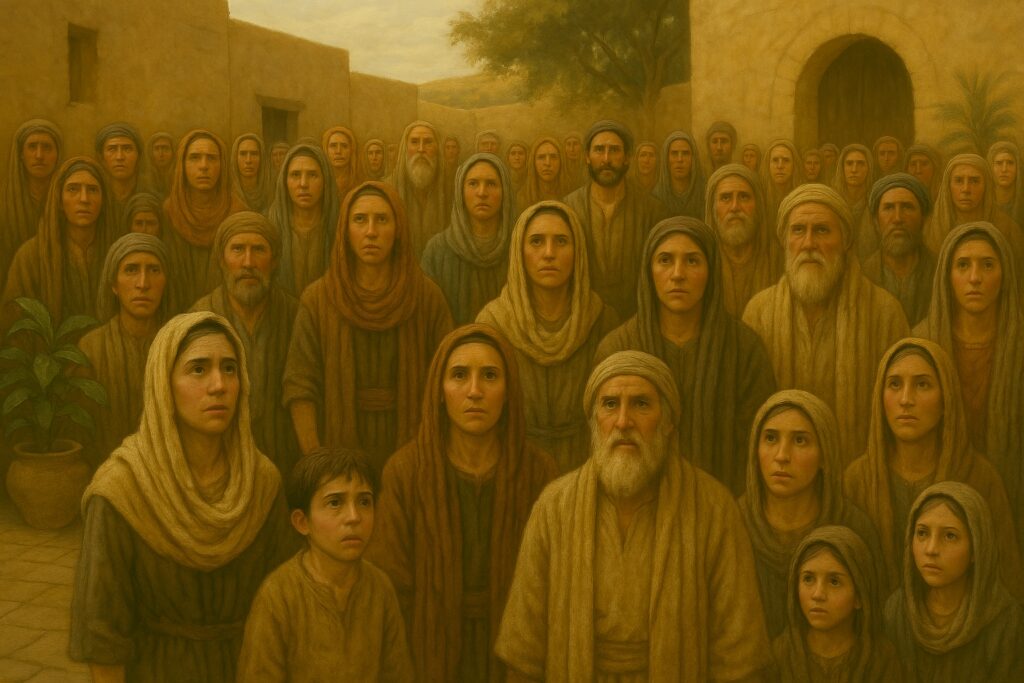
Luke 12.1 indicates that the crowd, evidently very large, was gathering, which might suggest another gathering distinct from the one associated with the discourse with the , possibly even on a different date. Nevertheless, the theme seems similar, since it addresses the behavior of the and their influence on the minds of the public.
Luke 12.1-12 contains teachings of the Messiah Jesus on several important themes, including hypocrisy, the fear of God, the value of the disciples in God's eyes, and blasphemy against the Holy Spirit. Here is a detailed explanation of this passage:
Hypocrisy (Luke 12.1-3) The Messiah Jesus begins by warning his disciples against the "leaven of the ," which is hypocrisy. He uses the image of leaven to show how hypocrisy can spread insidiously. He warns that everything hidden will be revealed, and that secret actions will be brought to light. This emphasizes the importance of integrity and transparency in spiritual life.
Fear of God (Luke 12.4-7) The Messiah Jesus urges his disciples not to fear those who can kill the body, but to fear God, who has the power to cast into hell. He also recalls the infinite value of every individual in God's eyes, emphasizing that even sparrows, which are sold for very little, are not forgotten by God. The hairs on our heads are all counted, which shows how deeply God cares for us.
Confession and denial (Luke 12.8-9) The Messiah Jesus speaks of the importance of publicly confessing his name. He promises that those who acknowledge him before others will be acknowledged before the angels of God, while those who deny him will be denied before the angels of God. This passage emphasizes the importance of faithfulness and public testimony to faith.
Blasphemy against the Holy Spirit (Luke 12.10) The Messiah Jesus warns that every sin and blasphemy will be forgiven, except blasphemy against the Holy Spirit (PER123). This passage has prompted much theological debate, but it is generally understood as a deliberate and persistent rejection of the work of the Holy Spirit, which makes repentance and forgiveness impossible.
Help from the Holy Spirit (Luke 12.11-12) The Messiah Jesus encourages his disciples not to worry when they are brought before the , the authorities, and the magistrates. He promises that the Holy Spirit will teach them what they should say at those times. This reminds the disciples that they are not alone and can rely on divine guidance in times of persecution and testimony.
This passage highlights essential themes of Christian life: integrity, reverent fear of God, faithfulness to Jesus, the seriousness of blasphemy against the Holy Spirit, and dependence on the Holy Spirit for guidance. Jesus teaches his disciples to live with complete trust in God, to be courageous in their testimony, and to remain faithful even in the face of persecution.
We find the various themes already mentioned during the Sermon on the Mount (Matthew 5.1 to Matthew 7.29, PER084 to PER108).
It is clear that Jesus often taught the same themes to what were probably different crowds. The disciples were thus able to hear these teachings several times, which helped them memorize them.