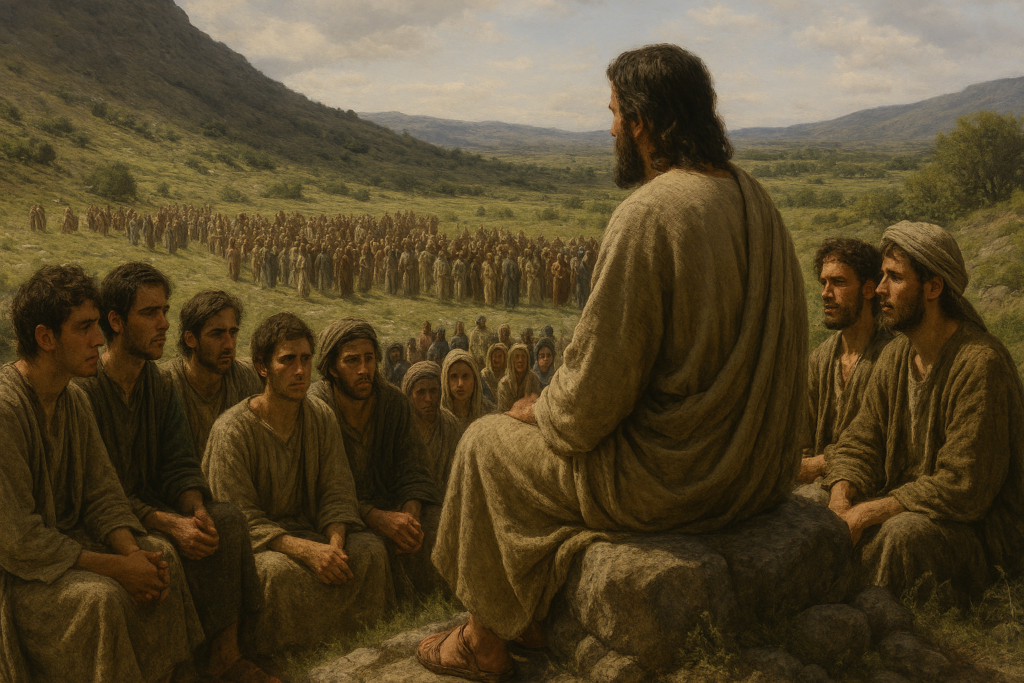


Jesus the Messiah, having withdrawn to a mountain near Capernaum in Galilee, spent the whole night in prayer, according to Luke (6:12). Early in the morning, the disciples, surprised not to find him in the house, went to look for him.
They found him on a mountain not far from Capernaum, probably a customary meeting place. After he appointed the twelve Apostles (ANN079) and gave his teaching on their future mission (ANN080 and ANN081), the crowd began to gather.
The crowd stopped on a broad plateau below. Jesus the Messiah and his Apostles therefore descended from the mountain to this open space. He healed many sick people and gave teaching in the form of .
Luke, the physician, gives us a surprising detail: sick people sought to touch Jesus the Messiah, because this act brought them healing. It is easy to imagine the crowd's enthusiasm and the healed people's reactions. Under these circumstances, delivering a discourse is difficult, leading us to think that some time passed before Jesus the Messiah could make himself heard.
The location seemed favourable for a long discourse, with the mountain helping his voice carry. Once calm returned, the Teacher began the long discourse we know as the Sermon on the Mount.
Several questions then arise: Did everyone hear? Had they not come mainly for healing? It is reasonable to think that the crowd primarily expected miracles. Confronted with so many wonders, the crowd must also have wanted to know more about the man claiming to be the Messiah. In any case, the apostles listened and, through Matthew's pen, summarise this very distinctive teaching for us. Luke also recounts this discourse.
Were all 19 points covered in this sermon mentioned on that particular day, or did Matthew use this passage to bring several discourses together? The Sermon on the Mount does seem long for a single discourse, but it remains possible. The disciples clearly have excellent memories.
Our conclusions lead us to consider that Matthew, as he regularly does, used this moment to bring together several statements on the same subjects spoken by the Teacher.