
We are examining the Sermon on the Mount, divided into 23 sections. It is easy to notice that Luke omits all subjects directly related to Mosaic law. His audience consists mainly of Gentiles unfamiliar with the rules governing Jewish life.
The second point illustrates the previous allegory's theme even more strongly. The disciple must be the light of the world, thus reflecting God's light in the world. Three different aspects are addressed, but all lead to the same conclusion.
1. ‘You are the light of the world; a city on a mountain cannot be hidden’: Jesus the Messiah compares his disciples to a city on a mountain that cannot be hidden. This means that, through their way of life, the disciples must be a visible example to the world, just as a city on a mountain is visible from afar.
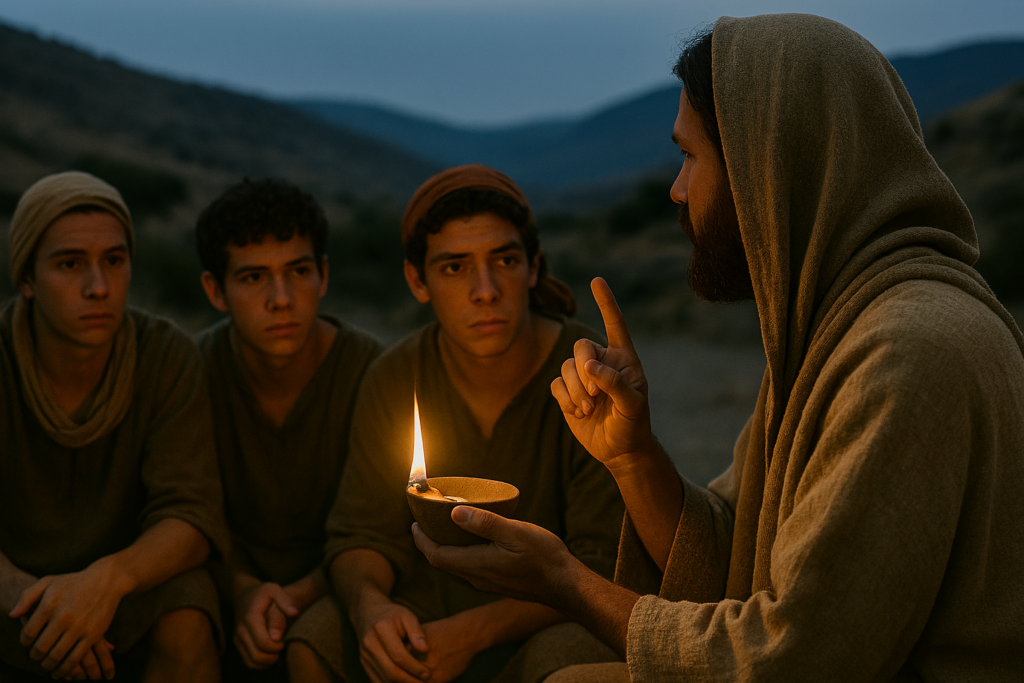
2. ‘No one lights a lamp to put it under a bucket; instead, it is placed on its stand and gives light to everyone in the house’: Similarly, a lamp is lit to illuminate a room, not to be hidden. Disciples are therefore called to let their ‘light’, that is, God's love and truth, shine for everyone.
3. ‘Let your light shine before people so that they see your good deeds and thus celebrate your heavenly Father's glory’: Jesus the Messiah explains that the purpose of letting their light shine is to lead others to celebrate God's glory rather than to receive praise. By living according to Jesus' teachings, disciples can help others recognise and praise God.
These verses from Matthew's Gospel are Jesus the Messiah's exhortation to his disciples to live so as to reflect God's light in the world. Although Luke does not take up this theme here, he cites two passages evoking light in connection with the disciple's witness (Luke 8.16 and Luke 11.33-35). These quotations come from other conversations. Mark 4.21 and John 8.12 also take up the theme of light, a concept developed at different times and places. These repetitions helped people memorise the many points raised by Jesus the Messiah.