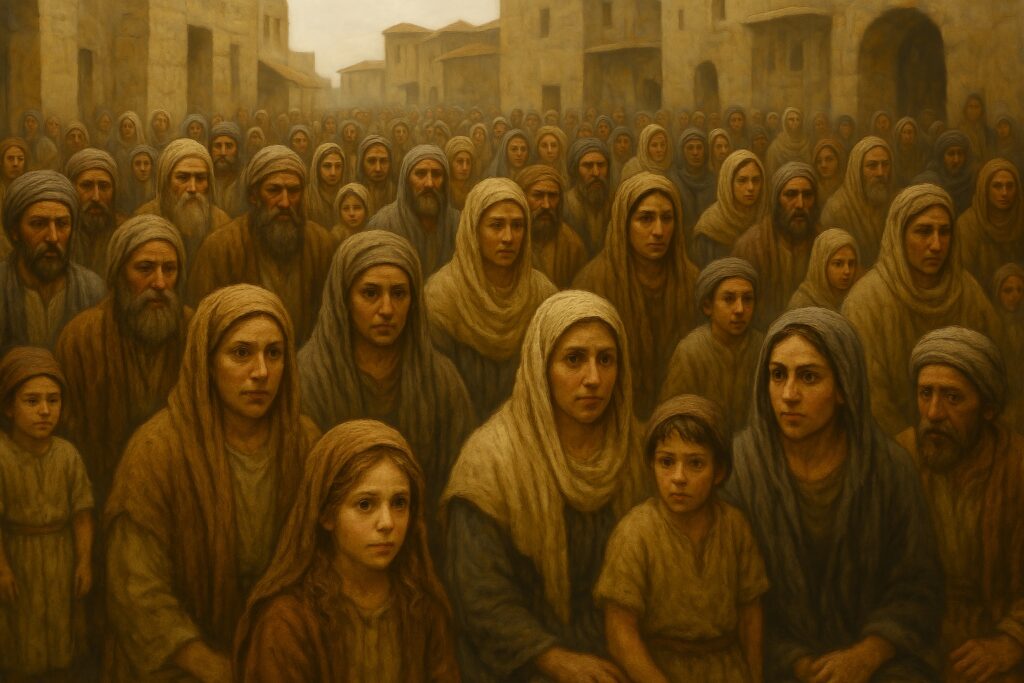

We might be surprised to see how large the crowds were that gathered to listen to the Messiah Jesus. An immense crowd presses around the Messiah Jesus, to the point of causing an almost dangerous mass movement. This context underlines how great his popularity is at this time: people are literally ready to jostle one another in order to hear him. It seems clear that many of them were expecting deliverance more than a message about the kingdom of God.
It is important to place these gatherings in their social context: they brought together parents and children, and were watched by spies in the service of the Roman and religious authorities. The government feared any sedition and paid close attention to these gatherings.
For these authorities, the movement of crowds was regarded as a political act.
These large gatherings did not always make it easy to speak, as it became difficult to be heard. Jesus therefore moved about among the crowd, spoke certain sentences and also healed a few sick people. Some people addressed him and asked questions (Luke 12.13) which Jesus endeavored to answer. The apostles accompanied their master and seem to have been charged with managing the crowd to ensure his safety.
This success draws the attention of the authorities, of the and of the authorities to the Messiah Jesus. The authorities, initially worried about possible sedition, are quickly reassured because Jesus' message contains no political demands. For their part, the perceive a challenge to their authority in the preaching and actions of Jesus, which some interpret as signs of his divinity.
John's account highlights a gradual intensification of the opposition expressed by the , correlated with the growing influence of the Messiah Jesus among the crowd.
The Master addresses his disciples, not to draw their attention to the size of the crowd, but in order to broach the subject of hypocrisy. The Messiah, Jesus, possessed a thorough knowledge of people's thoughts, as Luke 5.22, Matthew 9.4, Mark 2.8, Luke 6.8 and John 2.25 attest.