
John briefly reports the discourse delivered by Jesus on Wednesday, October 13, AD 32, during Hoshana Rabbah, the last day of the Feast of (the Feast of Booths or Tabernacles). On that occasion, the Messiah Jesus declared that he was a of living water. It appears that the closer we come to the end of his ministry, the more direct and precise his words become, even though not all the historical events had yet taken place to allow a complete understanding at that time.
Despite this extraordinary proclamation, the crowd remains divided: some believe and realize that Jesus is indeed the Messiah, while others still have questions and look for excuses to refuse what is plain.
Even the guards who came to arrest him disobeyed, because they realized they were living through extraordinary times.
That is the excuse they will offer.
The camp of the seems to be in a difficult situation in the face of the evidence they must consider.
Nicodemus takes the risk of intervening:
The only explanation put forward by the was the following:
The argument appears quite naive and weak, especially since the prophet Nahum came from Elkosh in Galilee, and Jonah from Gath-hepher, also in Galilee, according to some sources. Moreover, although the Messiah Jesus lived in Galilee, he was born in Judea, in Bethlehem.
The situation completely escapes the control of the religious authorities, who are about to slide into a fanatical opposition that will lead to the death of the Messiah Jesus.
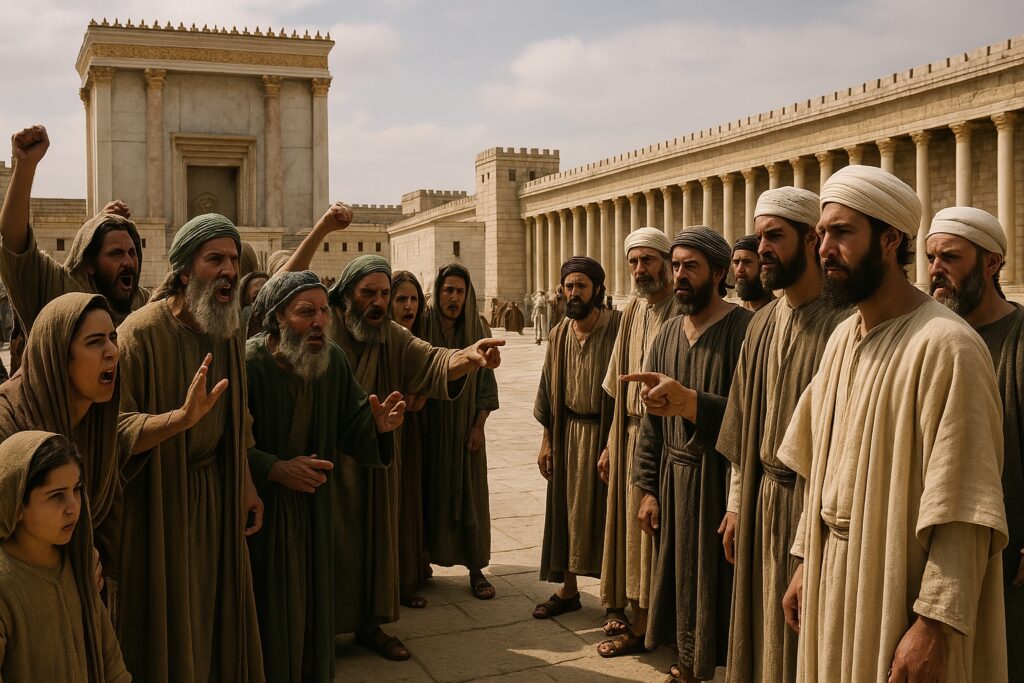
We note that among the crowd of listeners, many recognized in Jesus the Nazarene the Messiah announced by the prophets.
John clearly shows in his accounts the ever-growing opposition of the ; he depicts well the toxic climate that is taking hold and the hatred that only increases the religious authorities. The death of the Messiah Jesus now becomes the only conceivable option for these men.
The Messiah Jesus must show great caution to prevent his supporters from provoking a sedition, which could lead to serious consequences given the potentially violent reaction of the soldiers. Likewise, the religious authorities must act carefully to avoid any unrest during a possible public arrest of the Messiah Jesus. Thus, none of the parties involved has an interest in an uprising occurring in this context.
This situation helps us understand why the Messiah Jesus enjoyed freedom of action and speech at that time.