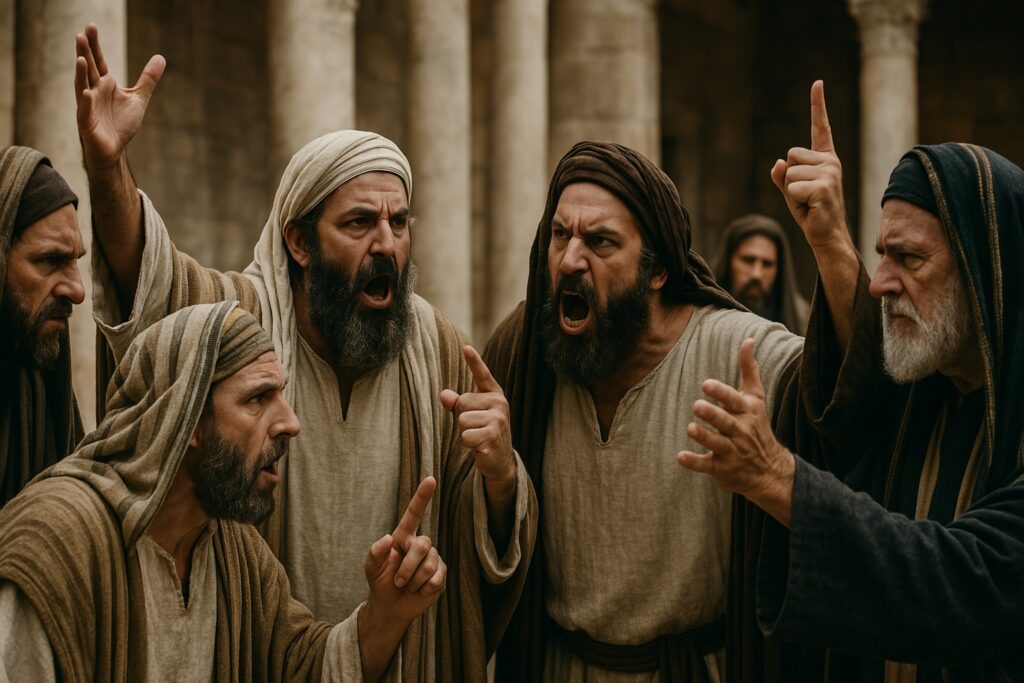

John 7.25-27 illustrates the questions of part of the crowd about the identity of Jesus. People wonder whether Jesus is truly the Messiah. One point of confusion is that the crowd knew Jesus came from Nazareth, whereas they thought the Messiah would appear suddenly with no known origin.
However, the prophet Micah 5.1 announces a birth in Bethlehem, while the prophet Isaiah 9.1 refers to the region of Zebulun and Naphtali, that is, Galilee. These people do not know this information precisely and rely solely on the ideas passed on by their religious leaders, who are in error. They see in Jesus only a carpenter from Nazareth. Yet the miracles and wonders he performs can come only from God, which should have alerted them.
Many people in the crowd were astonished to see that the Messiah Jesus was moving about freely and teaching the crowd. The passivity of the religious bodies was becoming suspicious. They themselves were uncertain, for they feared the reaction of the religious leaders. They imagined that the had finally recognized Jesus as the Messiah.
The Messiah Jesus is about to deliver a discourse of which John reports some details. He takes up the theme addressed in John 7.27, where the Master reaffirms his divinity and consequently his messiahship (John 7.28-29). John then specifies that the authorities sought to arrest him, but that this was not possible because the hour had not yet come (John 7.30).
A large part of the population adopted the principles advocated by Jesus, the Messiah, thus converting to his teachings (John 7.31). This success provoked the indignation and anger of the , who decided to send guards to seize him. Nevertheless, the Master continued his teaching among the crowd.
The words of the Messiah Jesus, quoted in John 7.33-34, underline the urgency for these people to make a decision, for after his death they will no longer see him. The privilege they enjoy at present will not occur again in the future. These statements may seem hard for the listeners to understand, but for Jesus, who is aware of the gravity of these moments, it is a trial, given the persistent reluctance of these people despite the evidence before their eyes.