
John does not use the term Passover, referring simply to ‘the festival of the Jews’. We interpret this as Pesach on Monday, Nisan 14, 3791, corresponding to March 24, AD 31.
Our main reason for interpreting this Jewish celebration as Passover is that John places it in his text between two other similar events, in John 2.23 and John 6.4. Chronologically, therefore, this deduction seems consistent. The pilgrimage underlines the importance of the celebration. The literary form seems to suggest a custom, something normal with regard to the journey. We could certainly consider another festival, but that hypothesis seems less plausible to us.
Furthermore, Luke 6.1 (PER076: Jesus is Lord of the Sabbath) recounts an event that took place on the second after Passover, during the return from Jerusalem, and we indeed observe that the wheat in Galilee is ready for harvest. We are therefore clearly in spring. As we shall see, the connection is made through the chronology of Mark's text.
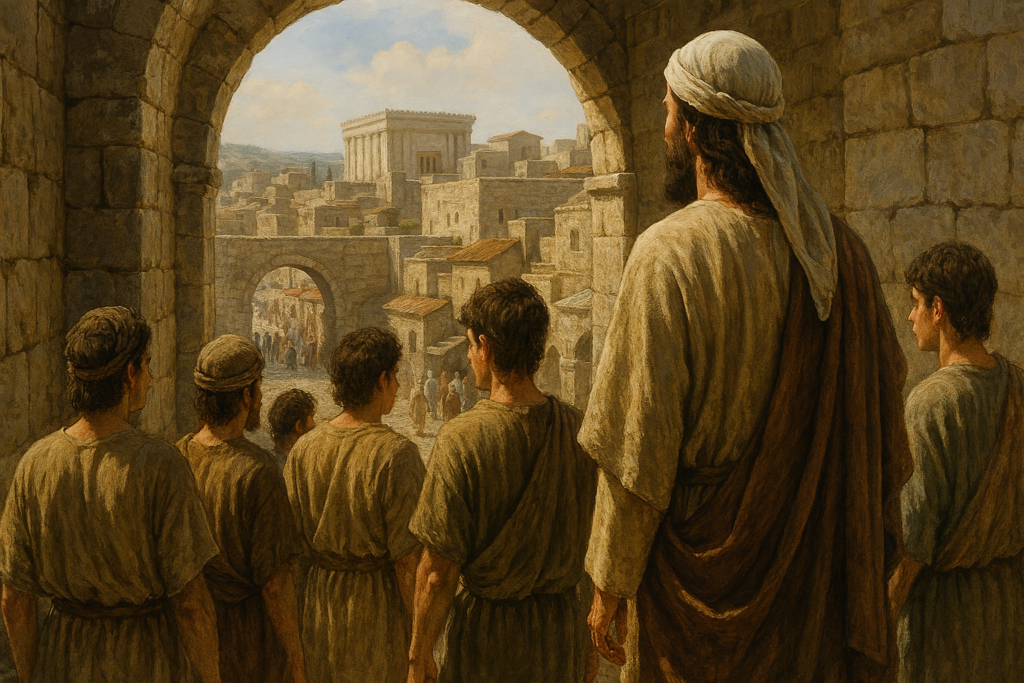
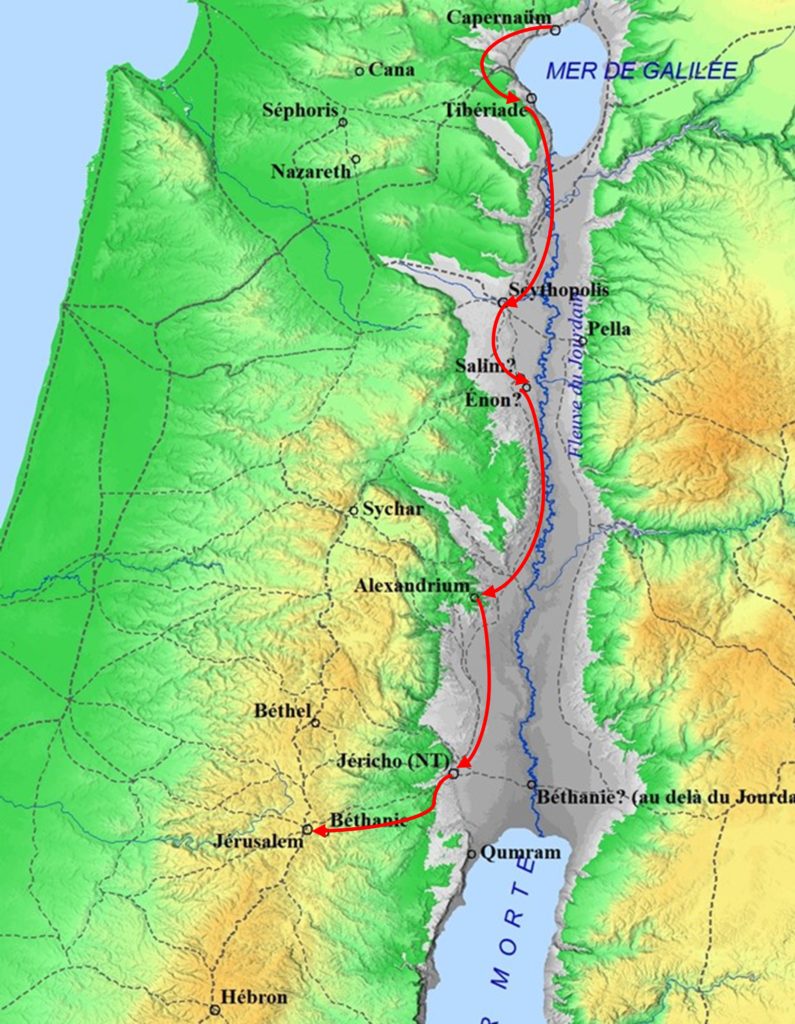
Here John mentions a second pilgrimage, therefore the Passover pilgrimage in our view, which Jesus the Messiah and his disciples will undertake. They will remain in Jerusalem at least until the , the day of the disabled man's healing at the .
Eighteen months have passed since the baptism of Jesus the Messiah. He and his disciples strictly observe the Jewish celebrations and pilgrimages prescribed by Judaism. These events also give Jesus the Messiah an opportunity to meet many people, some from the diaspora who have travelled to Jerusalem for the pilgrimage.
The very mild early spring weather in Israel makes it easy to sleep in tents, as most poor pilgrims did.
We observe that, by coming to Jerusalem, Jesus the Messiah automatically confronts the Jewish religious authorities, who never fail to question him. The people enjoy seeing him rebuke these proud . Like the Areopagus in Athens, the Temple court becomes a place of heated debate.
Jesus the Messiah takes advantage of these gatherings to proclaim his message, often in the form of .