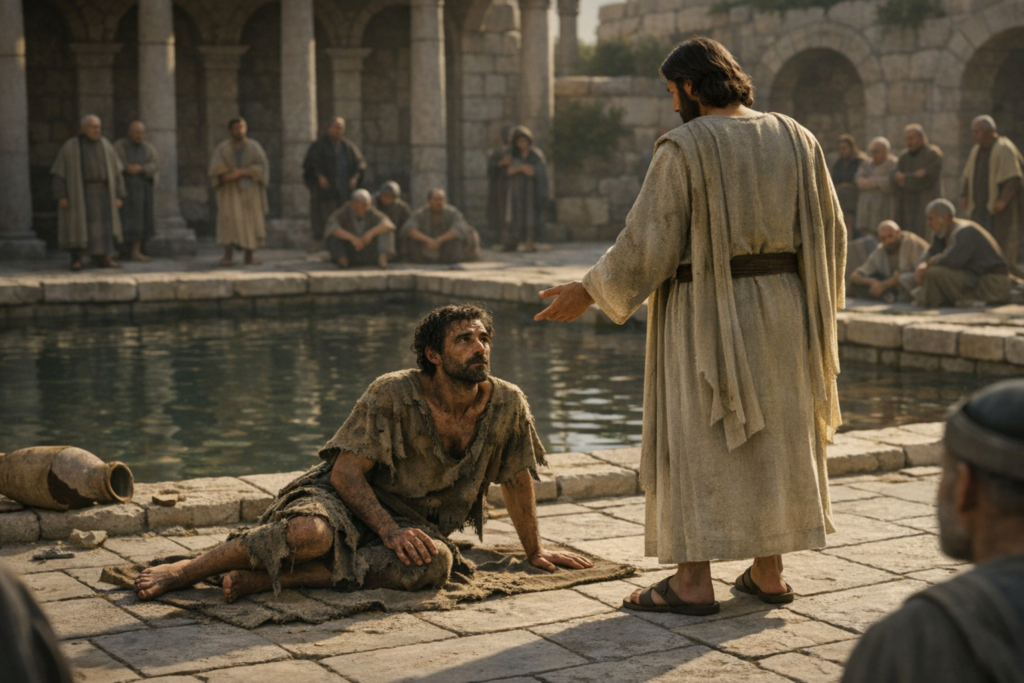
This question from Jesus to a man who had been ill for 38 years might seem hard for us to understand, since the answer appears so obvious. “Ask a blind man if he wants to see,” says the saying. It amounts to saying that some questions need not be asked, because the answer is obvious. It is a bit like saying: “Is water wet?” or “Does the sun shine?”.
In reality, Jesus asks the man this question because he has an answer to bring him. At that time there was a local superstition claiming that when the water of the pool of Bethesda was stirred, it was an angel stirring it, and the first to plunge into the water was apparently healed. What a cruel situation for the many sick people who were all seeking deliverance. They were waiting for a hypothetical healing, and all their hope rested on this tradition.
The Bible never teaches this kind of superstition, but these people had only this hope.
Jesus’ desire is to encourage this man to place his faith not in a local superstition, but in God. Yet the man’s answer centers on his inability to plunge into the water before the others.
“Rise,” Jesus said to him, “take up your mat and walk.” The invalid did not expect such a word, and instead of answering, “It is impossible,” he strives to obey, and it is at that moment that strength returns to him. He manages to stand up and even to carry his mat.
This event is wonderful, and that word is too weak, for this man who lived 38 years as an invalid and who is now healed.
However, the story does not end there. A little later, John relates that this healed man meets Jesus in the temple. They engage in a conversation, and John reports only this word of Jesus: “See, you are well again. Stop sinning, or something worse may happen to you.” (John 5.14).
After his healing, this man followed the instruction of Jesus the Messiah by carrying his mat. Afterwards, he went looking for Jesus the Messiah, who had melted into the crowd.
However, how can one stop sinning? It seems unachievable without outside intervention, especially that of God. Although we do not know all the details of this individual’s conversion, it is clear that his former sins were forgiven and that his healing represents only a tiny part of the vast blessing he received.
In this event, attention is often drawn to the exceptional nature of a physical healing. However, what is essential truly lies in the forgiveness of sins, which opens to the person concerned access to the kingdom of God.
It is obvious that a physical healing, however beneficial, cannot suffice if this person is to die a few years later. Although his situation is clearly much improved, Jesus the Messiah offers this man an infinitely more precious treasure. Through the forgiveness of his sins, he opens to him access to the kingdom of God and to eternal life, a benefit invisible to human eyes but of inestimable value.
Here we come to the difficulty faced by Jesus the Messiah, who healed many people during his ministry. This difficulty was that these healings were not to divert attention from the salvation of the soul.
Seeking temporary help from Jesus the Messiah would be a significant mistake. It implies that if this help is not obtained, one goes away without having considered what is essential: the salvation of our souls, which remains far more important.
The healing of our souls is by far more important than that of our bodies.
Dominique Lormier