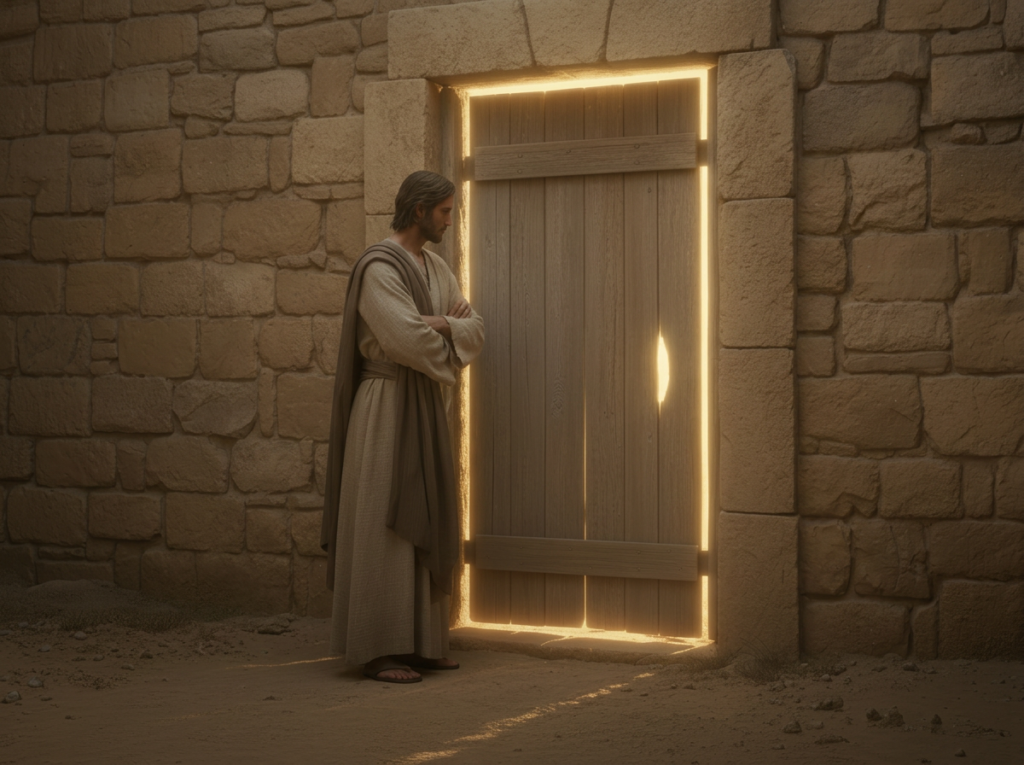
This verse must be understood in its context in order to grasp its full meaning. Many people may seek things such as wealth, success, recognition, peace or health without finding them. Some may ask without receiving, or knock at doors that remain closed.
Jesus the Messiah, in his discourse on a hill in the region of Capernaum in Galilee, addressed various themes. Our analyses have identified 23 distinct topics treated in this discourse, whose aim was to set forth the law of God. In it he laid down various rules reflecting the divine will.
In this particular case, (PER102), the Master speaks of prayer to God and therefore of faith.
So is he speaking only to disciples?
Every person hears a small voice that urges him toward God. Thus many sometimes feel the need to seek comfort in a church, and some have found improvements or healings there.
King Solomon said in his day:
Ecclesiastes 3.11 : "He has made everything beautiful in its time; also he has put eternity in their hearts, yet so that man cannot find out the work that God has done from the beginning to the end." This speaks of the work of God and of that small voice within us that evokes eternity.
It is because of this voice that Jesus the Messiah says: Matthew 7.8 : "For everyone who asks receives, and he who seeks finds, and to him who knocks it will be opened."
Please note that the verbs used: ask, seek and knock, indicate a certain insistence as well as effort. However, what matters to us here is the result obtained: receiving, finding and having the door opened.
The basic principle therefore remains simple. In creating man, God placed in his genes something like a signature which, at different moments of his life, leads him to seek the absolute, the divine, the purity of peace.
Building on this principle, Jesus the Messiah can affirm that whoever asks, receives. But what kind of asking is it exactly? It concerns existential questions such as the meaning of life, the reason for our presence here below, our ultimate destination and what awaits us after death. God would thus have an answer to these questions, since the Master declares that whoever asks, receives.
He also says whoever seeks, but here too, what kind of seeking is it? Giving meaning to one's life, living a life worth living, having an objective, a goal, and here too the answer is unequivocal: he finds.
And then there is this door at which one knocks, and behold, it opens. But which door is in question here?
John 10.9 : "I am the door. If anyone enters through me, he will be saved; he will go in and out and find pasture."
It is Jesus the Messiah who speaks. He is the door, which opens when someone knocks, and what follows is extraordinary: he will be saved.
Man's malaise comes from his being far from God, but regaining this communion restores the balance originally intended by God and broken by sin.
Everyone who believes in and accepts Jesus Christ as his Savior obtains forgiveness of his sins (Luke 7.48 and Mark 2.10) and gains access to eternal life. This experience deeply transforms the individual's outlook, enabling him to regain his intrinsic original state, altered by sin. He thus restores his communion with the Creator.
Dominique Lormier