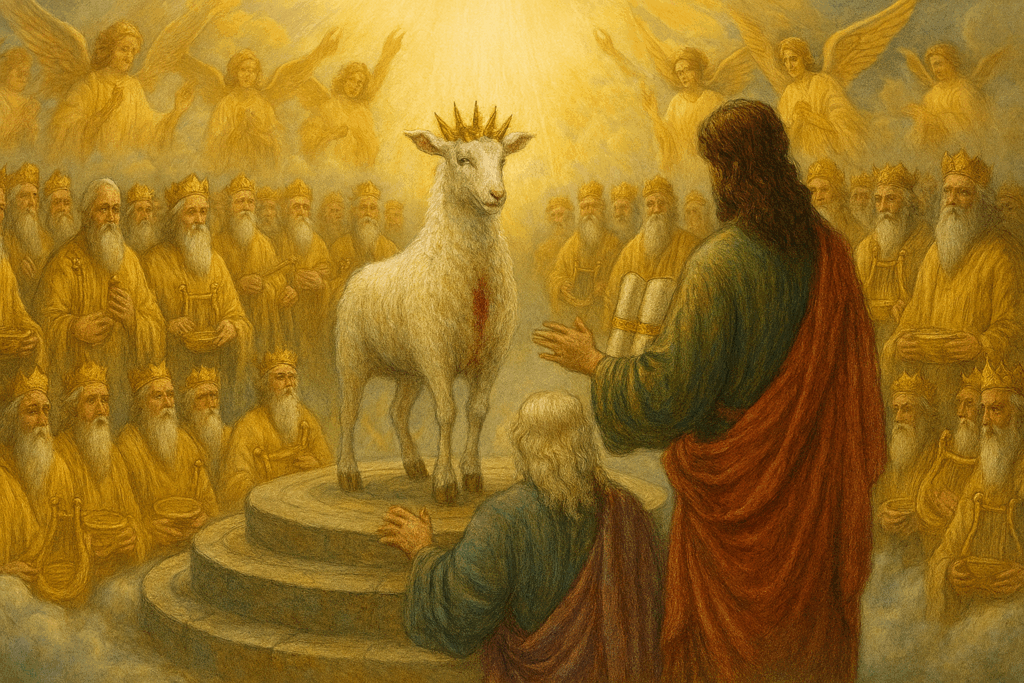
An exegetical study of Revelation 5, centered on the book sealed with seven seals that God holds in his hand and that only the Lamb — a figure of Christ — is worthy to open. The verse-by-verse analysis reveals a dramatic progression: from universal impossibility to the victory of the Lamb, inaugurating a mission of universal redemption and cosmic praise. The article continues from chapter 4 on the heavenly throne.
54 min
Revelation 5sealed bookLamb of Godseven sealsbiblical exegesis
42 verses
9 books
After the vision of the heavenly throne in chapter 4, John now turns his gaze to one specific element: a book that God holds in his right hand. John does not see God directly, but a luminous representation of his presence, in keeping with the idea that no human being can see God and live.
This book, sealed with seven seals, appears as a unique and decisive object. It becomes the center of attention and opens the rest of the account: understanding what it contains and why it is closed.
Chapter 5 does not introduce a new vision, but extends and deepens that of the previous chapter, unveiling the major stake of the divine plan.
After describing heaven and the throne of God in chapter 4, John now draws our attention to a particular detail. He states that God, or rather a representation of God, since no man can see God and live (Exodus 33.20; 1 Timothy 6.16), holds a book in his hand.
In the previous chapter, John had presented that part of heaven where the throne of God holds a central place, surrounded by all its splendor. He had also related what happens around this throne, notably the twenty-four elders who lay down their crowns. Now he notes that God holds a book in his right hand. His gaze narrows, focusing on this precise element, which will become the main subject of this chapter and the following ones.
This book stands out by its particular features: it is closed with seven seals, which underlines its unique character. The interest of the account now turns to the question of its contents and its meaning.
The study of this chapter 5 will give a better understanding of the unfolding of the vision. It is the direct continuation of the previous chapter, and not a new, independent vision.
The outline of the book, chapter IV B
Section
Subsection
Description
References
I
—
Introduction
Revelation 1.1-3
II
—
The things past: “what you have seen”
Revelation 1.4-20
III
—
The things present: “what is,” message to the seven Churches
Revelation 2.1 à Revelation 3.22
IV
A
The throne of Christ; the sealed book
Revelation 4.1 à Revelation 5.14
B
Opening of the 7 seals
Revelation 6.1 à Revelation 8.1
C
Parenthesis: Jews and Gentiles saved during the tribulation
Revelation 7.1-17
D
Judgment announced by the seven trumpets
Revelation 8.2 to Revelation 9.21 and Revelation 11.15-19
E
Parenthesis: prelude to the seventh trumpet
Revelation 10.1 à Revelation 11.14
F
Dominant figures
Revelation 12.1-17
G
Advent and reign of the Beast and the false prophet
Revelation 13.1-18
H
Parenthesis: prophetic visions
Revelation 14.1-20
I
Judgments announced by the seven bowls of the wrath of God
Revelation 15.1 à Revelation 16.21
J
Condemnation of Babylon the Great
Revelation 17.1 à Revelation 19.6
K
Preparations for Armageddon and the thousand-year reign
Revelation 19.7 à Revelation 20.6
L
Last Judgment; description of the holy city
Revelation 20.7 à Revelation 22.5
V
—
Conclusion: the last message of the Bible
Revelation 22.6-21
This outline comes from Scofield’s commentaries.
Summary of the paragraph:
This passage tells an intense scene: a sealed book that no one can open, then the surprise of a Lamb able to take it. The account moves from blockage to opening, from grief to praise, showing that worthiness is acquired through the gift of oneself.
The opening of the book inaugurates a universal mission, the redemption of all peoples, and triggers a cosmic response of praise that seals the victory and gives meaning and responsibility to history.
Full text:
This passage offers a scene of great intensity: a closed book that no one can open, then a surprise, a Lamb proves able. The movement of the text goes from blockage to opening, from grief to praise. It is an account of worthiness won, and of a universal mission: what was inaccessible becomes readable, for the good of all.
Verses and analyses
Revelation 5.1 (King James Version) :
And I saw in the right hand of him that sat on the throne a book written within and on the backside, sealed with seven seals.
King James Version (1769), domaine public — texte : eBible.org
Powerful image: A book held by "him who sat on the throne" indicates a decision or a plan awaiting fulfillment.
Double writing: "Inside and on the back" suggests full information: nothing essential is hidden.
Complete closure: The "seven seals" indicate total protection: it is not merely closed, it is reserved.
Educational stake: The heart of the chapter is access to meaning: who can make readable what the book contains?
Revelation 5.2 (King James Version) :
And I saw a strong angel proclaiming with a loud voice, Who is worthy to open the book, and to loose the seals thereof?
King James Version (1769), domaine public — texte : eBible.org
Central question: The criterion is not strength but worthiness.
Public call: The loud voice makes the stake universal; the question is put to everyone.
Tension created: The chapter sets up a dramatic expectation: the legitimate person is being sought.
Revelation 5.3 (King James Version) :
And no man in heaven, nor in earth, neither under the earth, was able to open the book, neither to look thereon.
King James Version (1769), domaine public — texte : eBible.org
Global impossibility: Three zones (heaven, earth, under the earth) = an exhaustive search without success.
Double impossibility: "Open" and even "look": access is forbidden, not only the action.
Effect on the reader: The account closes every door in order to emphasize the coming exception.
Revelation 5.4 (King James Version) :
And I wept much, because no man was found worthy to open and to read the book, neither to look thereon.
King James Version (1769), domaine public — texte : eBible.org
Sincere emotion: The tears express the importance of the book: without opening, no future.
Precise cause: The problem is not a lack of candidates, but a lack of sufficient worthiness.
Teaching through emotion: The text shows that missed understanding causes suffering; access to meaning is vital.
Revelation 5.5 (King James Version) :
And one of the elders saith unto me, Weep not: behold, the Lion of the tribe of Juda, the Root of David, hath prevailed to open the book, and to loose the seven seals thereof.
King James Version (1769), domaine public — texte : eBible.org
Change of tone: "Do not weep" introduces hope.
Valued identity: "Lion" and "root of David" convey authority and legitimacy.
Prior victory: He "has overcome" before opening: access is tied to a moral and real victory.
Narrative key: Worthiness = victory that authorizes the opening.
Revelation 5.6 (King James Version) :
And I beheld, and, lo, in the midst of the throne and of the four beasts, and in the midst of the elders, stood a Lamb as it had been slain, having seven horns and seven eyes, which are the seven Spirits of God sent forth into all the earth.
King James Version (1769), domaine public — texte : eBible.org
Surprise of identity: A lion was expected; a lamb appears. Same person, another symbolism: strength through the gift of oneself.
Active posture: "Standing": alive, present, operative.
Complete marks: "Seven horns" (authority) and "seven eyes" (a gaze that sees everywhere) = total capacity.
Universal reach: "Sent out into all the earth": this gaze and this action are not limited.
Revelation 5.7 (King James Version) :
And he came and took the book out of the right hand of him that sat upon the throne.
King James Version (1769), domaine public — texte : eBible.org
Decisive act: The passing of the book from the hand of the throne to the Lamb marks a confident transmission.
Closeness: The Lamb goes to the center and takes in hand what was inaccessible.
Implicit authorization: The throne does not resist: the Lamb is recognized.
Revelation 5.8 (King James Version) :
And when he had taken the book, the four beasts and four and twenty elders fell down before the Lamb, having every one of them harps, and golden vials full of odours, which are the prayers of saints.
King James Version (1769), domaine public — texte : eBible.org
Immediate response: The taking of the book triggers a general acknowledgment.
Instruments of response: Harps (praise) and bowls of incense (prayers) = two ways of expression: song and intercession.
Value of prayers: Prayers are precious ("gold") and rise like incense: they matter.
Revelation 5.9 (King James Version) :
And they sung a new song, saying, Thou art worthy to take the book, and to open the seals thereof: for thou wast slain, and hast redeemed us to God by thy blood out of every kindred, and tongue, and people, and nation;
King James Version (1769), domaine public — texte : eBible.org
New song: A new phase, a new song: an unprecedented act deserves an unprecedented response.
Foundation of worthiness: The Lamb is worthy because he gave himself: strength passes through sacrifice.
Inclusive scope: "Every tribe and language and people and nation": redemption crosses all human boundaries.
Educational keyword: Worthiness built by the gift of oneself for the benefit of others.
Revelation 5.10 (King James Version) :
And hast made us unto our God kings and priests: and we shall reign on the earth.
King James Version (1769), domaine public — texte : eBible.org
New identity: The redeemed receive a double mission: to rule and to connect (roles of authority and of service).
Earthly orientation: "They will reign on the earth": the effect of redemption is concrete, here below.
Responsibility: The worthiness received implies a role: not only a status, but a function.
Revelation 5.11 (King James Version) :
And I beheld, and I heard the voice of many angels round about the throne and the beasts and the elders: and the number of them was ten thousand times ten thousand, and thousands of thousands;
King James Version (1769), domaine public — texte : eBible.org
Sensory experience: Seeing and hearing: the praise is total.
Amplification: Countless multitudes: the acknowledgment extends to the immense.
Widened circle: The center (the throne) draws in the circles around it: the praise becomes cosmic.
Revelation 5.12 (King James Version) :
Saying with a loud voice, Worthy is the Lamb that was slain to receive power, and riches, and wisdom, and strength, and honour, and glory, and blessing.
King James Version (1769), domaine public — texte : eBible.org
List of values: Seven terms, like the seals: a symbolic counterpoint — what was sealed opens in fullness.
Worthiness acknowledged: The Lamb deserves these goods because he gave his life.
Perspective: The qualities mentioned cover action (power), means (wealth), discernment (wisdom), esteem (honor, glory), and the human response (praise).
Revelation 5.13 (King James Version) :
And every creature which is in heaven, and on the earth, and under the earth, and such as are in the sea, and all that are in them, heard I saying, Blessing, and honour, and glory, and power, be unto him that sitteth upon the throne, and unto the Lamb for ever and ever.
King James Version (1769), domaine public — texte : eBible.org
Total universality: Heaven, earth, under the earth, sea: no space is excluded.
Two recipients: The throne and the Lamb: the praise unites authority and the gift of oneself.
Long duration: "Forever and ever": stability and continuity of the acknowledgment.
Revelation 5.14 (King James Version) :
And the four beasts said, Amen. And the four and twenty elders fell down and worshipped him that liveth for ever and ever.
King James Version (1769), domaine public — texte : eBible.org
Sealed by the "Amen": Final agreement, collective validation.
Gesture of completion: Prostration and adoration close the movement: respectful silence after the proclamation.
Ending structure: The account moves from anguish to agreement, from weeping to the "Amen".
Final synthesis
Initial problem: A book bearing meaning and decisions remains closed; no one is worthy enough to touch it.
Unexpected resolution: A Lamb — a figure of self-giving — receives the authority to open because by giving himself.
Human consequence: People of every origin are redeemed and receive an active mission on earth.
Cosmic consequence: The praise spreads in circles: elders, angels, then all creatures, up to the final "Amen".
Educational message: True worthiness does not come from brute force, but from a gift that frees access to meaning and turns it into shared responsibility.
II. What observations can be made about the information in this chapter?
1. A central and mysterious object
The book is placed in the hand of him who sits on the throne: it is therefore at the heart of supreme authority.
Its presence creates a dramatic tension: the whole account revolves around its opening.
2. A complete but inaccessible content
It is written inside and outside: this underlines the fullness of the message, nothing is left aside.
Yet it is sealed with seven seals: the whole is closed, inaccessible without a legitimate intervention.
3. A question of worthiness
The question asked is not "who is strong?" but "who is worthy?".
The book becomes a test of legitimacy: only the one who has overcome through the gift of himself can open it.
4. A narrative pivot
The book is the catalyst of the account: it provokes John's weeping, the announcement of the lion, the revelation of the Lamb, and finally the universal praise.
Without it, the story remains blocked; with it, the story opens and unfolds.
5. An educational symbol
The book represents the revelation of the ultimate meaning: what is written but still hidden.
Its opening is a metaphor for access to truth: understanding the plan, entering into the logic of history.
It shows that understanding is vital: John weeps when it seems impossible.
Synthesis
The book of Revelation 5.1 is much more than an object: it is the symbol of the divine project, complete but sealed, inaccessible to every creature. Its importance lies in the fact that its opening conditions the rest of history and the revelation of its meaning.
Written inside and outside, it expresses the fullness of its content, but being closed with seven seals, it underlines the need for a particular worthiness to gain access to it. Everything revolves around it because it is the narrative and theological pivot: without opening, no revelation; with opening, the whole universe enters into praise.
Symbols rather than mechanisms, the seals are educational thresholds: they teach patience and show that the understanding of the divine plan is acquired gradually.
In short, the seals are both locks and triggers: their removal transforms history and makes readable what had until then been hidden.
The book at the center of this vision is the central element. It is closed with seven seals, and their progressive opening will bring about events.
The seven seals: closures and triggers
1. Complete closures
III. The seven seals: closures and triggers
The book is sealed with seven seals, a number of fullness: this means that its content is totally locked.
Each seal is a barrier: as long as it is not broken, a part of the book remains inaccessible.
2. A progressive process
The opening of the seals does not happen all at once, but sequentially.
Each opening is like a stage that releases a fragment of the divine plan.
This creates a narrative dynamic: with each seal, a new event is set off.
3. Revealing events
In chapter 6 (which immediately follows Revelation 5), we see that each opened seal brings about a vision or an event:
The first four: the famous "horsemen" (conquest, war, famine, death).
The following ones: cosmic upheavals, cries of the martyrs, silence in heaven…
In other words, the seals are triggers: they do not merely contain a text, they release a reality.
4. A pedagogy of waiting
The reader understands that the opening is progressive: we do not receive everything at once, but step by step.
This shows that the divine plan unfolds in time, with a logic of gradual revelation.
5. Symbolic importance
The seals are not mere material closures: they are thresholds.
Each threshold crossed brings us closer to a full understanding of the book.
Their number (seven) underlines that the revelation is complete and perfect, but only when all are opened.
Synthesis
The seven seals are both locks and triggers. They close the book to show that it is inaccessible without a particular worthiness, but their progressive opening brings about a series of events that unveil the divine plan step by step. Thus, the book is not only a text to be read: it is a reality to be lived, whose opening transforms history and the world.
IV. Who is able to open this book?
Summary of the paragraph:
A sealed book that no one can open plunges John into distress and sadness: the stake is great, for this book contains the divine purpose. Suddenly hope arises in an unexpected form: a Lamb appears where a lion was expected, a symbol that the Messiah's victory comes through sacrifice and not through brute force.
This Lamb, recognized as worthy, takes the book and thus allows history to continue: by his gift, he opens access to meaning and inaugurates a new stage of the account.
Full text:
No one seems able to open this book, for particular abilities are needed to accomplish this task. John stresses that no one is found worthy, not even to look at the book, which fills him with deep sadness and a feeling of powerlessness. The stake is great: it is a matter of discovering the contents of a work that God holds in his right hand, a book bearing the divine purpose.
In the midst of this distress, the scene takes an unexpected turn. John then perceives, near the throne, in the midst of the four living creatures mentioned in Revelation 4.6, the presence of a lamb. Yet the elder who wanted to comfort John had proclaimed that only one could accomplish this work: the lion of the tribe of Judah. But it is not a lion that appears, but a lamb. This distinction is fundamental: the power of Messiah Jesus, represented by these two symbols, does not lie in the strength of the lion, but in the sacrifice of the lamb. The image of the lamb recalls both the death of Messiah Jesus and his resurrection, for he is very much alive.
John thus seems to recognize in the Lamb Messiah Jesus, for it is he who steps forward to take the book, whereas this action seems impossible for a lamb. Thus, only one being is able to open the book: Messiah Jesus. The text states the reason for this exclusivity, notably in Revelation 5.5, where an elder proclaims the worthiness of the Messiah. The sacrifice and victory of Messiah Jesus on the cross give him an authority without equal in heaven, making him the only one able to open the book. By this act, he allows history to continue and to enter a new stage.
?
From the moment Messiah Jesus intervenes, an extraordinary praise bursts forth in heaven. All the heavenly beings acknowledge and celebrate his work as well as his unique position. This adoration contrasts sharply with the rejection he suffers on earth, where people do not grasp the significance of his sacrifice.
Indeed, only those in heaven are fully aware of the reality, the effectiveness and the greatness of the sacrifice accomplished by Jesus. Their praise testifies to this deep understanding, marking the fundamental difference between human perception and the heavenly recognition of the redemptive work of Messiah Jesus.
V. Main elements of this vision
Summary of the paragraph:
At the center of the vision, the throne and a book sealed with seven seals embody the divine project, complete but inaccessible. An angel throws out the crucial question — "Who is worthy?" — and the universal powerlessness brings John to tears.
Against all expectation, the Lamb appears, takes the book and reveals that worthiness comes from sacrifice, not from strength. His taking of the book triggers prostration, a new song and cosmic praise: the redeemed become kings and priests, and all creation acclaims the Lamb and the Throne up to the "Amen".
Structured synthesis of chapter 5
1. The sealed book in the hand of God
Full text:
Here are the main elements of the vision:
The throne and the one seated on it
Center of the scene: supreme authority, source of the book.
The book sealed with seven seals
Mysterious object, written inside and outside, totally closed.
Symbol of the divine plan, complete but inaccessible.
The mighty angel
Asks the dramatic question: "Who is worthy to open the book?"
Universal powerlessness
No one, neither in heaven nor on earth, can open or look at the book.
John weeps before this impossibility.
The announcement of the lion of Judah
An elder reassures: someone has overcome, he is worthy.
Royal and messianic identity.
The appearance of the Lamb
Surprise: instead of a lion, it is a lamb standing, marked by sacrifice.
He possesses fullness of strength (seven horns) and of sight (seven eyes).
The taking of the book
The Lamb steps forward and receives the book from the throne.
Decisive act: he is recognized as worthy.
The prostration and the prayers
The living creatures and the elders fall down, with harps and bowls of incense (the prayers of the saints).
The new song
Praise: the Lamb is worthy because he gave his life and redeemed people from every nation.
The redeemed become kings and priests.
The praise of the angels and the creatures
Myriads of angels proclaim his worthiness.
All creatures, in every place, unite to praise the throne and the Lamb.
The conclusion with the "Amen"
The living creatures and the elders seal the vision with adoration.
Summary of what happened
It is important to keep in mind that the account is expressed through symbolic language: in this vision, the figure of the lamb must not be understood literally, since a lamb cannot physically take hold of a book. John, in this scene, recognizes in the person of Messiah Jesus the crucified Lamb, the one who offered himself in sacrifice for the salvation of humanity.
This representation thus points to the redemptive sacrifice of Jesus, designated as the Lamb, and underlines the universal reach of his act in the economy of salvation.
In brief: the closed book becomes accessible thanks to the sacrificed Lamb, and this opening brings about a cosmic praise.
VI. How can this vision be explained?
The book represents the complete divine plan, but closed with seven seals.
The dramatic tension comes from the fact that no one is able to open it: history seems blocked, and John weeps.
2. The search for worthiness
The angel asks the question: "Who is worthy?"
The vision insists on moral worthiness, not on brute force.
This prepares the contrast between the expected lion and the revealed lamb.
3. The surprise of the Lamb
How can this vision be explained?
1. A drama around the sealed book
A mighty lion is expected, but a Lamb appears, standing, marked by sacrifice.
This explains that the victory is not military, but through the gift of oneself.
The Lamb is worthy because death by offering his life.
4. The transmission and the opening
The Lamb takes the book: this is the decisive gesture.
This is not a theft, but an official recognition by the throne.
The opening of the seals (chapter 6) will set off the events: the divine plan is set in motion.
5. The universal response
The elders, the angels, then all creatures fall down and sing.
The praise widens in concentric circles, up to the whole universe.
The vision shows that the act of the Lamb transforms not only the book, but all creation.
Synthesis
This vision can be explained as a drama of access to meaning:
The closed book = the mystery of the divine project.
The tears = human powerlessness before this mystery.
The Lamb = worthiness acquired through sacrifice.
The taking of the book = authority recognized.
The universal praise = the transformation of history and of creation.
Plainly put: the vision teaches that the ultimate meaning of history is not revealed by force, but by the gift of oneself, and that this revelation brings about a cosmic response of praise.
VII. The twenty-four elders
The
Summary of the paragraph:
The twenty-four elders of Revelation 4–5 form a symbolic assembly representing the whole people of God, uniting the Old and the New Testament. Seated around the throne, clothed in white and crowned with gold, they embody purity, received authority and priestly service.
Their gesture, falling down, laying down their crowns and singing with the living creatures, underlines that praise and divine sovereignty gather and transform redeemed humanity into kings and priests.
Full text:
The 24 elders in Revelation 4 and 5 symbolically represent the whole people of God, bringing together both the Old and the New Testament. They appear as royal and priestly figures, clothed in white and crowned with gold, taking part in the heavenly praise around the throne.
Description of the 24 elders
Position: They are seated on 24 thrones arranged around the central throne of God.
Appearance: Clothed in (a symbol of purity and victory) and wearing crowns of gold (a symbol of kingship and reward).
Role: They fall down before God, lay down their crowns and worship him who sits on the throne.
Participation: In Revelation 5, they join the four living creatures to sing a new song to the Lamb, acknowledging his redemptive work.
Theological interpretations
Representation of the two covenants: 12 elders for the 12 tribes of Israel (Old Testament). 12 elders for the 12 apostles (New Testament). Together, they symbolize the whole people of God, faithful under both covenants.
Figures of the victorious Church: Some exegetes see in them the believers who have "overcome" and who reign with Christ, in accordance with the promise made to the disciples (Matthew 19.28).
Liturgical function: They take part in the heavenly liturgy, representing universal adoration and anticipating the final communion of the saints.
Synthesis
Chapter 4: The 24 elders surround the throne of God, worshiping the Creator.
Chapter 5: They join the living creatures to praise the Lamb, acknowledging his work of salvation.
Key message: The 24 elders embody the unity and fullness of the people of God, in a posture of praise and submission.
VIII. Why does John give us this description?
Summary of the paragraph:
John does not content himself with stating facts: he sculpts an educational vision in which every detail, the right hand of the Throne, the book sealed with seven seals, the tears, the appearance of the Lamb, carries a theological meaning.
These images turn information into experience: they teach the sovereignty of God, the worthiness of Christ obtained through sacrifice, and the participation of all creation in praise.
Apocalyptic literature does not seek realism but symbolic force, in order to make the revelation memorable and to invite the reader to enter into the mystery.
Full text:
John relates a vision he had while he was on the . In this vision, he does not describe heaven as a whole, but a particular place in heaven where the throne of God stands. He does not see God himself, for it is written that no human being can see God and remain alive (cf. Exodus 33.20). What John perceives is a light, but he never sees God directly.
The purpose of this description of heaven is to make everyone understand the supreme authority of God. John insists that the events to come are not the fruit of chance or of a mere succession of circumstances, but result from the carrying out of a carefully worked-out and flawless plan. Only God has the power needed to carry out this
John does not simply recount facts, he conveys a revelation through powerful and detailed images.
Why so many details in Revelation 5?
The pedagogy of the vision
John does not merely say "there was a book".
He describes the right hand of him who sits on the throne, the book sealed with seven seals, the search for "who is worthy", John's tears, then the appearance of the Lamb. These details create a dramatic staging that makes the reader feel the importance of the moment: the history of salvation hangs on the opening of this book.
Lamb slain but standing: death and resurrection, paradoxical victory. Every detail is a theological symbol that reveals the depth of the mystery.
The heavenly liturgy
The songs of the elders, of the living creatures, of the angels and of all creation are not incidental: they show that the opening of the book is a cosmic event. John wants the reader to understand that this is not a mere book, but God's plan for history.
The effect on the reader
The apocalyptic style seeks to strike the imagination.
The visual and auditory details (thrones, crowns, songs, incense, instruments) immerse the reader in a sensory and spiritual experience. This makes the revelation memorable and participatory, not merely informative.
Educational synthesis
Without the details, Revelation 5 would be a dry note: "God had a book, Jesus took it."
With the details, it is a dramatic and symbolic vision that teaches:
The sovereignty of God.
The unique worthiness of Christ.
The participation of all creation in praise.
The difference between a minimalist account and a detailed apocalyptic account:
Minimalist: "God had a book, Jesus took it."
Apocalyptic: "A book sealed with seven seals, in the right hand of the Almighty, no one is worthy… except the Lamb slain but standing."
This contrast helps us understand why John chooses the language of visions: he conveys not only information, but a spiritual experience.
plan and to ensure its unfolding.
Chapter 4 therefore essentially highlights the almighty power of God: when He speaks, the thing happens; when He commands, it exists (Psalms 33.9). It is important to note that this description is not to be taken literally, for it remains symbolic. John seeks to compare what he sees with earthly elements in an attempt to convey it. However, this vision, according to the analysis proposed, goes beyond anything a human being could imagine, and its description can only be an imperfect reflection of reality.
John sees in the right hand of him who sits on the throne a book written inside and outside, sealed with seven seals (Revelation 5.1).
A mighty angel proclaims: "Who is worthy to open the book and break its seals?" (Revelation 5.2).
No one, neither in heaven, nor on earth, nor under the earth, is found worthy. John weeps greatly (Revelation 5.3-4).
2. The Lamb slain but standing
One of the elders comforts John: "Do not weep! Behold, the lion of the tribe of Judah, the root of David, has overcome to open the book and its seven seals" (Revelation 5.5).
John then sees a Lamb as though slain, but standing, having seven horns and seven eyes, which are the of God sent out into all the earth (Revelation 5.6).
The Lamb steps forward and takes the book from the right hand of him who sits on the throne (Revelation 5.7).
3. The praise of the living creatures and the elders
The four living creatures and the twenty-four elders fall down before the Lamb, each holding a harp and golden bowls full of incense, which are the prayers of the saints (Revelation 5.8).
They sing a new song: "Worthy are you to take the book and to open its seals, for you were slain, and by your blood you ransomed for God people from every tribe and language and people and nation. You have made them a kingdom and priests, and they will reign on the earth" (Revelation 5.9-10).
4. The praise of the countless angels
John hears the voice of myriads of angels around the throne, the living creatures and the elders, proclaiming with a loud voice: "Worthy is the Lamb who was slain to receive power, wealth, wisdom, might, honor, glory and praise" (Revelation 5.11-12).
5. The universal praise of creation
Every creature in heaven, on earth, under the earth and on the sea unites to say: "To him who sits on the throne and to the Lamb be praise, honor, glory and power forever and ever" (Revelation 5.13).
The four living creatures respond: "Amen!" and the elders fall down and worship (Revelation 5.14).
Theological message
Sovereign God: The sealed book represents his perfect plan for history.
Christ the mediator: Only the Lamb slain is worthy to open the book, for through his sacrifice.
Cosmic praise: The scene culminates in a universal adoration, in which all creation acknowledges the worthiness of the Lamb.
Unity of the throne and of the Lamb: Glory is shared between God and Christ, showing their communion in the work of salvation.
X. The key points to remember
Summary of the paragraph:
Chapter 5 stages a sealed book in the hand of the Throne, a symbol of God's sovereign plan, apparently inaccessible. Only the Lamb slain yet alive (Jesus Christ) proves worthy to take it, for his sacrifice grounds his legitimacy.
The twenty-four elders and the four living creatures fall down and strike up a new song, while myriads of angels and all creation proclaim the worthiness of the Lamb.
Central message: victory through the gift of oneself opens the divine story and arouses universal praise, uniting God and Christ in the work of salvation.
Full text:
The key points to remember (Revelation 5)
The sealed book in the hand of God represents his sovereign plan for history and salvation.
No one is worthy to open it, except the Lamb slain but standing (Jesus Christ), who has overcome through his sacrifice.
The 24 elders and the 4 living creatures fall down and sing a new song, acknowledging that the Lamb has redeemed people from all nations and made them priests and kings.
The myriads of angels proclaim his worthiness by listing seven attributes (power, wealth, wisdom, might, honor, glory, praise).
All creation unites in a universal praise addressed to God and to the Lamb.
Central message: The crucified and risen Christ is at the heart of the divine purpose, worthy to receive glory and to open the book of history.
To remember: Chapter 5 reveals that only the Lamb slain is worthy to open the sealed book, for through his sacrifice he has redeemed humanity. All creation then joins in a universal praise, acknowledging the unity of God and of the Lamb in the work of salvation (Revelation 5.9-13).
XI. A link with the book of Daniel?
Summary of the paragraph:
The prophet Daniel announces a book sealed "until the time of the end", an image of a withheld mystery; Revelation 5 shows the fulfillment of this expectation. John sees the book sealed with seven seals in the hand of the Throne, and only the Lamb slain proves worthy to open it.
The passage thus establishes a strong theological link between Daniel and Revelation: what was kept for the end is now unveiled in Christ, revealing the continuity and completion of the divine purpose.
Full text:
The prophet Daniel speaks of a sealed book that echoes the one in Revelation 5. In Daniel 12.4 and Daniel 12.9, it is said that the words are to be kept secret and the book sealed "until the time of the end". This mysterious book, sealed for a time, finds its fulfillment in Revelation 5, where the Lamb alone is worthy to open it.
Parallels between Daniel and Revelation
Daniel 12.4 (King James Version) :
But thou, O Daniel, shut up the words, and seal the book, even to the time of the end: many shall run to and fro, and knowledge shall be increased.
King James Version (1769), domaine public — texte : eBible.org
Daniel 12.9 (King James Version) :
And he said, Go thy way, Daniel: for the words are closed up and sealed till the time of the end.
King James Version (1769), domaine public — texte : eBible.org
Daniel receives a revelation, but it remains closed and sealed, inaccessible until the time set by God.
Revelation 5.1 (King James Version) :
And I saw in the right hand of him that sat on the throne a book written within and on the backside, sealed with seven seals.
King James Version (1769), domaine public — texte : eBible.org
Here, the book is fully sealed, but the Lamb slain is judged worthy to open it, revealing the divine plan for history.
Theological meaning
Daniel: announces a mystery reserved for "the time of the end".
Revelation: shows that this mystery is now revealed by Christ.
Link: The sealed book of Daniel finds its opening in Revelation thanks to the Lamb. This passage underlines the continuity between the Old and the New Testament: what was hidden is unveiled in Jesus.
To remember
Daniel announces a sealed book, inaccessible until the time of the end.
Revelation 5 reveals this book and shows that only Christ is worthy to open it.
The link between the two texts illustrates the coherence of biblical revelation: God prepares, then fulfills his plan in Messiah Jesus.
XII. Commentary
John continues the description of his vision, now concentrating on one specific element: the book. This choice particularly highlights the worth of the Messiah, Jesus, the Son of God. After presenting an overall scene, John draws attention to this book placed in the right hand of the representation of God. It remains uncertain whether the book was initially in God's right hand or whether he took hold of it during the vision. However, in view of the symbolism, since this book embodies the divine plan for humanity, it seems logical that it was always present in God's right hand.
Messiah Jesus, scorned and rejected by men, here regains all his dignity as Son of God with the honors associated with his position. It is essential to note that the qualities that enable him to open this book do not stem only from his status as Son of God, but above all from his victory over death through his sacrifice on the cross.
This vision sheds light on certain , notably that of the wicked vinedressers (Matthew 21.33-46, Mark 12.1-12, Luke 20.9-19), which put forward the judgment of the Master. It also allows a better understanding of the words of the epistle to the Hebrews
Hebrews 2.3 (King James Version)
How shall we escape, if we neglect so great salvation; which at the first began to be spoken by the Lord, and was confirmed unto us by them that heard him;
King James Version (1769), domaine public — texte : eBible.org
.
?
Conclusion
John draws us into a captivating account, marked by particularly symbolic images. Faced with this visual and literary richness, an exploration of other biblical texts proves necessary to better understand the author's thought, all the more so since the subject treated is that of a revelation. It would therefore be hard to conceive that such a revelation should remain obscure or hidden, especially when historical events confirm the biblical prophecies concerning the imminent return of Messiah Jesus.
Messiah Jesus, according to John's testimony, regains his place as Son of God. He is presented as the only one worthy to open the book, that is, to initiate all the historical events associated with the opening of each of the seven seals. This point underlines his central role in the unfolding of the divine plan and in the unveiling of the sealed mysteries.
However, this theme requires a more thorough analysis, which will be developed in the study of chapters 6 to 9. In revealing what he is going to accomplish, God invites us to study this information carefully, for his words are never spoken in vain.
A title, a person, a place, a reference (“Luke 15”)…
opens in a new window
Bible reference
INF239
Information note
INF239 - When will this scene take place?
When will this scene take place?
The immediate context
Revelation 5 describes the handing over of the scroll to the Lamb.
Revelation 6 shows the progressive opening of the seals, each one setting off a historical or cosmic event. The scene of the opening of the scroll is therefore the starting point of the revelation of the judgments and of the final history.
When does this take place?
Interpretations vary according to theological traditions:
Futurist perspective (classic evangelical)
The opening of the scroll corresponds to the beginning of the events of the end times.
The seals set off the apocalyptic judgments that precede the return of Christ.
This scene is therefore located after the ascension of Christ, but its fulfillment unfolds in future history, in the “time of the end.”
Historical perspective (historicist)
The seals represent successive periods in the history of the Church.
The opening of the scroll begins with the resurrection and ascension of Christ, and unfolds throughout human history.
Here, Revelation 5 is seen as an inaugural vision of Christ’s authority over history.
Symbolic perspective (idealist)
The sealed scroll symbolizes God’s plan for the whole of history.
The opening by the Lamb means that everything is revealed and fulfilled in Christ, regardless of a precise chronology.
This scene is therefore outside time, showing divine sovereignty over all history.
Educational synthesis
Historically: The opening of the scroll begins after the victory of Christ (resurrection and ascension).
Eschatologically: It announces the judgments and the final redemption.
Theologically: It reveals that only the crucified and risen Christ is worthy to unveil and accomplish God’s plan.
For these reasons, we consider that these events are yet to come, although they are probably imminent in view of historical realities, notably those concerning the land of Israel.
INF237
Information note
INF237 - What does it mean to open the scroll?
What does it mean to open the scroll?
What does it mean to “open the scroll”?
Access the hidden content
The scroll is sealed: no one can read it or even look inside.
Opening means making accessible what was closed: unveiling the divine plan and understanding the meaning of history.
Setting events in motion
Each broken seal brings a consequence (the horsemen, the upheavals, and so on).
To open the scroll is not merely to read it; it is to set in motion a series of events that transform the world.
An act of legitimacy
Only the Lamb is “worthy” to open the scroll.
The opening is therefore an act of moral authority: it is not a matter of curiosity, but of a right won through the victory of sacrifice.
Progressive revelation
The scroll is not opened all at once: each seal corresponds to a stage.
This shows that revelation is gradual, like learning that happens step by step.
Educational dimension
To open the scroll is to pass from incomprehension to understanding.
John weeps when no one can open it: this underlines that access to its meaning is vital.
The opening becomes a metaphor of illumination: understanding what was hidden and entering into the logic of the divine plan.
Synthesis
“Opening the scroll” means unveiling the complete divine plan, until then inaccessible, and at the same time setting in motion the events that flow from it. It is an act of legitimacy reserved for the Lamb, who has overcome through his sacrifice. The opening is not merely a reading, but the setting in motion of history, revealed step by step, up to the universal praise.
INF181
Information note
INF181 - Parable or metaphor
Parable or metaphor
The number of parables in the Gospels varies considerably depending on the scholars. Some are defined directly in the text, where we find that Jesus the Messiah announces a parable. However, many others are harder to classify.
Here, then, is a clear summary of the differences between parable, metaphor and image, and allegory, with biblical examples to illustrate:
Parable: a symbolic story with a moral or spiritual aim
Definition: A parable is a short, narrative story, often fictional, that illustrates a moral, spiritual or theological truth.
Structure: It features characters, a plot, and sometimes a twist or a reversal.
Function : It invites interpretation, often indirect, and provokes reflection or conversion.
Examples: The Sower (Matthew 13.1-23), The Good Samaritan (Luke 10.25-37), The Prodigal Son (Luke 15.11-32)
A parable is a narrative device that both hides and reveals; it demands active listening and interpretation.
Metaphor: a figure of speech based on an implicit analogy
Definition: A metaphor is the transfer of a term into another semantic field, without any word of comparison.
Structure: It is brief, often contained in a single sentence or expression.
Function: It sheds light on an abstract reality through a concrete image, but without a story.
Examples: “I am the light of the world” (John 8.12), “You are the salt of the earth” (Matthew 5.13)
A metaphor condenses a truth into a striking image, but does not tell a story.
Image: a generic term for any figurative representation
Definition: The image is an encompassing term that designates any figurative representation, whether narrative (parable), stylistic (metaphor), or visual.
Function: It serves to make the invisible visible, to embody the abstract.
Examples: The lamb (symbol of Christ), The rock (symbol of God in the Psalms).
The image is the common ground of parables and metaphors; it is their raw material.
In summary:
A parable is a symbolic story, generally long, which aims to teach or provoke reflection. It takes the form of a story, often with characters and a plot. An emblematic biblical example is that of the prodigal son (Luke 15.11-32).
A metaphor is a brief figure of speech based on an implicit analogy. It serves to shed light on a reality or strike the mind with a powerful image, without going through a story. For example: “I am the vine” (John 15.1 and John 15.5).
The image, for its part, is a more general concept. Its length varies and its function is to represent or embody an abstract reality. It can be visual, poetic or symbolic. Here we think of figures such as the lamb or the rock, frequently used in the Scriptures.
INF233
Information note
INF233 - The expression “7 spirits”?
What is the origin of the expression “7 spirits”?
The formula “seven spirits” in Revelation 1.4 is often puzzling, and the detail of whether “spirit” is capitalized or not plays a role in the interpretation.
Origin of the formula “seven spirits”
In the Greek text, we read ta hepta pneumata = “the seven spirits”.
Symbolism of the number 7: in the Bible, 7 expresses fullness, totality. Here it is not a matter of seven separate entities, but a figurative way of saying that the Spirit of God acts in his fullness.
Link with the Old Testament: Isaiah 11.2 describes the Spirit resting on the Messiah with seven qualities (wisdom, understanding, counsel, might, knowledge, fear of God, piety). This has often been compared to the “seven spirits”.
In Revelation: we find this expression in Revelation 3.1, Revelation 4.5 and Revelation 5.6, always in connection with the presence of God and of Christ.
Why no capital letter?
In the ancient Greek manuscripts, there was no distinction between capital and lowercase letters as there is today.
Modern translations sometimes choose to capitalize “Spirit” to indicate that it refers to the Spirit of God, or to leave it in lowercase to respect the literal “seven spirits”.
The S21 version, for example, keeps the lowercase, which leaves the interpretation open: either an image of the Holy Spirit in his fullness, or a symbolic representation of spiritual powers before the throne.
In summary
The formula “seven spirits” comes from the Greek text and from the biblical symbolism of the number 7.
It designates the fullness of the Spirit of God, not seven different spirits.
The absence of a capital letter is a translation choice: the Greek did not require it.
The meaning remains: the Spirit is fully present before the throne, associated with God and with Christ in the opening greeting.
INF238
Information note
INF238 - The meaning of the sacrifice?
The meaning of the sacrifice?
Does this vision speak only of the sacrifice of the Messiah Jesus, or does its principle extend to every believer?
The primary meaning: the sacrifice of Jesus
In Revelation 5, the center of the vision is the Lamb, slain yet standing.
This is clearly a reference to the Messiah Jesus: his sacrifice is unique, for he alone is declared “worthy” to open the scroll.
The text insists on this exclusivity: no one in heaven, on earth or under the earth was able, except him.
So, at the strict level of the text, “overcoming through self-giving” designates the sacrifice of Jesus as the foundational act.
The extension for Christians
Even though the vision speaks first of the Messiah Jesus, it has an educational and exemplary dimension.
Believers are called to take part in this logic of giving:
In Revelation 5.10, the redeemed become “kings and priests” → they receive an active mission.
In the rest of the book, the faithful are invited to overcome (cf. the letters to the Churches in chapters 2–3), but their victory comes through faithfulness and sometimes through bearing witness even to the point of sacrifice.
This means that the logic of the Lamb (overcoming through giving, not through force) becomes a model for every Christian.
Synthesis
Strict sense: the vision speaks of the unique sacrifice of Jesus, who alone opens the scroll.
Broader sense: it teaches a pedagogy of giving that extends to every believer.
In plain terms: the Messiah Jesus alone reveals the ultimate meaning of history, but Christians are invited to enter into this logic of the Lamb, also living a victory through self-giving, faithfulness and love.
Comparative table: Jesus and believers facing the sealed scroll
Element
For Jesus (the Lamb)
For every Christian
Victory
He has overcome through his unique sacrifice, by giving his life.
Believers are called to “overcome” through faithfulness, perseverance and sometimes witness even to the point of sacrifice.
Worthiness
He alone is declared “worthy” to open the scroll, because his offering is perfect.
Believers receive a derived worthiness: they become “kings and priests” thanks to his work.
Opening of the scroll
Exclusive act: Jesus alone can break the seals and set the divine plan in motion.
Believers do not open the scroll, but they take part in its content by living according to the logic of the Lamb.
Mission
To reveal the ultimate meaning of history and set the revelation in motion.
To carry this meaning into their daily lives, embodying self-giving and faithfulness.
Universal praise
Jesus is the object of the cosmic praise.
Believers join this praise and become witnesses of the Lamb in the
For Jesus: the vision stresses his unique sacrifice, which gives him the authority to open the scroll and to reveal the divine plan.
For believers: it becomes a model. They are not the authors of the revelation, but they are called to live by the logic of the Lamb: to overcome through giving, faithfulness and love, and to take part in the universal praise.
INF200
Information note
INF200 - A White Garment
A White Garment
The white garment that Christians will receive symbolizes purity, righteousness, victory and sharing in heavenly glory. It is a sign of spiritual transformation and of belonging to Christ.
Biblical origin of the white garment
The white garment appears several times in the Bible, notably in the book of Revelation, where it is associated with faithful believers:
_Revelation 3.5: “The one who conquers will be clothed in white garments; I will never blot his name out of the book of life.”
_Revelation 7.13-14: The elect are described as having “washed their robes and made them white in the blood of the Lamb.”
_Revelation 19.8: The Bride of the Lamb (the Church) receives a garment of fine linen, “the righteous deeds of the saints.”
Spiritual significance
The white garment represents:
_Purity and holiness: It symbolizes a life cleansed from sin by the sacrifice of Christ.
_Righteousness received from God: It is not human righteousness, but the righteousness that God grants to those who believe in Jesus.
_Victory over evil: It is promised to those who “conquer,” that is, who persevere in faith to the end.
_Resurrection and glory: It evokes the glorified state of believers in eternal life.
In the Christian tradition
_At baptism, new Christians often receive a white garment, a sign of their spiritual new birth.
_In the liturgy, priests wear white vestments at the feasts of the resurrection, recalling the victory of Christ.
_In Christian art, saints and angels are often depicted in white, reflecting their heavenly state.
A call to preparation
The white garment is not only a gift, it is also a call to live faithfully:
“Blessed are those who wash their robes, so that they may have the right to the tree of life” (Revelation 22.14)
This means that believers are invited to live in the light, to turn away from sin, and to prepare themselves for the wedding of the Lamb.
This white garment is indispensable to take part in the wedding of the Lamb, and anyone who managed to get in without this garment, if that were possible, would inevitably be driven out
INF226
Information note
INF226 - The island of Patmos
The island of Patmos
John was most likely in forced exile on the island of Patmos, used by the Romans as a place of deportation. In other words, he was not there voluntarily, but compelled by the imperial authorities.
Historical context
Revelation 1.9 says plainly: “I, John, your brother… was on the island called Patmos, because of the word of God and the testimony of Jesus.” → This indicates a situation of constraint, linked to his faithfulness.
The Romans used Patmos as a place of banishment for political or religious prisoners. The island, rocky and isolated, served to cut the exiles off from their communities.
Early Christian tradition (Irenaeus of Lyon, late second century) affirms that John was sent there under the emperor Domitian (around AD 95).
Modern historians qualify this: some speak of “exile” (expulsion from one’s community), others of “deportation” (a penalty imposed by the Roman state). In both cases, it was a political and religious constraint.
In summary
John did not choose Patmos: he was sent there by the Roman authorities.
One can speak both of exile (he is removed from his community) and of deportation (he is punished by the authorities).
This setting explains why Revelation is a book of resistance and hope: written from a place of marginalization, it affirms that the Messiah Jesus is present and sovereign, even when the empire seems to dominate.
Despite this difficult human setting of deportation, John affirms that he receives a vision from God. Exile does not prevent revelation; it even becomes its privileged place. It is precisely in weakness and isolation that the voice of the Messiah Jesus is heard.
The fact that John is in exile underscores the strength of the message. Revelation is not abstract speculation, but a revelation given in a situation of real distress. This makes the text credible and powerful: God speaks in history, not outside it.
In other words, the setting of marginalization explains the tone of the book, and the revelation explains its content. Together, they show that Christian hope is born in places of fragility, and that it affirms the sovereignty of Christ even when the empire seems to dominate
INF236
Information note
INF236 - He has overcome
The Messiah Jesus has overcome
In Revelation 5.5, it is said: “Do not weep, for the lion of the tribe of Judah, the offshoot of the root of David, has overcome so that he can open the scroll and its seven seals.”
Analysis :
The verb “has overcome” is central. But what does this victory mean?
It is not a military or political victory, like that of a roaring lion.
It is a victory through self-giving, revealed immediately afterward by the image of the Lamb offered in sacrifice (Revelation 5.6).
What did he overcome?
Evil and death, by giving himself.
The impossibility of access to meaning: no one was able to open the scroll, but he, through his sacrifice, makes the divine plan accessible.
The logic of closed power: he does not take the scroll by force, but because he is recognized as worthy.
How did he overcome?
By humility and sacrifice, not by domination.
By becoming the Lamb standing, marked by suffering but alive and active.
In summary:
“He has overcome” means that he passed through death, that he offered his life, and that this offering gives him the moral and spiritual authority to open the scroll. His victory is a victory of love over closedness, of giving over exclusion.