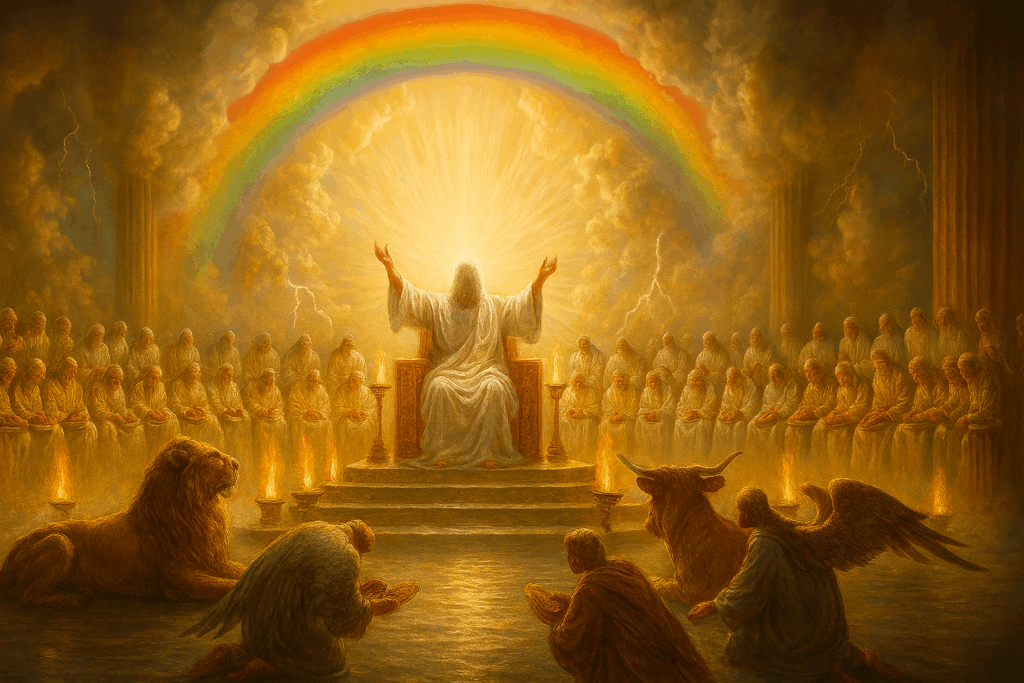
Exegetical study of Revelation 4, the vision of the heavenly throne that marks the turning point of the book. After the messages to the seven churches, John is carried up into heaven and beholds a throne surrounded by twenty-four elders and four living creatures. Every symbolic detail, lights, colors, sounds, expresses the sovereignty, holiness and divine authority that structure and govern history. This foundational vision sheds light on all the prophetic events to come.
42 min
Revelation 4heavenly thronevision of Johnexegesisbiblical prophecy
29 verses
4 books
Chapter 4 of Revelation opens a new stage in the narrative: after the messages to the churches, the vision rises toward heaven. A door opens, revealing the invisible center where history is decided.
There John discovers a symbolic scene organized around a throne from which order, vigilance and authority radiate. The lights, the creatures and the elders do not describe a fantastic setting, but a deep reality that structures the whole book.
This study proposes to go through the chapter verse by verse, following the gestures, the colors and the movements that make up this foundational vision and shed light on the events to come.
Full text:
Chapter 4 of Revelation marks a decisive turning point in the narrative. After the messages addressed to the seven churches, the text rises toward a heavenly scene, as if the gaze left the earth to rest on the invisible center of history. A door opens in heaven, and the reader is invited to contemplate what is taking place “above” the visible world.
This passage does not describe an imaginary place, but a symbolic scene in which every element, throne, light, creatures, elders, expresses a deep reality: that of an order, a vigilance, an authority that precedes and frames the events to come. The throne is at the center, not only of the image, but of the logic of the book. Around it, everything is organized, everything is evaluated, everything is prepared.
The aim of this study is to read this chapter verse by verse, avoiding overly technical or specialized religious terms, in order to draw out the gestures, images and rhythms that structure the vision. Every detail matters: the colors, the postures, the sounds, the movements. Together, they make up a foundational scene that sheds light on the whole rest of the book.
The outline of the book, chapter IV A
Section
Subsection
Description
References
I
—
Introduction
Revelation 1.1-3
II
—
The things past: “what you have seen”
Revelation 1.4-20
III
—
The things present: “what is,” message to the seven Churches
Revelation 2.1 à Revelation 3.22
IV
A
The throne of Christ; the sealed book
Revelation 4.1 à Revelation 5.14
B
Opening of the 7 seals
Revelation 6.1 à Revelation 8.1
C
Parenthesis: Jews and Gentiles saved during the tribulation
Revelation 7.1-17
D
Judgment announced by the seven trumpets
Revelation 8.2 to Revelation 9.21 and Revelation 11.15-19
E
Parenthesis: prelude to the seventh trumpet
Revelation 10.1 à Revelation 11.14
F
Dominant figures
Revelation 12.1-17
G
Advent and reign of the Beast and the false prophet
Revelation 13.1-18
H
Parenthesis: prophetic visions
Revelation 14.1-20
I
Judgments announced by the seven bowls of the wrath of God
Revelation 15.1 à Revelation 16.21
J
Condemnation of Babylon the Great
Revelation 17.1 à Revelation 19.6
K
Preparations for Armageddon and the thousand-year reign
Revelation 19.7 à Revelation 20.6
L
Last Judgment; description of the holy city
Revelation 20.7 à Revelation 22.5
V
—
Conclusion: the last message of the Bible
Revelation 22.6-21
This outline comes from Scofield’s commentaries.
I. Exegetical analysis of Revelation 4.1-11
Summary:
Chapter 4 of Revelation reveals the other side of the stage of history: a heavenly scene in which everything is organized around a central throne, surrounded by twenty‑four elders and four watchful beings.
Through powerful images rather than technical concepts, the text shows an authority that sees everything, evaluates everything and prepares the events to come. Every detail, lights, sounds, movements, attitudes, helps to build a dramatic tension and to reveal the deep order that structures the book.
This foundational vision is a reminder that nothing in Revelation is chaotic: everything proceeds from a sovereign center, attentive and just.
Full text:
This passage opens a window onto the backstage of history as Revelation unveils it. The author presents a scene set beyond our earthly reality, organized around a central throne, surrounded by an assembly of twenty‑four elders and four extraordinary beings.
The text does not require any particular technical mastery: it relies above all on powerful images to evoke authority, order, beauty, vigilance and the deep significance of events. Each verse helps to build a dramatic tension that prepares the reader for the major developments of the following chapters.
Verse-by-verse reading
Revelation 4.1 (King James Version) :
After this I looked, and, behold, a door was opened in heaven: and the first voice which I heard was as it were of a trumpet talking with me; which said, Come up hither, and I will shew thee things which must be hereafter.
King James Version (1769), domaine public — texte : eBible.org
Analysis:
The “open door” introduces a change of plane: we move from the earthly to the heavenly. The voice “like a trumpet” is not an aesthetic detail; it evokes a clear call, impossible to ignore (Revelation 1.10, Revelation 1.12-18).
The invitation “Come up here” turns the reader into a witness: we will not only hear, we will see. The expression “what must take place” announces an orderly unfolding, not an improvisation.
Revelation 4.2 (King James Version) :
And immediately I was in the spirit: and, behold, a throne was set in heaven, and one sat on the throne.
King James Version (1769), domaine public — texte : eBible.org
Analysis:
“Seized” indicates an intensified perception: the scene is not seen with ordinary eyes.
The throne is the visual and symbolic center: a fixed point around which everything is organized. The text does not name the one who is seated; this restraint directs attention toward the function (authority, decision, origin) rather than the label.
Revelation 4.3 (King James Version) :
And he that sat was to look upon like a jasper and a sardine stone: and there was a rainbow round about the throne, in sight like unto an emerald.
King James Version (1769), domaine public — texte : eBible.org
Analysis:
The stones (jasper, sardius, emerald) suggest brilliance, solidity and value. Rather than describing a face, the text describes a light. The rainbow all around the throne evokes an atmosphere of stability and enveloping beauty.
The dominant color (emerald green) adds a tone of life, soothing, in contrast with the flashes of lightning that will come in v. 5.
Revelation 4.4 (King James Version) :
And round about the throne were four and twenty seats: and upon the seats I saw four and twenty elders sitting, clothed in white raiment; and they had on their heads crowns of gold.
King James Version (1769), domaine public — texte : eBible.org
Analysis:
The circle of thrones shows an organization: the central authority surrounds itself with a council. The “” evoke integrity and transparency; the “golden crowns” signal real responsibility, not merely symbolic. The number 24 suggests a complete representation (a full assembly), as if the scene gathered the whole of history.
Revelation 4.5 (King James Version) :
And out of the throne proceeded lightnings and thunderings and voices: and there were seven lamps of fire burning before the throne, which are the seven Spirits of God.
King James Version (1769), domaine public — texte : eBible.org
Analysis:
The flashes of lightning, voices and thunders convey energy and decision-making power. The “seven torches” indicate an active and manifold presence, like a fullness of sight and action.
The image is both sound and light: nothing here is static. We understand that the decisions that go out from this center will have reach and intensity.
Revelation 4.6 (King James Version) :
And before the throne there was a sea of glass like unto crystal: and in the midst of the throne, and round about the throne, were four beasts full of eyes before and behind.
King James Version (1769), domaine public — texte : eBible.org
Analysis:
The “sea of glass” acts as a space of separation and clarity: perfect transparency, no fog or confusion.
The four beings, placed “in the midst and around,” link the center to the edges; they are like sentinels. “Full of eyes” means hypervigilance: nothing escapes their observation, neither in front nor behind.
Revelation 4.7 (King James Version) :
And the first beast was like a lion, and the second beast like a calf, and the third beast had a face as a man, and the fourth beast was like a flying eagle.
King James Version (1769), domaine public — texte : eBible.org
Analysis:
Four complementary profiles: strength (lion), endurance and service (ox), intelligence and relationship (man), height and piercing vision (eagle).
The panel covers power, work, thought, perspective. Taken together, it says: the heavenly scene takes into account all the dimensions needed to govern and to evaluate.
Revelation 4.8 (King James Version) :
And the four beasts had each of them six wings about him; and they were full of eyes within: and they rest not day and night, saying, Holy, holy, holy, Lord God Almighty, which was, and is, and is to come.
King James Version (1769), domaine public — texte : eBible.org
Analysis:
The “six wings” reinforce the idea of mobility and responsiveness. The eyes “all around and within” indicate outward vigilance and inward lucidity.
Their continual proclamation anchors three simple ideas: separation (nothing corrupt mingles here), power (capacity to act without limit), mastery of time (past, present, future). The rhythm of day and night shows an uninterrupted stability.
Revelation 4.9 (King James Version) :
And when those beasts give glory and honour and thanks to him that sat on the throne, who liveth for ever and ever,
King James Version (1769), domaine public — texte : eBible.org
Analysis:
The movement is cyclical: observation → recognition → homage.
Three words (“glory, honor, thanks”) form a complete response: recognizing worth, respecting authority, expressing gratitude. The mention “lives forever and ever” places the axis of the scene beyond the fragility of time.
Revelation 4.10 (King James Version) :
The four and twenty elders fall down before him that sat on the throne, and worship him that liveth for ever and ever, and cast their crowns before the throne, saying,
King James Version (1769), domaine public — texte : eBible.org
Analysis:
The elders, though crowned, lay down their signs of authority. A powerful gesture: they return their legitimacy to the source that gave them this responsibility.
The bowing down and the laying down of the crowns say: peripheral authority recognizes the priority of the center. It is a pedagogy of humility for every power.
Revelation 4.11 (King James Version) :
Thou art worthy, O Lord, to receive glory and honour and power: for thou hast created all things, and for thy pleasure they are and were created.
King James Version (1769), domaine public — texte : eBible.org
Analysis:
The reason for the homage is stated simply: the origin of all things. “Glory, honor, power” takes up the triad of v. 9, but applies it to the underlying motive: the creation and the sustaining of existence.
The formula links beauty (glory), rightful place (honor) and capacity to act (power) to the first decision (“by your will”).
The argument is universal: if everything comes from there, everything depends on there.
Synthesis
Visual and symbolic center: the throne, a fixed point from which light, sounds and decisions go forth.
Organized circle:twenty-four elders, a sign of a complete and responsible representation, yet aware of its limits.
Watchful sentinels:four beings with complementary profiles, hyper-attentive, between center and periphery.
Rhythm of response:observation and proclamation alternate, and the assembly responds by laying down its crowns.
Main motive: the origin of all things (creation) justifies the recognition and the surrender of all authority to the center.
This scene sets up the grammar of the following chapters: a sovereign center, an organized periphery, a constant vigilance, and a back-and-forth of homage. It prepares the reader to understand that the actions to come (seals, trumpets, bowls) are not chaotic impulses, but decisions arising from a stable framework.
Conclusion
This heavenly tableau is not here to multiply strange details: it clarifies the logic of the narrative. The world is observed, evaluated and led from a center that sees everything, hears everything, and acts with justice. The figures around the throne show a complete governance: strength, service, intelligence, breadth of vision. The crowns laid down teach every human power its rightful place: to receive, to serve, and to give account.
When reading Revelation, it is worth remembering that chapter 4 offers an essential point of reference: it highlights the central and attentive presence that underlies every event described.
II. How can human words be used to illustrate a heavenly scene?
Summary:
Chapter 4 of Revelation plunges us into a vision that John tries to render in human words. He does not describe an earthly place, but a divine tableau that goes beyond our categories. Through comparisons, fragments and symbols, he seeks less to explain than to suggest, opening a door onto the invisible.
The images, sea of glass, flashes of lightning, colors, creatures, do not freeze the scene: they direct the gaze and invite contemplation. This approach is a reminder that the vision is not a technical diagram, but a pedagogy of mystery, in which every detail becomes a sign to meditate on.
Full text:
We must understand that the apostle John saw this scene, which constitutes his vision, and that now he must, with his human words, describe and explain what his eyes have seen.
It is therefore not a question of describing a human scene but a divine tableau!
Chapter 4 of Revelation places us before a fundamental difficulty: how to render the unspeakable in human words? John does not describe an earthly place, but a heavenly scene that goes beyond our ordinary categories. Yet he chooses to write, to compare, to evoke, so that his readers may catch a glimpse of what he beheld.
His language is made of comparisons (“like a sea of glass,” “like crystal”), of fragments (the throne, the flashes of lightning, the creatures, the elders), and of symbols (colors, numbers, sounds). These images do not claim to confine the heavenly reality, but they open a door: they suggest, they orient, they invite us to see differently.
This tension is precious. It is a reminder that the text is not a technical description, but an instructive vision: it makes the invisible visible, it gives structure to the incomprehensible, it turns a spiritual experience into an accessible account. The reader is thus invited to enter a scene in which every detail, light, movement, posture, becomes a sign to meditate on.
Three strategies that John uses
The use of comparisons: John does not say “it was this,” but “it looked like…”:
“like a sea of glass”
“like crystal”
“like a lion,” “like an eagle” These formulas acknowledge the distance between what he sees and what he can say.
The fragmentation of the gaze
He never describes everything at once. He proceeds by fragments: the throne, the flashes of lightning, the creatures, the elders… as if each detail were a facet of a whole impossible to grasp in a single glance.
Symbolization by number and color
John uses numbers (7, 24), colors (jasper, emerald), sounds (thunders, voices) to give structure to the invisible. These are landmarks, not equivalents. They allow the reader to find their bearings without claiming to understand everything.
Why this tension is precious
It requires the reader not to reduce the scene to a frozen image. It invites an open, contemplative reading, in which each element can be meditated on, interpreted, revisited. It is a pedagogy by symbol, not by diagram.
John does not seek to “explain” heaven, but to make the invisible visible. He uses human words to suggest, to evoke, to open a door. This is not a technical description, but an invitation to see differently.
He also seems to describe only the main elements, those that are important, those that speak.
III. Main elements of this vision
Summary:
John does not seek to describe everything: he retains only the elements that structure the vision and reveal its meaning. An open door, a central throne, brilliant colors, crowned elders, flashes of lightning, a sea of crystal, living creatures in adoration…
Each detail is chosen for its symbolic force, not for its realism. By successive touches, John composes a scene in which authority, beauty, vigilance and humility answer one another.
This chapter does not offer a photograph of heaven, but a vision constructed to speak to the reader, to invite him to contemplate and understand what is at stake at the center of history.
Full text:
John does not seek to describe everything: he selects the main elements, those that structure the scene and that “speak” through their symbolism. Here is a verse-by-verse list of the major elements of Revelation 4.1‑11:
The main elements described by John
Revelation 4.1 : The open door in heaven.
Commentary: This is the threshold, the passage. John does not describe the whole of heaven, but an opening that allows him to see. The image is simple and powerful: a door that opens, an invitation to enter.
Revelation 4.2 : The throne and the one seated on it.
Commentary: The throne is the central element. John does not describe the face or the features of the one seated, but only the position: seated, at the center. It is the image of supreme authority.
Revelation 4.3 : The precious stones and the rainbow.
Commentary: Instead of a portrait, John speaks of colors and light. The stones (jasper, sardius, emerald) and the rainbow give an impression of beauty and value. These are visual symbols that speak more than physical details.
Revelation 4.4 : The twenty-four elders on their thrones.
Commentary: John does not describe their faces or their daily gestures. He mentions only their and their golden crowns. These are signs of integrity and responsibility, not realistic portraits.
Revelation 4.5 : The flashes of lightning, the voices, the thunders and the seven torches.
Commentary: John retains the manifestations of power (sounds, lights) and the seven burning torches. He does not describe the architecture of the place, but the signs that express energy and vigilance.
Revelation 4.6-7 : The sea of crystal and the four living creatures.
Commentary: The sea of glass is an image of clarity and separation. The four living creatures are described by their forms (lion, ox, man, eagle), not by secondary details. They are symbols of strength, service, intelligence and vision.
Revelation 4.8 : The song of the four living creatures.
Commentary: John does not describe their activities, but their proclamation: “Holy, holy, holy…”. What matters is not their appearance, but their continual speech, which structures the scene.
Revelation 4.9-10 : The gesture of the elders: bowing down and laying down their crowns.
Commentary: John does not recount their thoughts, but their symbolic gesture. To bow down and lay down the crown is to acknowledge that all authority comes from the central throne.
Revelation 4.11 : The declaration of the elders.
Commentary: Their word is brief and essential: to acknowledge the dignity and power of the one who created all things. John does not develop a long speech, but a condensed formula that says what is essential.
Synthesis
John does not describe everything he sees. He chooses the elements that speak:
The throne (center and authority).
The colors and lights (value, beauty, life).
The elders and their gestures (responsibility and humility).
The living creatures and their song (vigilance and proclamation).
The sounds and flashes of lightning (power and energy).
His method is selective: he does not give a realistic photograph, but a symbolic composition. What matters are the signs that convey a message, not the decorative details.
The
IV. The four living creatures
Summary:
The four living creatures of Revelation 4 are not strange creatures meant to arouse curiosity, but powerful symbols of vigilance, strength and uninterrupted praise.
Lion, ox, man and eagle: each embodies an essential dimension of creation placed before the throne. Full of eyes, they keep watch without ceasing; by their continual song, they envelop the heavenly scene in a proclamation of holiness.
Their presence shows that nothing escapes the gaze of heaven and that all creation is involved in worship. Through them, John reveals an orderly, complete and living scene, in which every element takes part in the acknowledgment of divine authority.
Full text:
The four living creatures of Revelation 4 are symbolic figures that express vigilance, power and permanent praise. They are not described to satisfy curiosity, but to show that the heavenly scene is surrounded by total attention and a continual response to the authority of the throne.
Their description
In Revelation 4.6-8, John presents them as follows:
The first looks like a lion (strength, royalty).
The second like an ox (endurance, service).
The third has the face of a man (intelligence, relationship).
The fourth looks like an eagle in flight (height, piercing vision). Each of them has six wings and is full of eyes in front and behind, a sign of total vigilance.
Their role
Vigilance: The eyes everywhere indicate that no detail escapes their observation. They are the sentinels of the throne.
Continual praise: Day and night, they proclaim: “Holy, holy, holy is the Lord God Almighty, who was, and who is, and who is to come” (Revelation 4.8). Their main function is to maintain an atmosphere of acknowledgment and holiness.
Symbolic mediation: They link the center (the throne) to the rest of the scene. Their presence shows that heavenly governance takes into account all the dimensions of life: strength, work, intelligence, vision.
Their meaning
Biblical origin: These figures recall the vision of Ezekiel ([Ezekiel 1 and 10), where they are called “cherubim.”
Universal symbolism: The number four evokes the four cardinal points, and therefore the totality of space and creation. The creatures represent the whole living world placed before the throne.
Ancient Christian reading: The Church Fathers saw in them the symbols of the four evangelists: the lion for Mark, the ox for Luke, the man for Matthew and the eagle for John.
Why this information is important
John does not describe these creatures to “decorate” the scene. Their presence underscores three essential points:
The whole of creation is involved in praise.
Vigilance is absolute: nothing escapes the gaze of heaven.
Praise is continual: the center of the narrative is surrounded by a permanent proclamation of holiness.
Synthesis
The four living creatures are symbolic sentinels: they represent strength, service, intelligence and vision, covering all the dimensions of life and creation. Their role is to keep watch and to proclaim without ceasing the holiness and power of the one who sits on the throne.
This information serves to show that the heavenly scene is complete, balanced and active: nothing is forgotten, everything is included in praise and vigilance.
The , the lion
The , the bull
The
The , the eagle
The
V. The twenty-four elders
Summary:
The twenty‑four elders of Revelation 4 form a symbolic assembly representing redeemed and faithful humanity, placed very near the throne. Clothed in white and crowned with gold, they embody purity, responsibility and received authority.
Their number, 24, evokes the totality of the people of God, from the tribes of Israel to the apostles of Christ. Their central gesture, laying down their crowns before the throne, is a reminder that all human authority is derived and must be returned to God.
They are not identifiable individuals, but a collective figure that links heaven and earth, showing that victorious humanity takes part in divine praise and government in a posture of humility.
Full text:
The 24 elders of Revelation 4 represent a symbolic assembly of redeemed and faithful humanity, placed around the throne to signify participation, responsibility and homage.
Their description
Revelation 4.4: “Around the throne were twenty-four thrones; and on those thrones sat twenty-four elders, clothed in and wearing golden crowns on their heads.”
They are seated, clothed in white (purity, integrity), and wear golden crowns (received authority).
Their position is close to the central throne, which underlines their importance.
Their role
Complete representation: The number 24 is often read as the combination of the 12 tribes of Israel (Old Testament) and the 12 apostles (New Testament). They thus symbolize the whole people of God, old and new.
Delegated authority: Being seated on thrones with crowns shows that they take part in heavenly governance, but always in dependence on the central throne.
Praise and submission: Their most striking gesture is to lay down their crowns before the throne (Revelation 4.10), a sign that all human authority must be returned to God.
Who are they?
Not angels: Angels are never described with crowns or seated on thrones. The elders rather represent glorified human beings, associated with victory and faithfulness.
Collective figures: They are not identifiable individuals, but a symbolic representation of all victorious believers, those who have “overcome” and received the promise of being seated with Christ (Revelation 3.21).
Heavenly council: Their arrangement in a circle around the throne recalls a consultative assembly, like a royal council, but one that submits entirely to the center.
Why this place?
Proximity to the throne: They are the closest to the center, which shows their privileged role in the heavenly scene.
Instructive example: Their gesture of humility (laying down the crowns) is a lesson for every human power: authority is never absolute, it must be returned to the source.
Link between heaven and earth: They embody the continuity between human history (tribes, apostles) and the heavenly scene. Their presence shows that faithful humanity is integrated into divine governance.
Synthesis
The 24 elders are a collective figure: they represent all victorious believers, from the Old and the New Testament. They are placed around the throne to signify that redeemed humanity takes part in heavenly praise and authority, but always in a posture of submission. Their role is to set an example: to receive a crown, but to lay it down before the throne, acknowledging that all authority comes from God and must be returned to him.
VI. Why does John give us this description?
Summary:
Chapter 4 of Revelation is not a backdrop, but the essential framework that sheds light on the whole rest of the book. John shows the throne, the heavenly beings and the liturgy of heaven in order to anchor the authority of his message and to recall that God reigns before any revelation.
This vision prepares the reader: before the judgments, it affirms that nothing escapes the divine order. Through colors, symbols and songs, John turns a spiritual truth into a visual experience, making the message living and memorable.
The heavenly scene thus becomes a key to reading and a guarantee of authenticity for everything that follows.
Full text:
Chapter 4 of Revelation is not a mere decorative introduction: John does not describe heaven to “look pretty,” but to give a theological and instructive framework to everything that follows.
Why this vision of heaven?
Anchoring the authority of the message: John does not speak in his own name. By showing the throne, the heavenly beings and the liturgy of heaven, he establishes that his message comes directly from God, the universal sovereign.
Preparing the reader for the revelation: before the judgments and the sometimes terrible visions, John shows the ultimate reality: God reigns, and everything is ordered around him. This gives a key to reading: earthly events are not out of control.
Staging the symbolism: the colors, the precious stones, the living creatures, the songs… all of this conveys spiritual truths (holiness, glory, power, creation that worships). Without this staging, the message would risk being abstract.
Teaching through the image: John uses a vision to strike the imagination. The reader does not receive words alone, but a visual and sensory experience that makes the truth more memorable.
In summary
John does not content himself with passing on doctrinal content: he immerses his readers in the heavenly reality so that they understand that everything that is about to be announced is rooted in the throne of God. The description of heaven is therefore a guarantee of authenticity, a hermeneutical key and a teaching tool.
VIII. Commentary
Summary:
John reports a vision received on the , in which he sees not the whole of heaven, but the precise place where the throne of God stands. He does not see God directly, only a light that suggests his presence, because the invisible goes beyond what a human gaze can bear.
This scene aims to show that the events to come are neither a matter of chance nor of chaos, but of a sovereign plan perfectly under control. Chapter 4 thus puts forward the omnipotence of God, whose word creates and orders.
The description remains symbolic: John uses earthly images to evoke a heavenly reality that goes beyond all human imagination.
Full text:
John relates a vision he had while he was on the . In this vision, he does not describe heaven as a whole, but a particular place in heaven where the throne of God stands. He does not see God himself, for it is written that no human being can see God and remain alive (cf. Exodus 33.20). What John perceives is a light, but he never sees God directly.
The purpose of this description of heaven is to make everyone understand the supreme authority of God. John insists that the events to come are not the fruit of chance or of a mere succession of circumstances, but result from the carrying out of a carefully worked-out and flawless plan. Only God has the power needed to carry out this plan and to ensure its unfolding.
Chapter 4 therefore essentially highlights the almighty power of God: when He speaks, the thing happens; when He commands, it exists (Psalms 33.9). It is important to note that this description is not to be taken literally, for it remains symbolic. John seeks to compare what he sees with earthly elements in an attempt to convey it. However, this vision, according to the analysis proposed, goes beyond anything a human being could imagine, and its description can only be an imperfect reflection of reality.
Summary:
John does not present his vision as a mere introduction, but as the affirmation that God is the Almighty who leads history toward the return of the Messiah. This heavenly scene serves as a key to reading everything that follows: it shows that God has a sovereign plan and that he has the absolute power to accomplish it.
The images used, comparisons, symbols, fragments, must not be taken literally, for they are only human approximations of a reality that goes beyond all representation.
The essential is not in the visual details, but in the central message: the vision is sufficient in itself and directs the reader toward what God wishes to reveal, without any need to add or imagine anything more.
Full text:
This vision should not be considered merely as an introduction to the revelations that follow in John's account. Through his words and the comparisons he uses, John seeks to affirm that God is the Almighty, in order to anchor firmly in the minds of his readers that God has prepared a plan for the return of the Messiah, Jesus. This return will mark the end of this world, and God has the absolute power to carry out this plan.
Moreover, this passage can also be seen as a key of interpretation for understanding the rest of John's revelation. The mode of description used will remain the same, and one must not dwell on the details, for John limits himself to comparisons with what is familiar to him. Thus, these comparisons give only an approximate idea of the reality he is trying to describe.
The essential therefore does not lie in the minuteness of the details. For example, trying to represent graphically the creatures evoked by John would necessarily lead to a multitude of interpretations, depending on the imagination of each artist. It is therefore essential to concentrate on the main message in order to understand the vision well and to avoid getting lost in superfluous explanations. The vision of God presented to John is sufficient in itself: it requires neither complementary visions nor human imagination to be understood, because all the factual elements needed are already included in it and await discovery by the reader.
A title, a person, a place, a reference (“Luke 15”)…
opens in a new window
Bible reference
INF242
Information note
INF242 - Comparison with the information in Ezekiel and Isaiah
Comparison with the information in Ezekiel and Isaiah
The living creatures of Revelation 4 are indeed related to the cherubim of Ezekiel and the seraphim of Isaiah, but John reinterprets them for his own theological framework.
The cherubim of Ezekiel (Ezekiel 1.4-28; Ezekiel 10.1-22)
Description: Four living creatures, each with four faces (man, lion, ox, eagle) and four wings.
Function: To carry the throne of God and to manifest his glory and mobility.
Symbolism: They represent the fullness of creation and the divine power that moves freely.
The seraphim of Isaiah (Isaiah 6.1-13)
Description: Seraphim, each with six wings.
Function: Perpetual praise (Holy, Holy, Holy), purification of the prophet (a seraph touches Isaiah’s lips with a burning coal).
Symbolism: They express the holiness and purity of God, and serve as liturgical mediators.
John’s living creatures (Rev 4.6-11)
Description: Four distinct living creatures (lion, ox, man, eagle), each with six wings and “full of eyes.”
Function: Perpetual praise (Holy, Holy, Holy), introduction of the seals (Rev 6), handing over of the bowls (Rev 15).
Symbolism: They take up the figures of Ezekiel (lion, ox, man, eagle), but separate them into four individuals, and give them the six wings of Isaiah’s seraphim.
The links between the three visions
John combines Ezekiel and Isaiah:
The faces of the cherubim become distinct creatures.
The six wings of the seraphim are assigned to each one.
Common liturgical function: All proclaim the holiness of God (Holy, Holy, Holy).
Symbolic function: They represent the whole creation (strength, service, intelligence, transcendence) and take part in the divine revelation.
Pedagogical development:
Ezekiel → vision of the mobile throne and of glory.
Isaiah → vision of holiness and purification.
John → vision of creation worshiping and active in the eschatological plan.
Synthesis
The living creatures of John are a synthesis of the cherubim of Ezekiel and the seraphim of Isaiah:
They take up the symbolic forms of the cherubim.
They adopt the six wings of the seraphim.
They unite these traditions to show that the whole creation worships God and takes part in his plan of judgment and salvation.
Comparative table of the living creatures
Aspect
Revelation 4 (John)
Ezekiel 1 (Cherubim)
Isaiah 6 (Seraphim)
Number
4 living creatures
4 living creatures
6 seraphim
Position
Around the throne
Around the throne of God
Above the throne
Appearance
1. Lion
2. Ox
3. Man
4. Eagle
Each creature has 4 faces (man, lion, ox, eagle)
Each has a human form
Wings
6 wings each
4 wings each
6 wings each
Function
Perpetual praise (Holy, Holy, Holy), introduction of the seals, handing over of the bowls
Carrying the throne, manifesting the divine glory
Perpetual praise (Holy, Holy, Holy), purification of the prophet
Symbolism
Represent the totality of creation (strength, service, intelligence, transcendence)
Represent the fullness of creation and the mobility of the throne
Represent divine holiness and purity
Involvement
Active in the revelation (seals, bowls, praise)
Ezekiel’s inaugural vision, role as bearers of the throne
Isaiah’s inaugural vision, liturgical role
INF240
Information note
INF240 - Why does John specify “the voice that I had heard”?
Why does John specify “the voice that I had heard”?
Context of the verse
Revelation 4.1 marks a transition: John moves from the letters to the Churches (chs. 2–3) to the great heavenly vision.
The text says: “After this I looked, and behold, a door was open in heaven. The first voice that I had heard, like the sound of a trumpet, said to me: Come up here…”
Why does John specify “the voice that I had heard”?
Narrative continuity: John refers back to the voice heard in Revelation 1.10–11, that of the glorified Christ who had given him the first revelation. This creates a common thread between the visions.
Divine authority: By recalling that it is the same voice, John stresses that the origin of the revelation is single and reliable: it is Christ who speaks, not a new source.
A landmark for the reader: The expression helps the reader recognize the voice as familiar, already introduced, and therefore trustworthy. This avoids any confusion with the other voices that will appear in the book (angels, creatures, etc.).
Pedagogical dimension: John shows that the revelation is not a series of isolated visions, but a coherent discourse guided by the same Lord.
Symbolism
The voice is described “like a trumpet”: an image of clarity, power and solemn summons.
The recalling of this voice reinforces the idea that John is led step by step in a pedagogical progression: first the vision of Christ (ch. 1), then the Churches (chs. 2–3), then the heavenly throne (ch. 4).
In summary: John says “the voice that I had heard” to ensure continuity, to recall the authority of Christ, and to guide the reader through a coherent revelation. It is a way of showing that everything that follows proceeds from the same divine source.
INF246
Information note
INF246 - The Order in Which the Living Creatures Are Described
The Order in Which the Living Creatures Are Described
The order in which the four living creatures are described in Revelation 4.7 (lion, ox, man, eagle) is not random: it carries a symbolic and theological meaning
The order in the text
John describes:
The first living creature → lion
The second → ox/calf
The third → face of a man
The fourth → eagle in flight
Importance of the order
Progression from the earthly creation to the heavenly
Lion → king of the land animals, symbol of power.
Ox → domestic animal, linked to service and sacrifice.
Man → pinnacle of the earthly creation, bearer of reason and of the divine image.
Eagle → heavenly creature, symbol of transcendence and elevation. The order follows an ascent: from the earthly (raw strength) to the spiritual (elevation toward God).
Echo of Ezekiel’s cherubim
Ezekiel sees the four faces simultaneously (man, lion, ox, eagle).
John takes up these figures but arranges them in sequence, which gives a pedagogical dynamic: progression and hierarchy.
Liturgical structure
The order may reflect an arrangement around the throne: each living creature occupies a direction (Jewish and Christian tradition: lion to the north, ox to the west, man to the south, eagle to the east).
This symbolizes the totality of space and of creation gathered in adoration.
Christological reading
Some Church Fathers saw in this order a correspondence with the four gospels:
Lion → Matthew (messianic kingship)
Ox → Mark (service and sacrifice)
Man → Luke (the humanity of Christ)
Eagle → John (spiritual elevation, divine contemplation). Even though this link is not explicit in the text, it has left its mark on the Christian tradition.
Synthesis
The order is not arbitrary: it follows a symbolic progression of creation, from the earthly to the heavenly.
It reflects the fullness of creation around the throne.
It was read in tradition as a christological key (the four gospels).
Its function is pedagogical: to show that all dimensions of creation take part in worship and in the divine plan.
INF244
Information note
INF244 - The Third Living Creature with a Human Face
The Third Living Creature with a Human Face
The third living creature of Revelation 4.7 deserves careful analysis, because its translation and its symbolism are not trivial.
The Greek word
The text says: « τὸ τρίτον ζῷον ἔχον τὸ πρόσωπον ὡς ἀνθρώπου » — to triton zōon echon to prosōpon hōs anthrōpou.
ζῷον (zōon)** = “living creature”, a generic term that stresses vitality.
πρόσωπον (prosōpon)** = “face”, “countenance”, sometimes “appearance”.
ἄνθρωπος (anthrōpos)** = “man”, in the generic sense of a human being. The translation “the third living creature had a face like that of a man” is accurate and faithful to the Greek.
What does this third creature represent?
Human dimension: It embodies the intelligence, the reason and the relational capacity proper to man.
Link with creation: In the series of the four living creatures (lion, ox, man, eagle), man represents the rational and spiritual creation, complementary to the other dimensions (strength, service, transcendence).
Christological link: Some exegetes see in it an allusion to the incarnate Christ, the “Son of Man”, who unites divinity and humanity.
Link with Ezekiel: In Ezekiel 1.10, one of the faces of the cherubim is that of a man. John takes up this image but makes it a distinct creature.
Its role in the rest of Revelation
Revelation 6.5–6: The third living creature says “Come!” and introduces the black horseman (famine).
Revelation 7.11: It takes part in the worship with the other living creatures and the angels.
Revelation 15.7: Like the others, it is involved in handing over the bowls of wrath. It is therefore not merely symbolic: it acts concretely in the unfolding of the judgments.
Why this description?
Biblical teaching purpose: John wants to show that the whole creation is represented before the throne:
Lion → strength and kingship
Ox → service and sacrifice
Man → intelligence and relationship
Eagle → transcendence and swiftness
Theology: The human face reminds us that man is created in the image of God (Genesis 1.26–27). Its presence in heavenly worship underlines humanity’s calling to take part in worship and in the divine plan.
Heavenly liturgy: Like the seraphim of Isaiah, these creatures sing “Holy, Holy, Holy”, but John insists on their diversity to show the fullness of creation.
Synthesis
The Greek word is well translated: “a face like that of a man”.
This third creature represents the rational and relational dimension of creation, and can be read as an allusion to the incarnate Christ.
It acts actively in the revelation (seals, praise, handing over of the bowls).
Its description aims to show that humanity, as part of creation, is called to worship and is included in the divine plan.
INF243
Information note
INF243 - The Second Living Creature, the Bull
The Second Living Creature, the Bull
The second living creature of Revelation 4.7 deserves careful analysis, because its translation and its symbolism are not trivial.
The Greek word
The text says: « τὸ δεύτερον ζῷον ὅμοιον μόσχῳ » — to deuteron zōon homoion moschō.
ζῷον (zōon)** = “living creature”, a generic term that stresses vitality.
μόσχος (moschos)** = “young bovine”, “calf”, sometimes “bullock”.
It is not the word for “adult ox” (bous) nor for “wild bull” (tauros). ? The most literal translation would therefore be “like a calf”, but many versions prefer “ox” or “bull” to convey the symbolic weight.
What does this second creature represent?
Sacrificial dimension: The calf/ox is the animal of the sacrifices in the Temple (cf. Leviticus 4.3-4). It evokes offering, service and consecration.
Domesticated strength: Unlike the lion (royal power), the ox symbolizes strength placed at the service of others, patience and labor.
Christological link: Some exegetes see in it an allusion to Christ in his role as servant and sacrificial victim, in contrast with the lion of Judah (Revelation 5.5).
Complementarity: In the series of the four living creatures, it embodies the dimension of creation devoted to service and sacrifice, alongside kingship (lion), intelligence (man) and transcendence (eagle).
Its role in the rest of Revelation
Revelation 6.3–4: The second living creature says “Come!” and introduces the red horseman (war).
Revelation 7.11: It takes part in the worship with the other living creatures and the angels.
Revelation 15.7: One of the living creatures gives the angels the seven bowls of wrath. ? It is therefore not merely symbolic: it acts concretely in the unfolding of the judgments.
Why this description?
Link with Ezekiel: John takes up the figures of the cherubim (Isaiah 1.10), where one of the faces is that of an ox.
Link with Isaiah: He gives them six wings, like the seraphim (Isaiah 6.2).
Teaching purpose: The description shows that the whole creation, in its strength, its service, its intelligence and its transcendence, is involved in worship and in the divine plan.
Theology: The second living creature reminds us that heavenly worship is inseparable from the notion of sacrifice and service, values that are central in biblical revelation.
Synthesis
The Greek word μόσχος is better translated “calf” or “young bovine”, but “ox” or “bull” are interpretive choices meant to reinforce the symbolism.
This second creature represents the sacrificial and serving dimension of creation.
It acts actively in the revelation (seals, praise, handing over of the bowls).
Its description aims to show that heavenly worship includes service and sacrifice, in addition to kingship, intelligence and transcendence.
INF245
Information note
INF245 - The Fourth Living Creature, the Eagle
The Fourth Living Creature, the Eagle
The fourth living creature of Revelation 4.7, “like an eagle in flight”, is rich in symbolism.
The Greek word
The text says: « τὸ τέταρτον ζῷον ὅμοιον ἀετῷ πετομένῳ » — to tetarton zōon homoion aetō petomenō.
ζῷον (zōon)** = “living creature”, a generic term for an animate creature.
ἀετός (aetos)** = “eagle”.
πετόμενος (petomenos)** = present participle of “to fly”, hence “in flight”. The translation “like an eagle in flight” is accurate and faithful to the Greek.
What does this fourth creature represent?
Transcendence and height: The eagle is the bird that flies the highest, a symbol of divine vision and of closeness to heaven.
Vigilance and swiftness: In the Bible, the eagle is associated with vigilance and strength (Deuteronomy 32.11; Isaiah 40.31).
Spiritual dimension: It embodies the capacity of creation to rise toward God, to see from afar and to act swiftly.
Complementarity: With the lion (strength), the ox (sacrifice), and man (intelligence), the eagle represents transcendence and spiritual vigilance.
Its role in the rest of Revelation
Revelation 6.7–8: The fourth living creature says “Come!” and introduces the pale horseman (death).
Revelation 4.8: Like the others, it takes part in the perpetual praise (Holy, Holy, Holy).
Revelation 7.11: It joins the angels and the other living creatures in worship. ? It is therefore active in the unfolding of the judgments and in the heavenly liturgy.
Why this description?
Link with Ezekiel 1.10: One of the faces of the cherubim is that of an eagle. John takes up this image but makes it a distinct creature.
Link with Isaiah 6.2: Like the seraphim, each of the living creatures has six wings and proclaims the holiness of God.
Theology: The eagle in flight symbolizes the transcendent dimension of creation, which rises toward God and takes part in his plan.
Teaching purpose: Its description completes the picture of the four living creatures, representing the whole of creation:
Lion → royal power
Ox → sacrifice and service
Man → intelligence and relationship
Eagle → transcendence and vigilance
Synthesis
The Greek word is well translated: “eagle in flight”.
This fourth creature represents the transcendence, the vigilance and the spiritual dimension of creation.
It acts actively in the revelation (seals, praise, handing over of the judgments).
Its description aims to show that the whole creation, in all its dimensions, is associated with worship and with the divine plan.
INF241
Information note
INF241 - The first living creature, the lion
The first living creature, the lion
The first “living creature” (ζῷον, zōon) of Revelation 4.7 deserves careful analysis.:
The Greek term
The word used is ζῷον (zōon)**, which literally means “living being,” “living creature.”
It is not the usual word for “animal” (thērion), but a broader term that stresses vitality and animation.
The translation “living creature” is therefore correct and underlines that these beings are more than animals: they are heavenly figures, close to the cherubim of Ezekiel (Ezekiel 1.5–10) and the seraphim of Isaiah (Isaiah 6.2–3).
The first creature: “like a lion”
The lion is a symbol of strength, majesty and kingship. In the Bible, it often evokes divine power and sovereignty (cf. Genesis 49.9; Amos 3.8).
In the heavenly context, this first living creature probably represents the royal power of God and his authority over creation.
Some exegetes also see in it an allusion to Christ himself, “the lion of the tribe of Judah” (Revelation 5.5), although the text does not identify him directly.
Role in the rest of Revelation
These four living creatures appear on several occasions:
Rev 4.8–9: they sing ceaselessly of the holiness of God (Holy, Holy, Holy…).
Rev 6.1–7: each of the four living creatures introduces the opening of the first four seals, saying “Come!” — which triggers the going forth of the four horsemen.
Rev 7.11: they join the angels in worshiping God.
Rev 15.7: one of them hands the angels the seven bowls of wrath.
Their role is therefore active: they are not merely decorative, but take part in the revelation and in the carrying out of the judgments.
Why this description?
Link with the Old Testament: John takes up the visions of Ezekiel and Isaiah, but adapts them to show the fullness of creation worshiping God.
Pedagogical symbolism: each living creature embodies a dimension of creation:
Lion → strength and kingship
Ox → power and service
Man → intelligence and relationship
Eagle → swiftness and transcendence
Together, they represent the totality of created life, placed before the throne to glorify God.
Their description serves to show that all creation is involved in the heavenly worship and in the accomplishment of the divine plan.
Synthesis
The Greek word ζῷον is correctly translated as “living creature.”
The first creature, like a lion, symbolizes royal power and divine majesty.
It takes part in the rest of the revelation, notably by opening the seals and by participating in the heavenly worship.
Its description aims to show that the whole creation, in its strengths and qualities, is associated with divine worship and judgment.
INF200
Information note
INF200 - A White Garment
A White Garment
The white garment that Christians will receive symbolizes purity, righteousness, victory and sharing in heavenly glory. It is a sign of spiritual transformation and of belonging to Christ.
Biblical origin of the white garment
The white garment appears several times in the Bible, notably in the book of Revelation, where it is associated with faithful believers:
_Revelation 3.5: “The one who conquers will be clothed in white garments; I will never blot his name out of the book of life.”
_Revelation 7.13-14: The elect are described as having “washed their robes and made them white in the blood of the Lamb.”
_Revelation 19.8: The Bride of the Lamb (the Church) receives a garment of fine linen, “the righteous deeds of the saints.”
Spiritual significance
The white garment represents:
_Purity and holiness: It symbolizes a life cleansed from sin by the sacrifice of Christ.
_Righteousness received from God: It is not human righteousness, but the righteousness that God grants to those who believe in Jesus.
_Victory over evil: It is promised to those who “conquer,” that is, who persevere in faith to the end.
_Resurrection and glory: It evokes the glorified state of believers in eternal life.
In the Christian tradition
_At baptism, new Christians often receive a white garment, a sign of their spiritual new birth.
_In the liturgy, priests wear white vestments at the feasts of the resurrection, recalling the victory of Christ.
_In Christian art, saints and angels are often depicted in white, reflecting their heavenly state.
A call to preparation
The white garment is not only a gift, it is also a call to live faithfully:
“Blessed are those who wash their robes, so that they may have the right to the tree of life” (Revelation 22.14)
This means that believers are invited to live in the light, to turn away from sin, and to prepare themselves for the wedding of the Lamb.
This white garment is indispensable to take part in the wedding of the Lamb, and anyone who managed to get in without this garment, if that were possible, would inevitably be driven out
INF226
Information note
INF226 - The island of Patmos
The island of Patmos
John was most likely in forced exile on the island of Patmos, used by the Romans as a place of deportation. In other words, he was not there voluntarily, but compelled by the imperial authorities.
Historical context
Revelation 1.9 says plainly: “I, John, your brother… was on the island called Patmos, because of the word of God and the testimony of Jesus.” → This indicates a situation of constraint, linked to his faithfulness.
The Romans used Patmos as a place of banishment for political or religious prisoners. The island, rocky and isolated, served to cut the exiles off from their communities.
Early Christian tradition (Irenaeus of Lyon, late second century) affirms that John was sent there under the emperor Domitian (around AD 95).
Modern historians qualify this: some speak of “exile” (expulsion from one’s community), others of “deportation” (a penalty imposed by the Roman state). In both cases, it was a political and religious constraint.
In summary
John did not choose Patmos: he was sent there by the Roman authorities.
One can speak both of exile (he is removed from his community) and of deportation (he is punished by the authorities).
This setting explains why Revelation is a book of resistance and hope: written from a place of marginalization, it affirms that the Messiah Jesus is present and sovereign, even when the empire seems to dominate.
Despite this difficult human setting of deportation, John affirms that he receives a vision from God. Exile does not prevent revelation; it even becomes its privileged place. It is precisely in weakness and isolation that the voice of the Messiah Jesus is heard.
The fact that John is in exile underscores the strength of the message. Revelation is not abstract speculation, but a revelation given in a situation of real distress. This makes the text credible and powerful: God speaks in history, not outside it.
In other words, the setting of marginalization explains the tone of the book, and the revelation explains its content. Together, they show that Christian hope is born in places of fragility, and that it affirms the sovereignty of Christ even when the empire seems to dominate