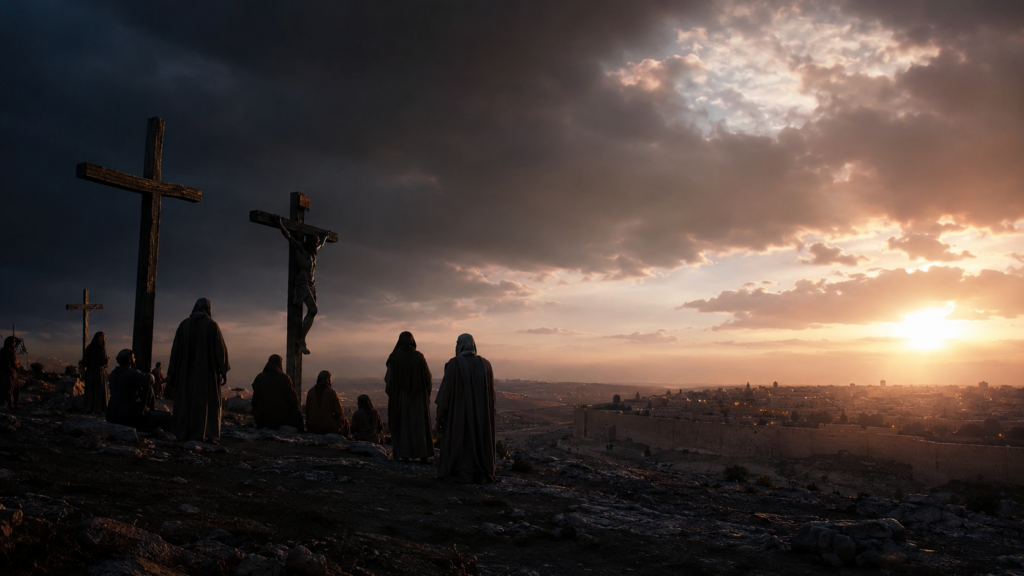
The article explores the riddle of Jesus’ “three days and three nights,” proposing that the darkness that fell during the crucifixion be regarded as the “third night.” This would make it possible to reconcile the Gospel account with a symbolic and theological reading. The author examines the story of Jonah to understand what these days mean.
135 min
Jesuscrucifixionthree days and three nightsdarkness
176 verses
91 books
How are we to understand Jesus’ proclamation in Matthew 12.40? What do these “three days and three nights” mentioned by the Lord with reference to the prophet Jonah represent?
Several elements invite us to consider this reading:
The Gospels attest a phenomenon of total darkness in broad daylight, lasting three hours at the heart of the crucifixion. This was neither an ordinary eclipse nor a commonplace meteorological event; it is a divine sign, a miracle that we accept as a historical fact without seeking a rational explanation — for the very nature of a miracle is to go beyond human rationality. (Matthew 27.45)
In biblical usage, “night” evokes darkness, judgment, the veiling of light. The darkness at noon belongs to this symbolic and theological register: it expresses cosmic mourning and divine judgment at the moment when the Son of God bears the sin of the world. (Amos 8.9: “In that day… I will make the sun go down at noon, and I will darken the earth in broad daylight.”)
We propose that God sent this exceptional night, among other reasons, to veil the nakedness of his Son on the cross — an act of mercy and divine modesty — and that it was before the end of this darkness that Jesus gave up his spirit. If death occurred during this prodigious “night,” it can legitimately be counted in the reckoning of the “three nights.”
Jesus himself, on other occasions, mentions a period of “three days” in connection with his death and resurrection, notably to “rebuild the temple” (John 2.19-21). The coherence of his teaching invites us to seek a harmonization that respects both the letter of Matthew 12.40 and the Passover chronology.
Method and objectives
In this study, we will take up:
1- Le texte de Jonas afin de bien comprendre à quoi correspondent les « trois jours et trois nuits » dans leur contexte originel. (Jonah 1.15-16,
Verset(s) introuvable(s) : 11
)
2- The details provided by each evangelist concerning the Passion, the death, the burial, and the resurrection of Jesus. We will strive to grasp the exact meaning of their words, keeping in mind that their purpose was never to define a strict chronology, but to explain events that were essential in their eyes. (Matthew 27-28; Mark 15-16; Luke 23-24; John 19-20)
3- The theological and symbolic significance of the darkness at noon, and its possible inclusion in the reckoning of the “three nights.”
We believe, as we have often indicated in various studies, that all the information transmitted by the evangelists is rigorously accurate. When Matthew speaks of “darkness over all the land,” we accept it as a historical fact, without demanding a natural explanation. It is obvious that this darkness does not constitute a normal chronological night in the calendar sense; however, can we not equate it with a “night” in the sense of the prophetic reckoning?
This is the hypothesis that we will test against the texts, seeking to honor both exegetical rigor and the theological coherence of the scriptural witness.
Transition: The first chapter will examine the account of Jonah, the typological matrix of the “sign” announced by Jesus, in order to clarify what the expression “three days and three nights” covers in its Old Testament context. (Jonah 1.15-16; Matthew 12.40)
1.1. Narrative context: Jonah’s disobedience and flight
I. Jonah: the typological matrix of the “three days and three nights”
The commands Jonah to go to Nineveh to proclaim a message of judgment there. (Jonah 1.1-2)
Jonah refuses and flees “from the presence of the ,” boarding a ship bound for Tarshish. (Jonah 1.3)
A violent storm strikes the ship; the frightened sailors throw Jonah into the sea after he acknowledges his responsibility. (Jonah 1.4-15)
Point to note:
Jonah’s flight and his being swallowed up by the sea prefigure, in the Christian typological reading, the descent of Christ into death — not through disobedience, but through perfect obedience to the Father. (Philippians 2.8)
1.2. The stay in the belly of the fish: “three days and three nights”
Key text:
“The appointed a great fish to swallow Jonah, and Jonah was in the belly of the fish three days and three nights.” (Jonah 1.17; in some versions: Jonah 2.1)
Analysis:
The expression “three days and three nights” marks a significant length of stay in a place of apparent death: the entrails of the sea monster, at the bottom of the sea.
Jonah himself describes this experience as a descent into the realm of the dead: “Out of the belly of Sheol I cried, and you heard my voice… You cast me into the deep, into the heart of the seas.” (Jonah 2.3-4)
The “bars of the earth” closed upon him “forever,” he says, before the brought his life up “from the pit.” (Jonah 2.7)
Point to note:
The belly of the fish functions as a temporary tomb: a place of darkness, of separation from the world of the living, but also a place where prayer rises to God and where deliverance is prepared.
1.3. The deliverance: cast out onto dry land
At the end of the three days and three nights, “the spoke to the fish, and it vomited Jonah out onto dry land.” (
Verset(s) introuvable(s) : 11
)
Jonah, having come out of the sea monster alive, receives for a second time the command to go to Nineveh. (Jonah 3.1-2)
Point to note:
The coming out of the fish is a figure of resurrection: the one who had been swallowed up, held in a place of death, is restored to life and to his prophetic mission.
1.4. The value of the expression “three days and three nights” in the Hebrew context
In biblical Hebrew, the expression “days and nights” (יָמִים וּשְׁלֹשָׁה לֵילוֹת) emphasizes the totality and continuity of a period, rather than a strict hourly count.
A significant parallel is found in the book of Esther: the queen asks for a fast of “three days, night or day,” and yet she appears before the king “on the third day.” (Esther 4.16, Esther 5.1)
This parallel shows the elasticity of the formula: “three days and three nights” can designate a period covering three days without requiring a full 72 hours.
Point to note:
The Semitic idiom allows an inclusive reading: any fraction of a day can count as a “day,” and the mention of “nights” reinforces the idea of totality rather than imposing a rigid calculation.
1.5. Jonah as a prophetic “sign”
Jesus himself establishes the typological link: “An evil and adulterous generation asks for a sign; but no sign will be given to it except the sign of the prophet Jonah. For as Jonah was three days and three nights in the belly of the great fish, so will the Son of Man be three days and three nights in the heart of the earth.” (Matthew 12.39-40; cf. Luke 11.29-30)
The “sign of Jonah” is therefore the death, burial, and resurrection of the Messiah, prefigured by the prophet’s being swallowed up and delivered.
Point to note:
The function of the parallel is typological and prophetic: Jonah foretells Christ; the belly of the fish prefigures the tomb; the coming out alive prefigures the resurrection.
1.6. The “three days and three nights” of Jonah: which nights?
If we examine the account of Jonah carefully, the question arises: which “nights” are included in these three days?
Jonah is thrown into the sea in the midst of the storm, probably during the day (the sailors tried to row back to land, which presupposes visibility). (Jonah 1.13)
The text does not specify the exact time of the swallowing nor that of the deliverance.
The expression “three days and three nights” functions as an idiomatic block designating the entire stay, without detailing the beginning and the end of each night.
Point to note:
The text of Jonah provides no hourly chronology; the emphasis is on the reality of the stay in a place of apparent death and on the divine deliverance that follows.
1.7. Synthesis: Jonah as an interpretive key for Matthew 12.40
The account of Jonah establishes a figure: a man swallowed up in a place of death, held “three days and three nights,” then restored alive to his mission.
The expression “three days and three nights” is an idiom of totality, not a stopwatch.
Jesus takes up this figure to announce his own death, his stay in the tomb, and his resurrection.
The question that arises for the Passion of Christ is therefore: how do the Gospels allow us to recover this pattern of “three days and three nights,” and what role can the extraordinary darkness of the crucifixion play in this reckoning?
Transition: Chapter 2 will examine Jesus’ announcements concerning his death and resurrection, as well as the different formulations (“on the third day,” “after three days,” “three days and three nights”), in order to clarify how they fit together and what they imply. (Matthew 12.40; Matthew 16.21; Mark 8.31; John 2.19-21)
2.1. The first announcements of the Passion
II. The announcements of Jesus: “on the third day,” “after three days,” and “three days and three nights”
On several occasions, Jesus announces to his disciples that he will be put to death and then rise again.
Among the best-known formulations are:
“From that time Jesus began to show his disciples that he must go to Jerusalem and suffer many things the elders, the chief priests, and the scribes, and be killed, and be raised the third day.” (Matthew 16.21)
“The Son of Man must suffer many things, be rejected by the elders, by the chief priests, and by the scribes, be killed, and rise again after three days.” (Mark 8.31)
“The Son of Man is about to be delivered into the hands of men; they will kill him, and on the third day he will rise again.” (Matthew 17.22-23; Luke 9.22)
Observation:
The evangelists sometimes report the words of Jesus in the form “on the third day,” and sometimes in the form “after three days.” Yet all of them describe the same historical event: the resurrection of the Messiah Jesus.
2.2. “The third day” and “after three days”
Some critics consider that these two expressions would be incompatible.
In reality, they belong to the Semitic mode of expression common in the first century.
Thus:
“on the third day” (Matthew 16.21; Luke 24.7);
“after three days” (Mark 8.31; Mark 9.31);
designate the same period.
This equivalence appears clearly during the trial of Jesus.
The false witnesses declare:
“I am able to destroy the temple of God and to rebuild it in three days.” (Matthew 26.61)
Whereas John reports:
“Destroy this temple, and in three days I will raise it up.” (John 2.19)
A few verses later, John explains that Jesus was speaking of the temple of his body (John 2.21).
Likewise, the religious leaders ask Pilate:
“That deceiver said, while he was still alive, ‘After three days I will rise.’” (Matthew 27.63)
They then demand that the tomb be guarded:
“until the third day” (Matthew 27.64)
Observation:
In one and the same context, the use “after three days” and “until the third day” interchangeably, proof that they understood these expressions as equivalent.
2.3. The unanimous testimony of the evangelists
The accounts of the resurrection all place the event on the first day of the week.
(Matthew 28.1-6)
(Mark 16.1-6)
(Luke 24.1-7)
(John 20:1–18)
The disciples on the road to Emmaus declare on that very day:
“Today is the third day since these things happened.” (Luke 24.21)
This statement is particularly important.
Since the events began on Friday, the two disciples consider Sunday to be “the third day”:
1- Friday: first day;
2- Saturday: second day;
3- Sunday: third day.
Observation:
This way of counting corresponds perfectly to the Jewish inclusive reckoning, in which any part of a day can be counted as a whole day.
2.4. A particular difficulty: the “three nights”
While the expressions “on the third day” and “after three days” harmonize naturally, the formula of Matthew 12.40 remains more specific:
“For as Jonah was three days and three nights in the belly of the great fish, so will the Son of Man be three days and three nights in the heart of the earth.”
On the traditional hypothesis of a crucifixion on Friday afternoon and a resurrection on Sunday morning, we can identify:
part of Friday;
the whole of the ;
part of Sunday.
The counting of the three days therefore poses no difficulty.
On the other hand, only two calendar nights seem to appear:
the night from Friday to Saturday;
the night from Saturday to Sunday.
The question then becomes legitimate:
How are we to understand the explicit mention of the “three nights”?
2.5. A unique expression in the words of Jesus
It should be noted that Jesus uses the complete expression “three days and three nights” only once in connection with his resurrection: (Matthew 12.40).
In all the other announcements, he uses simpler formulations:
“on the third day”;
“after three days”;
“in three days.”
This singularity deserves attention.
Matthew probably does not seek to provide a detailed chronological calculation. His main aim is to draw a parallel between the experience of Jonah and that of Christ.
The heart of the sign lies in death followed by a miraculous deliverance, just as Jonah was restored alive after his stay in the depths.
Observation:
The typological character of the passage must be taken into account before any attempt at a rigorous hourly calculation.
2.6. A first avenue of reflection
The Gospels report that before the death of Jesus, a supernatural darkness covered the land for three hours:
“From the sixth hour until the ninth hour there was darkness over all the land.” (Matthew 27.45)
(Mark 15:33)
(Luke 23:44–45)
This darkness occurs immediately before the death of Christ.
Now, in biblical thought, night is defined above all by the absence of light (Genesis 1.5). Darkness is also a frequent symbol of divine judgment (Exodus 10.21-23; Amos 8.9).
Without claiming that it was an ordinary calendar night, one may ask whether this exceptional period of darkness does not share, in a particular way, in the “sign of Jonah” announced by Jesus.
This hypothesis therefore deserves to be examined in the light of the Passion narratives.
Summary of chapter 2
The expressions “on the third day,” “after three days,” and “in three days” are used interchangeably in the Gospels.
The Jewish inclusive reckoning naturally explains the resurrection on Sunday after a crucifixion on Friday.
The main difficulty concerns the mention of the “three nights” in Matthew 12.40.
This formula appears in a typological context based on the sign of Jonah.
The supernatural darkness of the crucifixion is a particular element that deserves to be studied in the context of this question.
Transition: Chapter 3 will examine the accounts of the crucifixion in detail in order to establish precisely the chronology of the events from the darkness of the sixth hour to the burial of the Messiah Jesus (Matthew 27.45-61; Mark 15.33-47; Luke 23.44-56; John 19.28-42).
III. The darkness of the crucifixion and the chronology of the Passion
Having examined Jesus’ various announcements concerning his death and resurrection, we must now study the events of the crucifixion itself. The four Gospels report that an exceptional darkness covered the land for several hours before the death of Christ. This datum, often considered only in its theological aspect, could also play an important role in understanding the expression “three days and three nights” (Matthew 12.40).
7.1. What the Gospels affirm with certainty
3.1. The converging testimony of the Gospels
Three evangelists explicitly mention the darkness that accompanied the crucifixion.
Matthew writes:
“From the sixth hour until the ninth hour there was darkness over all the land.” (Matthew 27.45)
Mark reports the same fact:
“When the sixth hour had come, there was darkness over all the land until the ninth hour.” (Mark 15.33)
Luke adds an additional detail:
“It was now about the sixth hour, and there was darkness over all the land until the ninth hour. The sun was darkened.” (Luke 23.44-45)
Observation:
The three accounts are independent yet perfectly convergent. No evangelist presents this darkness as an ordinary phenomenon. All of them describe it as an exceptional event occurring at the very moment when Jesus accomplishes his sacrifice.
3.2. A supernatural darkness
Various attempts have been proposed to explain this darkness:
a solar eclipse;
a meteorological phenomenon;
a sandstorm;
heavy cloud cover.
However, several elements make these hypotheses unconvincing.
First, the Jewish Passover takes place at the full moon (Exodus 12.6; Leviticus 23.5). A natural solar eclipse is then impossible, since it requires a new moon.
Second, the Gospels do not present this event as a natural phenomenon but as a divine sign associated with the death of the Messiah.
Third, the duration mentioned is particularly remarkable: about three hours.
Observation:
From the biblical perspective, there is no need to look for a natural explanation of this event. The inspired authors present it as a divine intervention accompanying a unique moment in the history of salvation.
3.3. Darkness in the Old Testament
The association between darkness and divine judgment appears frequently in the Scriptures.
At the ninth plague of Egypt:
“The said to Moses, ‘Stretch out your hand toward heaven, that there may be darkness over the land of Egypt.’” (Exodus 10.21)
The prophet Amos announces:
“And in that day,” says the Lord, the , “I will make the sun go down at noon, and I will darken the earth in broad daylight.” (Amos 8.9)
Isaiah also uses darkness as a symbol of God’s judgment:
“The land will be plunged into darkness.” (Isaiah 5.30)
Observation:
For Jewish readers of the first century, a supernatural darkness at midday immediately evoked a divine intervention, a judgment, or a particular manifestation of God.
3.4. Darkness at the moment when Christ bears sin
According to New Testament theology, Jesus then bears the sins of the world.
“Behold, the Lamb of God, who takes away the sin of the world.” (John 1.29)
“He who knew no sin, he made to be sin for us.” (2 Corinthians 5.21)
“He himself bore our sins in his body on the tree.” (1 Peter 2.24)
It is therefore not surprising that creation itself seems to react to this event.
Some commentators have seen in this darkness the visible expression of the judgment that Christ underwent in the place of men.
Others see in it a sign of cosmic mourning at the death of the Son of God.
These interpretations are not incompatible.
3.5. A night in the middle of the day?
The Bible defines night as the time when light disappears:
“God called the light Day, and the darkness he called Night.” (Genesis 1.5)
Naturally, the darkness of the crucifixion is not an ordinary night in the astronomical sense.
However, it has several characteristics usually associated with night:
the disappearance of light;
the interruption of the normal course of the day;
an atmosphere of judgment;
symbolic separation.
For three hours, the land is plunged into an abnormal darkness in the very middle of the day.
Observation:
Our hypothesis does not claim that it was a calendar night. It simply suggests that this exceptional darkness could be regarded as a particular “night” within the framework of the prophetic sign announced by Jesus.
3.6. The moment of Jesus’ death
The Gospels indicate that Jesus dies around the ninth hour, that is, approximately at three in the afternoon.
(Matthew 27.46-50)
(Mark 15.34-37)
(Luke 23:46)
His death therefore occurs immediately after this period of darkness.
The succession of events is remarkable:
1- Darkness covers the land.
2- Jesus utters his last words.
3- Jesus gives up his spirit.
4- The veil of the Temple is torn.
5- Various extraordinary signs occur. (Matthew 27.51-54)
Thus, the death of Christ is located directly in the continuation of this supernatural darkness.
3.7. A hypothesis to examine
If we adopt a crucifixion on Friday, April 1, AD 33, we obtain:
First possible night:
the supernatural darkness from the sixth to the ninth hour.
Second night:
from Friday evening to Saturday morning.
Third night:
from Saturday evening to Sunday morning.
This proposal does not claim to constitute an absolute demonstration.
It nevertheless presents several advantages:
it retains the Friday crucifixion;
it respects Jesus’ repeated statements concerning the third day;
it maintains the importance of the sign of Jonah;
it gives a particular place to a phenomenon that the three evangelists judged important enough to report.
3.8. Summary of chapter 3
The darkness of the crucifixion is attested by Matthew, Mark, and Luke.
It cannot be explained simply by an ordinary solar eclipse.
In the Bible, darkness is frequently associated with divine judgment.
Jesus dies immediately after this period of darkness.
This darkness could constitute an important element in understanding the expression “three days and three nights” in (Matthew 12.40).
Transition: Chapter 4 will examine the accounts of the burial and the resurrection in order to establish precisely how many days and nights are explicitly mentioned by the evangelists between the death of the Messiah Jesus and the discovery of the empty tomb.
IV. The burial, the tomb, and the counting of days and nights
Having studied the darkness of the crucifixion, we must now examine the events that immediately follow the death of Jesus. The accounts of the burial and the resurrection provide several valuable chronological indications that help us understand how the first disciples counted the days separating the death of the Messiah from his resurrection.
4.1. The death of Jesus before the beginning of the Sabbath
The four Gospels indicate that Jesus dies on the day of preparation.
Matthew reports:
“When evening had come, there came a rich man from Arimathea, named Joseph.” (Matthew 27.57)
Mark specifies:
“Since it was the day of preparation, that is, the day before the …” (Mark 15.42)
Luke adds:
“It was the day of preparation, and the was about to begin.” (Luke 23.54)
John confirms:
“It was the Preparation of the Passover.” (John 19.14)
Observation:
The evangelists agree in placing the death of Jesus on the eve of the . The burial must therefore be carried out quickly before sunset.
4.2. The burial in Joseph’s tomb
Joseph of Arimathea asks Pilate for the body of Jesus.
(Matthew 27.58)
(Mark 15.43-45)
(Luke 23.52-53)
(John 19.38)
Nicodemus then brings a mixture of myrrh and aloes.
(John 19.39)
The body is wrapped in a linen cloth and laid in a new tomb.
(Matthew 27.59-60)
(John 19.40-42)
A stone is rolled in front of the entrance.
(Matthew 27.60)
(Mark 15.46)
Observation:
Jesus’ stay in the tomb begins before sunset on Friday. In the Jewish calendar, the following day begins at sunset (Genesis 1.5).
4.3. The women observe the burial
The women who had followed Jesus are present at the laying in the tomb.
(Matthew 27.61)
(Mark 15.47)
(Luke 23.55)
Luke specifies:
“They returned and prepared spices and perfumes. Then they rested on the according to the law.” (Luke 23.56)
Observation:
The women know perfectly well where the body was laid. The accounts therefore rule out any hypothesis of a mistaken tomb.
4.4. The Sabbath: a day of silence
The day after the crucifixion corresponds to the .
Matthew reports a unique event:
“The next day, that is, the day after the Preparation, the chief priests and the gathered before Pilate.” (Matthew 27.62)
They request a military guard:
“Sir, we remember that that deceiver said, while he was still alive, ‘After three days I will rise.’” (Matthew 27.63)
The tomb is then:
sealed;
placed under surveillance;
guarded by soldiers.
(Matthew 27.65-66)
Observation:
Remarkably, the enemies of Jesus remember his announcement of the resurrection while the disciples still seem not to understand its full significance.
4.5. The first day of the week
All the Gospels place the discovery of the empty tomb on the first day of the week.
(Matthew 28:1)
(Mark 16.2)
(Luke 24:1)
(John 20:1)
The tomb is already empty when the women arrive.
No Gospel explicitly describes the exact moment when Jesus comes out of the tomb.
The evangelists affirm only that at the moment of their arrival:
the stone has already been moved;
the tomb is empty;
Jesus has already risen.
Observation:
The texts never say that Jesus rises at dawn on Sunday. They indicate only that the tomb is found empty at that time.
4.6. How many days can be counted?
On the traditional hypothesis:
First day:
Friday (day of the crucifixion and the burial).
Second day:
Saturday (day of the ).
Third day:
Sunday (day of the discovery of the empty tomb).
This way of counting corresponds exactly to the statements:
“on the third day” (Matthew 16.21);
“today is the third day” (Luke 24.21);
“he will rise on the third day” (Luke 18.33).
Observation:
The disciples themselves use this inclusive method of calculation. This constitutes a particularly strong argument in favor of a Friday crucifixion.
4.7. How many nights can be identified?
If we retain only the calendar nights, we obtain:
First night:
from Friday evening to Saturday morning.
Second night:
from Saturday evening to Sunday morning.
The difficulty therefore remains concerning the third night mentioned in (Matthew 12.40).
Several solutions have been proposed:
a crucifixion on Wednesday;
a crucifixion on Thursday;
a full idiomatic reading of the expression;
or the integration of the supernatural darkness of the crucifixion into the reckoning.
Each hypothesis has advantages and difficulties.
4.8. The importance of the testimony of the disciples on the road to Emmaus
The account of the disciples on the road to Emmaus is one of the most important elements of the case.
On the very Sunday of the resurrection, they declare:
“It is now the third day since these things happened.” (Luke 24.21)
This statement is made:
by contemporaries of the events;
on the very same day;
according to the Jewish customs of their time.
Observation:
If Jesus had been crucified on Wednesday or Thursday, it would be difficult to explain why these disciples still speak of the “third day.”
Their testimony confirms that the traditional Friday–Sunday chronology corresponds to their way of reckoning time.
4.9. Summary of chapter 4
Jesus is buried before the beginning of the .
His body remains in the tomb during the .
The tomb is found empty on the first day of the week.
The disciples regard this Sunday as “the third day.”
The difficulty therefore does not concern the three days but only the three nights of (Matthew 12.40).
The supernatural darkness preceding the death of Jesus remains an element capable of shedding light on this question.
Transition: Chapter 5 will examine in more detail the biblical meaning of night, darkness, and obscurity in Scripture in order to determine whether the three hours of darkness at the crucifixion can legitimately be likened to a particular form of “night” within the framework of the sign of Jonah.
5.1. The first biblical definition of night
V. The biblical meaning of night and darkness
The first mention of night appears already in the account of creation:
“God called the light Day, and the darkness he called Night.” (Genesis 1.5)
This fundamental definition deserves attention.
The text does not first define night by an astronomical position of the sun or by a precise hour. It associates it above all with the presence of darkness, while day is associated with light.
Observation:
From the very first chapter of the Bible, the fundamental distinction rests on the opposition between light and darkness.
5.2. Darkness as a symbol of divine judgment
In many biblical passages, darkness appears as a direct manifestation of God’s judgment.
During the plagues of Egypt:
“There was thick darkness in all the land of Egypt for three days.” (Exodus 10.22)
The prophet Joel announces:
“A day of darkness and gloom, a day of clouds and thick darkness.” (Joel 2.2)
Zephaniah mentions:
“A day of wrath, a day of distress and anguish, a day of ruin and devastation, a day of darkness and gloom.” (Zephaniah 1.15)
Observation:
In biblical thought, extraordinary darkness is frequently associated with a particular intervention of God in human history.
5.3. Darkness and the judgment of the Messiah
The crucifixion is the moment when Christ bears the sins of the world.
(John 1.29)
(2 Corinthians 5.21)
(1 Peter 2.24)
In this context, the darkness at noon appears particularly significant.
The event is not presented as a mere cosmic phenomenon, but as a sign accompanying the redemptive work accomplished at the cross.
The parallel with the divine judgments of the Old Testament then becomes evident.
Observation:
If the darkness of Egypt manifested God’s judgment on Pharaoh, that of the crucifixion could manifest the judgment passed on sin at the moment when the Messiah offers himself in sacrifice.
5.4. Darkness announced by the prophets
Several prophecies seem to find a particular echo in the events of the Passion.
Amos declares:
“And in that day,” says the Lord, the , “I will make the sun go down at noon, and I will darken the earth in broad daylight.” (Amos 8.9)
This formulation is remarkable.
The prophet does not describe a normal nocturnal darkness but a darkening of the day itself.
The image corresponds precisely to what Matthew, Mark, and Luke report:
the darkness occurs right in the middle of the day;
it interrupts the normal course of the day;
it immediately precedes the death of the Messiah.
Observation:
Without claiming that Amos directly prophesies the crucifixion, the parallel remains particularly striking.
5.5. A supernatural night in the midst of the day
The central question of this study can now be formulated as follows: should the darkness that covered the land during the crucifixion be regarded as a mere spectacular phenomenon or as a genuine supernatural night?
From an astronomical point of view, it is obviously not an ordinary night. The sun continues its normal course and the event occurs in the middle of the day.
However, from the point of view of those who witness the scene, the light disappears completely and gives way to darkness. Now, according to the first biblical definition, God “called the darkness Night” (Genesis 1.5).
The Gospels describe precisely a situation in which darkness replaces light in broad daylight (Matthew 27.45; Mark 15.33; Luke 23.44-45).
We therefore propose to regard this darkness as an exceptional and miraculous night, introduced by God into the normal course of the day of the crucifixion.
5.6. Did Jesus die during this night?
The Gospel accounts indicate that the darkness begins at the sixth hour and ends at the ninth hour.
During this period, Jesus remains alive on the cross.
Then, at the end of this darkness, he cries out with a loud voice and gives up his spirit (Matthew 27.46-50; Mark 15.34-37; Luke 23.46).
The texts do not allow us to determine with absolute precision whether Jesus dies a few moments before the darkness has completely disappeared or exactly when the light returns. However, the events appear closely linked.
From this perspective, we propose that Jesus died during this supernatural night or immediately at its end, and that his death was ascertained only once the light had returned.
The passage from night to day would then symbolically mark the Messiah’s entry into death.
5.7. A proposed reckoning of the three days and three nights
If this hypothesis is adopted, the reckoning could be understood as follows:
First night:
the supernatural darkness that covers the land during the crucifixion (Matthew 27.45).
First day:
the return of light after the death of the Messiah.
Second night:
the night from Friday to Saturday.
Second day:
the .
Third night:
the night from Saturday to Sunday.
Third day:
the first day of the week, the day of the resurrection (Matthew 28.1; Mark 16.2; Luke 24.1; John 20.1).
This proposal retains all the chronological data of the Gospels while giving a particular meaning to the mention of the “three days and three nights” in (Matthew 12.40).
5.8. The limits of the hypothesis
Nevertheless, we must remain cautious.
No biblical text explicitly states:
“The darkness at noon is the first of the three nights.”
We are therefore in the realm of interpretation and not of dogmatic assertion.
This hypothesis must be evaluated according to several criteria:
its coherence with the whole of Scripture;
its ability to harmonize the texts;
its respect for the Gospel chronology;
its absence of contradiction with Jesus’ other statements.
Observation:
A hypothesis can be plausible without being absolutely demonstrable. The aim is not to impose a conclusion but to examine the biblical data honestly.
5.9. Summary of chapter 5
The Bible fundamentally associates night with darkness (Genesis 1.5).
Supernatural darkness is often linked to divine judgment (Exodus 10.22; Joel 2.2; Zephaniah 1.15).
The three hours of darkness at the crucifixion are an exceptional event recognized by several evangelists.
This darkness occurs precisely at the moment when Jesus bears the sin of the world.
It is therefore conceivable that it shares in the symbolism of the “three nights” of the sign of Jonah.
However, this interpretation remains an exegetical hypothesis that must be confronted with the whole of the biblical data.
Transition: Chapter 6 will examine the main solutions proposed throughout the history of interpretation to resolve the question of the “three days and three nights,” in order to compare their strengths and limits with the hypothesis developed in this study.
VI. The main interpretations of the “three days and three nights”
Since the earliest centuries of Christianity, interpreters have sought to understand how to harmonize Jesus’ statement in (Matthew 12.40) with the accounts of the Passion and the resurrection. Several solutions have been proposed. Each has strengths and difficulties. Before evaluating our own hypothesis, we must therefore examine them.
6.1. The traditional solution: the Jewish inclusive reckoning
The oldest and most widespread position holds that Jesus was crucified on Friday and rose on Sunday.
This interpretation rests on the principle of inclusive reckoning used in the Jewish world.
According to this method:
any part of a day counts as a whole day;
the day of the crucifixion counts as the first day;
the is the second day;
Sunday is the third day.
This approach is based on several texts:
(Matthew 16:21)
(Luke 24.7)
(Luke 24.21)
(1 Corinthians 15.4)
It also benefits from the parallel of Esther:
“Fast for me, and neither eat nor drink for three days, night or day.” (Esther 4.16)
Then:
“On the third day, Esther put on her royal robes.” (Esther 5.1)
Observation:
This solution perfectly explains the expressions “on the third day” and “after three days.” On the other hand, some consider that it responds less directly to the explicit mention of the “three nights” in (Matthew 12.40).
6.2. The hypothesis of a Thursday crucifixion
Some authors propose that Jesus died on Thursday.
The scheme then becomes:
Thursday: crucifixion;
Friday: first full day;
Saturday: second full day;
Sunday: third day.
This proposal makes it possible to obtain:
three days;
three calendar nights.
However, several difficulties appear.
The disciples on the road to Emmaus declare on Sunday:
“Today is the third day since these things happened.” (Luke 24.21)
Now if the crucifixion had taken place on Thursday, Sunday would correspond rather to the fourth day according to the usual method of calculation.
Observation:
This hypothesis resolves the question of the nights but complicates several explicit statements of the Gospels.
6.3. The hypothesis of a Wednesday crucifixion
Another theory places the crucifixion on Wednesday.
Its defenders generally consider that the “three days and three nights” must be understood as exactly seventy-two hours.
The proposed scheme is then:
Wednesday afternoon: death of Jesus;
Thursday: first day;
Friday: second day;
Saturday: third day;
resurrection at the end of the .
This theory does indeed yield three full days and three nights.
However, it encounters several difficulties:
it often requires distinguishing several successive Sabbaths;
it makes the account of the women more complex;
it is difficult to reconcile with (Luke 24.21);
it sometimes supposes that Jesus rose several hours before the discovery of the empty tomb.
Observation:
This hypothesis favors a literal reading of Matthew 12.40 but requires numerous additional chronological reconstructions.
6.4. The purely idiomatic interpretation
Other commentators consider that the expression “three days and three nights” is simply a Semitic formula equivalent to “three days.”
According to this approach:
there is no real difficulty;
Matthew 12.40 must be interpreted like Esther 4,16–5.1;
the “three nights” have no independent chronological value.
This solution has the advantage of simplicity.
However, some readers consider that it does not fully account for the fact that Jesus explicitly mentions the nights when he could simply have spoken of “three days.”
Observation:
The question then remains why Matthew retains this more developed formulation.
6.5. The typological interpretation
Another approach emphasizes the nature of the sign of Jonah.
According to this reading:
the emphasis is not placed on the calculation of time;
the essential lies in the parallel between Jonah and Jesus;
the stay in the fish prefigures the stay in the tomb;
Jonah’s deliverance prefigures the resurrection.
This understanding relies on the immediate context of (Matthew 12.39-40).
Observation:
The sign of Jonah is above all a prophetic and christological sign. Its primary purpose is perhaps not to provide a precise chronological measure.
6.6. The hypothesis developed in this study
The interpretation proposed in this study seeks to retain the advantages of the traditional position while taking seriously the mention of the “three days and three nights.”
It rests on several observations:
1- The Gospels clearly place the resurrection on the third day.
2- The disciples themselves speak of Sunday as the third day (Luke 24.21).
3- The darkness at noon is an exceptional event reported by several independent witnesses.
4- Jesus gives up his spirit during this supernatural darkness or immediately at its end (Matthew 27.45-50; Mark 15.33-37; Luke 23.44-46).
5- The Bible fundamentally associates night with darkness (Genesis 1.5).
We therefore propose that the darkness that covers the land from the sixth to the ninth hour is an exceptional night introduced by God into the very heart of the day of the crucifixion. Jesus would then enter into death during this supernatural night, while the return of light would symbolically mark the first day of the reckoning.
From this perspective, the three nights could be understood as:
the supernatural night of the crucifixion;
the night from Friday to Saturday;
the night from Saturday to Sunday.
The three days would then be:
the return of light after the death of the Messiah;
the Sabbath;
the first day of the week, the day of the resurrection.
Observation:
This proposal fully retains the traditional chronology of the Gospels while giving a particular meaning to the darkness of the crucifixion and to the mention of the “three days and three nights” of the sign of Jonah (Matthew 12.40).
6.7. Which solution seems the most coherent?
Any attempt at harmonization must respect several criteria:
all the biblical data;
the statements of Jesus;
the accounts of the evangelists;
the testimony of the disciples on the road to Emmaus;
the Jewish chronological practices of the first century.
The solution adopted must also avoid creating more difficulties than it resolves.
Now, several alternative hypotheses require complex reconstructions that are never explicitly mentioned in the Gospels.
Conversely, the traditional chronology rests directly on the most explicit statements of the texts.
6.8. Summary of chapter 6
The traditional Friday–Sunday position remains the oldest and most widely attested.
The Wednesday or Thursday hypotheses resolve some difficulties but create others.
The idiomatic interpretation explains well the Semitic language of Matthew 12.40.
The typological approach reminds us that the sign of Jonah is not solely chronological.
The hypothesis developed in this study considers that Jesus enters into death during a supernatural night brought about by the darkness of the crucifixion. This particular night could be the first of the three nights mentioned in the sign of Jonah while preserving the traditional chronology of the Passion.
Transition: Chapter 7 will offer a general synthesis of the data studied and will assess whether the hypothesis of the darkness as a “third night” truly makes it possible to harmonize all the texts relating to the sign of Jonah and to the resurrection of the Messiah Jesus.
VII. General synthesis and assessment of the hypothesis
Several points appear clearly established by the texts:
Jesus died on the day of preparation, on the eve of the Sabbath (Mark 15.42; Luke 23.54).
His body was placed in the tomb before sunset (John 19.42).
The tomb was found empty on the first day of the week (Matthew 28.1; John 20.1).
The disciples regarded this Sunday as “the third day” (Luke 24.21).
Jesus had announced several times that he would rise “on the third day” (Matthew 16.21; Luke 9.22).
Observation:
These statements form the firmest foundation of the Gospel chronology and must remain the priority in any attempt at interpretation.
7.2. What Matthew 12.40 adds to the debate
The difficulty stems essentially from a single text:
“For as Jonah was three days and three nights in the belly of the great fish, so will the Son of Man be three days and three nights in the heart of the earth.” (Matthew 12.40)
This statement raises a well-known chronological difficulty: if Jesus was crucified on a Friday afternoon and the tomb was found empty at dawn on Sunday, how are we to count “three days and three nights”? The Semitic inclusive reckoning — in which any fraction of a day counts as a day — easily resolves the question of the “three days.” But what about the “three nights”? On the hypothesis of a Friday crucifixion, only two calendar nights separate the burial from the resurrection: the night from Friday to Saturday and the night from Saturday to Sunday. One night would therefore apparently be missing.
Foundations of the hypothesis
This formulation is unique in the Gospels.
Everywhere else, Jesus speaks simply of:
the third day;
three days;
or a resurrection after three days.
The problem therefore does not concern all of Jesus’ announcements, but a particular expression inserted in the context of the sign of Jonah.
7.3. The role of the account of Jonah
The study of the book of Jonah has shown several important elements:
the expression “three days and three nights” belongs to a Semitic idiom;
the account provides no precise hourly calculation;
the emphasis is placed on the stay in a place of apparent death and then on the divine deliverance;
Jesus uses Jonah as a prophetic figure announcing his own resurrection.
Observation:
The sign of Jonah appears more as a theological parallel than as a chronometric calculation intended to measure exactly the length of the stay in the tomb.
7.4. The particular place of the darkness of the crucifixion
The darkness reported by Matthew, Mark, and Luke remains one of the most remarkable phenomena of the Passion.
For three hours:
the light disappears;
the land is plunged into darkness;
the sacrifice of the Messiah reaches its fulfillment.
(Matthew 27:45 ; Mark 15:33 ; Luke 23:44–45)
Now the Bible frequently associates:
darkness with night;
darkness with judgment;
darkness with the direct intervention of God.
(Genesis 1.5 ; Exodus 10.22 ; Amos 8.9)
Observation:
It is therefore not unreasonable to ask about the particular significance of this darkness within the framework of the prophetic sign announced by Jesus.
7.5. A coherent but undemonstrable hypothesis
The hypothesis proposed in this study can be summarized as follows:
the three days are naturally explained by the Jewish inclusive reckoning;
the last two nights correspond to the nights from Friday to Saturday and from Saturday to Sunday;
the supernatural darkness of the crucifixion constitutes an exceptional night during which Jesus enters into death;
the return of light symbolically marks the first day of the reckoning.
This proposal has several advantages:
it retains the traditional chronology of the Passion;
it respects Jesus’ repeated statements announcing his resurrection on the third day;
it remains compatible with the testimony of the disciples on the road to Emmaus (Luke 24.21);
it gives a particular place to the darkness of the crucifixion, an event emphasized by three evangelists;
it avoids the complex reconstructions requiring a Wednesday or Thursday crucifixion.
However, we must honestly acknowledge that no biblical text explicitly states that this darkness constitutes the first night of the sign of Jonah.
We are therefore in the realm of exegetical hypothesis and not of doctrinal certainty.
7.6. What this study does not seek to demonstrate
It is important to specify that our aim is not to assert that this solution is the only possible one.
Other approaches can be defended seriously, notably:
the idiomatic interpretation of the expression;
the emphasis placed on the typology of Jonah;
certain chronological variants.
Our approach consists simply in examining whether the darkness of the crucifixion can shed additional light on a frequently raised difficulty.
7.7. Final synthesis
The biblical data allow us to affirm with confidence:
that Jesus died on Friday;
that he was buried before the Sabbath;
that he rose on the third day;
that the Gospels are coherent on this chronology.
The question of the “three days and three nights” remains mainly a question of interpreting (Matthew 12.40) and not a contradiction between the accounts.
The hypothesis examined in this study offers an avenue of reflection worthy of consideration, without claiming to exhaust the subject.
Conclusion
Jesus’ statement concerning the “three days and three nights” has given rise to numerous debates throughout the history of Christianity. For some, this expression would constitute an insurmountable difficulty for the traditional chronology of the Passion. Yet careful examination of the Scriptures leads to a very different conclusion.
The Gospels unanimously affirm that Jesus rose on the third day (Matthew 16.21; Luke 24.7; 1 Corinthians 15.4). The disciples themselves testify that the Sunday of the resurrection corresponded to the “third day” since the crucifixion (Luke 24.21). This information constitutes major historical data that must not be called into question.
The study of the book of Jonah has shown that the expression “three days and three nights” belongs to Semitic language and fits within a typological context. Jesus does not seek merely to announce a duration, but above all to present his death and resurrection as the fulfillment of the prophetic sign announced by Jonah (Matthew 12.39-40).
Moreover, the extraordinary darkness that covered the land at the crucifixion is an exceptional event, reported by several independent witnesses (Matthew 27.45; Mark 15.33; Luke 23.44-45). According to the hypothesis examined in this study, this darkness would not represent only a divine sign accompanying the death of the Messiah. It could also constitute a supernatural night during which Jesus enters into death. The return of light would then symbolically mark the first day of the reckoning, making it possible to understand how the sign of Jonah can associate three days and three nights while preserving the traditional chronology of the Passion.
At the end of this study, we find that the biblical texts present no real contradiction. The various statements relating to the death, the burial, and the resurrection of the Messiah Jesus harmonize coherently when they are placed back in their historical, cultural, and theological context.
Moreover, this analysis reminds us that the evangelists’ primary aim was not to provide a treatise on chronology, but to bear witness to a unique event: the victory of the Messiah over death. The true sign of Jonah is not a calculation of hours or days. It lies in the fact that the one who entered into death came out of the tomb alive, thereby fulfilling the Scriptures and confirming his identity as Son of God (Romans 1.4; Acts 2.24-32).
The hypothesis proposed in this study does not claim to resolve all chronological questions definitively. It does, however, offer a possible explanation of the mention of the “three days and three nights” that respects at once the traditional chronology of the Passion, the biblical language relating to darkness, and the overall coherence of the Gospel testimony. Thus, far from weakening confidence in the Scriptures, this reflection once again brings to light the depth and harmony of the inspired accounts.
A title, a person, a place, a reference (“Luke 15”)…
opens in a new window
Bible reference
INF380
Information note
INF380 - The Jewish Authorities
The Jewish Authorities
Les autorités qui ordonnent l'arrestation de Pierre et Jean en Acts 4.1-3 constituent un ensemble de responsables religieux particulièrement influents. Luc mentionne trois groupes distincts : les sacrificateurs, le commandant du Temple et les sadducéens. Leur intervention permet de mieux comprendre les rapports de force qui existaient à Jérusalem au début de l'Église.
1- The Priests
Les « sacrificateurs » désignent les prêtres qui assuraient le culte quotidien du Temple. Certains appartenaient aux familles sacerdotales les plus influentes et plusieurs siégeaient au Sanhédrin. Leur fonction leur conférait une autorité considérable sur la vie religieuse du peuple.
The Temple was the center of Jewish life. Seeing two Galileans teach publicly within its courts, draw crowds, and perform miracles could be perceived as a challenge to their authority. The priestly leaders had already played a decisive role in the trial of Jesus (John 11.47-53; John 18.13-14) and now found themselves confronted with his disciples.
2- The captain of the Temple
Luc mentionne également « le commandant du Temple » (Acts 4.1). Il s'agissait probablement du chef de la garde du Temple, personnage très important dans la hiérarchie juive. Selon les sources juives, notamment la Mishna, ce responsable supervisait les lévites chargés de la sécurité et du maintien de l'ordre dans l'enceinte sacrée.
Il ne s'agissait pas d'un officier romain, mais d'un responsable juif. Sa fonction consistait à prévenir tout désordre susceptible d'attirer l'intervention des autorités romaines. Son rang était particulièrement élevé, immédiatement après celui du souverain sacrificateur.
The arrest of Peter and John was therefore not an improvised initiative, but an official operation carried out by the recognized authorities of the Temple.
3- The Sadducees
Luc souligne surtout la présence des sadducéens (Acts 4.1-2). Ce groupe était composé en grande partie des familles sacerdotales les plus riches et les plus influentes. Ils entretenaient généralement de bonnes relations avec les autorités romaines afin de préserver leur position privilégiée.
Contrairement aux pharisiens, les sadducéens rejetaient plusieurs doctrines importantes :
the resurrection of the dead (Matthew 22.23);
the existence of angels and spirits (Acts 23.8);
certaines traditions orales développées par les pharisiens.
The apostles’ preaching directly challenged their convictions. To announce that Jesus had risen amounted to confirming the very doctrine they were fighting against. It is therefore not surprising that Luke stresses their irritation (Acts 4.2).
4- An Opposition Jesus Had Already Encountered
It is striking that the same groups who had contributed to the condemnation of Jesus now find themselves facing his disciples. In a sense, Peter and John continue the ministry of their Master and meet the same adversaries.
This continuity appears clearly in the Gospel accounts. The religious leaders had sought to reduce Jesus to silence (Mark 14.53-65); now they try to silence his witnesses.
5- The Sanhedrin in the Background
Bien que le Sanhédrin ne soit pas encore mentionné explicitement en Acts 4.1-3, il se profile déjà derrière cette arrestation. Le lendemain, Pierre et Jean seront effectivement conduits devant cette assemblée suprême (Acts 4.5-6).
Le Sanhédrin était composé d'environ soixante-dix membres, parmi lesquels se trouvaient :
the high priest;
the elders of the people;
the chief priests;
the scribes and teachers of the Law;
representatives of the Sadducean and Pharisaic parties.
Under Roman rule, this institution retained broad religious and judicial authority, even though its power to carry out a death sentence was severely limited.
6- A Concern More Than Mere Doctrinal Hostility
The opposition of the Jewish authorities cannot be explained solely by theological differences. Several factors must have worried them:
the rapid growth of the Christian movement (Acts 2.41);
the growing influence of the apostles over the people;
the miracles performed publicly (Acts 4.16);
the risk of popular unrest that could provoke Roman intervention;
the implicit challenge to their own religious authority.
A few weeks earlier, they had probably thought that the crucifixion of Jesus would put a definitive end to his movement. Yet they discover with surprise that his disciples are carrying on his work with a new assurance.
7- A First Confrontation Destined to Be Repeated
Cette arrestation inaugure une longue série d'affrontements entre les autorités juives et les apôtres. Pierre et Jean comparaîtront plusieurs fois devant le Sanhédrin (Acts 4.5-22 ; Acts 5.27-40), Étienne sera condamné à mort (Acts 7.54-60), et Saul de Tarse deviendra l'un des principaux persécuteurs de l'Église avant sa conversion (Acts 8.1-3).
Paradoxically, this opposition would only contribute to the spread of Christianity, in keeping with the program announced by the Lord: “You will be my witnesses in Jerusalem, and in all Judea and Samaria, and to the ends of the earth” (Acts 1.8).
8- An Interesting Remark
Luc ne mentionne pas ici les pharisiens. Ce silence est probablement significatif. Les principaux adversaires des apôtres dans les premiers chapitres des Actes semblent être les sadducéens et les familles sacerdotales qui contrôlaient le Temple. Les pharisiens, bien qu'opposés au mouvement chrétien sur plusieurs points, apparaissent parfois plus modérés, comme le montrera plus tard l'intervention de Gamaliel (Acts 5.34-39). Cette nuance est importante pour comprendre la diversité du judaïsme du premier siècle.
INF002
Information note
INF002 - The Pharisees
The Pharisees
The Pharisees were an important religious and social group in ancient Judaism, particularly during the Second Temple period. Here are some key points about them:
Origins and history
Origines : Les Pharisiens ont émergé comme un groupe distinct après la révolte des Maccabées, vers 165-160 av. J.-C. Ils étaient souvent considérés comme les descendants spirituels des Hasidéens.
Period: They flourished until the destruction of the Second Temple in AD 70. After that date, their teachings formed the basis of what became rabbinic Judaism.
Beliefs and practices
Textes Sacrés : Contrairement aux Sadducéens, qui se concentraient uniquement sur la loi écrite (le Pentateuque), les Pharisiens croyaient en une loi écrite et une loi orale (la Torah orale). Résurrection : Les Pharisiens croyaient en la résurrection des morts et en l'immortalité de l'âme. Rites et Lois : Ils insistaient sur l'importance des traditions orales et des interprétations adaptées aux circonstances contemporaines.
Influence et Héritage Influence : Les Pharisiens ont eu une grande influence sur la liturgie et la pratique religieuse juive. Leurs enseignements ont été incorporés dans la Mishna, une compilation de la tradition orale juive, vers 200 ap. J.-C. Héritage : Après la destruction du Second Temple, les enseignements des Pharisiens ont formé la base du judaïsme rabbinique, qui continue d'influencer le judaïsme moderne.
The Pharisees are often mentioned in the New Testament, notably in the Gospels and the Acts of the Apostles, where they are frequently in conflict with Jesus and the other religious figures of the time.
The Pharisees in the Bible
Ils constituent le groupe le plus représentatif du judaïsme. Ses membres, originaires du peuple, s’opposent aux compromis, avec l’envahisseur Romain, mais aussi avec l’hellénisme. Nous les voyons plus proches de la population que les sadducéens.
Ils sont cités à cent trois reprises dans le Nouveau Testament, quatre vint treize fois dans les Évangiles, neuf fois dans les Actes des apôtres et une fois dans l’épître aux Philippiens.
Leurs rapports avec le Messie Jésus apparaissent fréquemment tendus, conflictuels. Il les reprendra à certains moments avec des termes violents, comme, « malheur à vous », « hypocrites » ce qui démontre bien cette opposition. Ils n’ont pas accès aux postes de hautes responsabilités, contrôlés par les Romains, et donc réservés aux sadducéens sympathisants, mais forment le groupe le plus important du Sanhédrin.
Ils se considèrent comme les grands défenseurs de la loi de Moïse qu’ils commentent. Leur interprétation devient la règle à suivre pour le peuple. Le Messie Jésus condamnera ces dérives à diverses occasions (Matthew 23.13-29).
Ils sont souvent en désaccord avec leurs collègues sadducéens sur des points de doctrine tels que la vie éternelle ou les anges. Ils ont ajouté à la Loi écrite de Moïse, des principes oraux, qui leur permettent de contourner ses prescriptions. Jésus ne manquera pas de le signaler (Matthew 23.23).
Nicodème et Joseph d’Arimathée appartenaient à ce groupe politico-religieux ce qui ne les a pas empêchés de se convertir au christianisme.
INF231
Information note
INF231 - De la part ?
De la part de Jean, de la part de Dieu, de la part des 7 esprits, de la part de Jésus Christ ?
Revelation 1.4-5 : « De la part de Jean aux sept Églises… que la grâce et la paix vous soient données de la part de celui qui est, qui était et qui vient, de la part des sept esprits qui sont devant son trône, et de la part de Jésus-Christ… »
Qui écrit ?
Jean est bien l’auteur humain : il rédige la lettre, il signe son nom, il s’adresse directement aux Églises.
Mais il se présente comme messager : il transmet une révélation qui ne vient pas de lui.
C’est pourquoi il dit : “de la part de…” → il se met en position de relais, pas de source.
Les trois “de la part de”
De la part de Dieu : “celui qui est, qui était et qui vient” → Dieu éternel, présent dans tout le temps.
De la part des sept esprits : image symbolique de la plénitude de l’Esprit de Dieu (le chiffre 7 = totalité). Cela signifie que l’Esprit agit pleinement devant le trône.
De la part de Jésus-Christ : présenté comme témoin fidèle, premier ressuscité, chef des rois.
Ces trois “de la part de” forment une salutation trinitaire : Dieu, l’Esprit, et Jésus-Christ. Jean écrit, mais il situe son message dans cette source divine.
In summary
Oui, c’est Jean qui écrit.
Mais il insiste : le contenu vient de Dieu, par l’Esprit, et par Jésus-Christ.
Sa formule “de la part de…” est une manière de dire : je vous écris, mais ce n’est pas mon message, c’est celui que j’ai reçu et que je transmets.
Cela donne à l’Apocalypse son autorité : ce n’est pas une opinion personnelle de Jean, mais une révélation qu’il relaie fidèlement.
INF004
Information note
INF004 - The Romans
The Romans
In 63 BC the Roman general Pompey invaded the territory of Israel and took Jerusalem. In 45 BC, thanks to Julius Caesar, Judaism became a legal religion.
Five years later, in 40 BC, Emperor Augustus put an end to the Hasmonean dynasty and appointed Herod the Great, an Idumean and therefore not of royal descent, king of the Jews.
A few years after the death of Herod the Great, in AD 6, Rome changed the status of Judea, together with Samaria and Idumea (the biblical Edom), turning them into Roman provinces placed under the responsibility of Roman procurators.
The sons of King Herod were promoted by the Roman authority to the rank of tetrarchs and governed these various provinces under the aegis of the procurators.
So during the ministry of the Messiah Jesus, a prefect, Pontius Pilate, and a tetrarch, Herod Antipas, shared power. The two men hated each other until the day of the condemnation of the Messiah Jesus (Luke 23.12).
Forty years after the crucifixion of the Messiah Jesus, the Jewish uprising, which began in AD 66, was crushed. Titus destroyed the Temple of Jerusalem in AD 70, and it all ended with the fall of Masada on May 2, AD 73.
Other revolts followed until AD 135.
In AD 130, Emperor Hadrian once again changed the status of the land of Israel by founding a new Roman colony; the name of Jerusalem was replaced by Aelia Capitolina.
The Messiah Jesus carried out His ministry in a territory occupied by the Romans, with a governor appointed by Rome.
At this point in history, three men therefore shared the leadership of the land of Israel:
Pontius Pilate, the Roman prefect, held all powers, particularly over Judea.
Herod Antipas ruled over Galilee and Perea.
The High Priest, Caiaphas, was responsible for religious matters.
INF089
Information note
INF089 - The Sabbath
The Sabbath
The Sabbath is a day of rest and sanctification in Jewish tradition, observed from Friday evening to Saturday evening. Here are some important points to know about the Sabbath:
Origins and meaning
Commandement Biblique : Le sabbat est l'un des Dix Commandements donnés par Dieu à Moïse sur le mont Sinaï. Il est mentionné à plusieurs reprises dans la Torah, notamment dans Exode 20.8-11 et Deutéronome 5.12-15. Création : Le sabbat commémore le jour de repos de Dieu après les six jours de la création, tel que décrit dans Genèse 2.2-3. Libération d'Égypte : En plus de la création, le sabbat est aussi un rappel de la libération des Israélites de l'esclavage en Égypte, symbolisant la liberté et la sanctification.
Observance and practices
Repos : Le sabbat est un jour de repos complet où les travaux créatifs (appelés "melakhot") sont interdits. Cela inclut des activités comme cuisiner, écrire, allumer un feu, et plus encore. Célébration : Le sabbat commence le vendredi soir avec un repas festif, souvent précédé par l'allumage des bougies du sabbat. Des prières spéciales, comme le Kiddouch (sanctification), sont récitées. Services Religieux : Les juifs pratiquants assistent aux services religieux dans les synagogues, où des lectures spéciales de la Torah et des prières sont effectuées.
Temps en Famille et Spiritualité : Le sabbat est aussi un moment de rassemblement familial, d'étude de la Torah, et de réflexion spirituelle.
Spiritual importance
Relationship with God: The Sabbath is a time devoted to spirituality and strengthening one's relationship with God, a time of physical and spiritual rest. Community: The Sabbath encourages community and family gatherings, strengthening social and religious ties.
The meaning of the Sabbath for Jews
Pour les Juifs, le sabbat est bien plus qu'un simple jour de repos. Il est un rappel hebdomadaire de la création du monde et un symbole du pacte entre Dieu et le peuple d'Israël. Le sabbat est un temps sacré dédié à la prière, à la réflexion spirituelle, et à la communion familiale et communautaire.
L'observation du sabbat implique l'abstention de tout travail, la participation à des services religieux à la synagogue, la préparation de repas spéciaux et la célébration en famille. C'est un moment pour se détacher des préoccupations matérielles et se concentrer sur le spirituel, renforçant ainsi les liens avec Dieu et avec les proches.
Sabbath observance in Jesus' time
Au temps de Jésus, le sabbat avait une grande importance religieuse et sociale. Les lois du sabbat étaient scrupuleusement observées, et les pharisiens, ainsi que les scribes, étaient particulièrement vigilants quant au respect strict de ces lois. Ils avaient élaboré un ensemble détaillé de règles pour déterminer ce qui était considéré comme un "travail" interdit le jour du sabbat.
Jésus, cependant, a souvent défié ces interprétations rigides des lois du sabbat. Par exemple, il a guéri des malades le jour du sabbat, ce qui a provoqué des controverses avec les autorités religieuses de son temps. Jésus a enseigné que le sabbat a été fait pour l'homme, et non l'homme pour le sabbat (Marc 2.27), soulignant ainsi l'importance de la compassion et de l'humanité par rapport aux règles strictes.
L'approche de Jésus vis-à-vis du sabbat mettait en lumière l'idée que les lois religieuses devaient servir le bien-être des gens, plutôt que devenir des fardeaux oppressifs. Cette perspective a contribué à des tensions entre lui et les autorités religieuses, et a joué un rôle dans les conflits qui ont finalement conduit à sa crucifixion.
The Sabbath is a central institution of Judaism, symbolising rest, sanctification and the relationship with God. It plays an essential role in Jewish religious and social life, offering a weekly pause devoted to reflection, prayer and fellowship with loved ones.
INF038
Information note
INF038 - YHWH
YHWH
Le tétragramme YHWH est le nom propre de Dieu utilisé dans la Bible hébraïque. Voici quelques informations clés :
Meaning and origin
Nom de Dieu : YHWH est considéré comme le nom le plus sacré de Dieu dans le judaïsme. Il est souvent traduit par "L'Éternel" ou "Jehovah" en français.
Origine : Le terme "tétragramme" signifie "quatre lettres" en grec, se référant aux quatre lettres hébraïques יהוה (yod, hé, waw, hé).
Pronunciation
Unknown: The exact pronunciation of the tetragrammaton is unknown because, in Jewish tradition, it was forbidden to pronounce this name in order to avoid profaning it.
Substitutes: In its place, substitutes such as "Adonai" (Lord) or "HaShem" (The Name) are used.
Usage
Texte Sacré :Le tétragramme apparaît fréquemment dans la Torah et d'autres écrits de la Bible hébraïque. Rituel et Prières : Dans les prières et les rituels, les Juifs utilisent généralement "Adonaï" pour remplacer YHWH lorsqu'ils lisent les textes sacrés à haute voix.
Theological importance
Monothéisme :YHWH souligne l'unicité et l'exclusivité de Dieu dans la foi juive. Relation Divine :Il exprime la relation personnelle entre Dieu et le peuple d'Israël, marquant une révélation divine et une alliance.
The tetragrammaton is therefore a central and sacred element in Jewish theology and religious practice.