ANN012

The Magi from the East in Bethlehem

The article examines the account of the Magi who came from the East to pay homage to Jesus, stressing the historicity of Matthew's narrative and its resonance with Old Testament prophecies. It also looks at the holy family's stay in Bethlehem and the uniqueness of the account of the Magi in the Gospel of Matthew.

62 min Magi Bethlehem Jesus prophecies historical 52 verses 11 books

Further information

Introduction

Magi, somewhere in the East, observed a celestial phenomenon, whether natural or miraculous, and interpreted it as the sign of the birth of an exceptional king. This manifestation must have lasted several months, as we will show, since it prompted a long journey to Judea. Convinced that this star announced the coming into the world of a sovereign, they set out to find this promised child.

We are aware that some exegetes regard this account as legendary, meant to underline the extraordinary character of the birth of the Messiah Jesus. According to them, Matthew would have taken up literary motifs well known in antiquity, when the birth of great men was accompanied by heavenly signs.

Our position is very different. We place the writing of the Gospels very soon after the death and resurrection of the Messiah Jesus, at a time when many eyewitnesses could still confirm or refute the facts reported (Luke 1.1-4).

Read chapter 2: The Gospels.

These witnesses, including Mary herself, are in our eyes a historical guarantee. The account is not a late construction, but the faithful transmission of real events, even if some aspects remain mysterious and go beyond our rational explanations (John 3.16-17).

Read the appendix ANN013: The Star of Bethlehem.

It is impossible to approach this story without mentioning the prophetic texts that seem to resonate with it. Psalm 72, attributed to Solomon, announces that kings from the East will come to offer gifts to the Messiah:

Psalms 72.8-12 (King James Version) :
He shall have dominion also from sea to sea, and from the river unto the ends of the earth.They that dwell in the wilderness shall bow before him; and his enemies shall lick the dust.The kings of Tarshish and of the isles shall bring presents: the kings of Sheba and Seba shall offer gifts.Yea, all kings shall fall down before him: all nations shall serve him.For he shall deliver the needy when he crieth; the poor also, and him that hath no helper.

Likewise, Isaiah speaks of caravans bringing gold and incense in honor of the Lord:

Isaiah 60.6 (King James Version) :
The multitude of camels shall cover thee, the dromedaries of Midian and Ephah; all they from Sheba shall come: they shall bring gold and incense; and they shall shew forth the praises of the LORD.

Some researchers think that Matthew drew on these passages to construct his account. We believe rather that these prophecies, far from being the source of the account, are a remarkable confirmation of it: they shed light on the facts reported without having produced them.

We will therefore examine Matthew's account closely, placing it back in its historical, cultural and biblical context, in order to grasp its real significance. Let us remember that Matthew wrote his Gospel while many witnesses were still alive, able to attest the truth of these events.

I. Matthew's account

Remarkably, Matthew is the only evangelist to mention the coming of the Magi. If we follow Luke's account, Joseph and Mary, after the birth of Jesus, performed the rites prescribed by the Law: circumcision on the eighth day, then the purification of Mary and the presentation of the child at the Temple on the fortieth day (Luke 2.21-24). After this episode, Luke seems to indicate a direct return to Nazareth.

Read the appendix ANN016: The journey to Egypt.

We are therefore about 41 days after the birth of Jesus. We have already mentioned the material difficulties of such a stay: Joseph probably had to work locally to provide for his family during this month and a half. An important question remains: did the family leave for Nazareth immediately, or did it stay for some time in Bethlehem?

Two clues given by Matthew suggest a longer delay. First, the family no longer lives in a makeshift shelter, but in a house. Second, Matthew no longer speaks of a "newborn", but of a young child.

Matthew 2.9-11 (King James Version) :
When they had heard the king, they departed; and, lo, the star, which they saw in the east, went before them, till it came and stood over where the young child was.When they saw the star, they rejoiced with exceeding great joy.And when they were come into the house, they saw the young child with Mary his mother, and fell down, and worshipped him: and when they had opened their treasures, they presented unto him gifts; gold, and frankincense, and myrrh.

The Greek term used by Matthew is paidion, which refers to a young child. Luke, on the other hand, uses brephos to speak of the newborn lying in the manger:

Luke 2.12 (King James Version) :
And this shall be a sign unto you; Ye shall find the babe wrapped in swaddling clothes, lying in a manger.

This difference in vocabulary is not insignificant: it indicates that time passed between the visit of the shepherds (Luke) and that of the Magi (Matthew). Most researchers envisage a delay of a few weeks; some go as far as a few months.

In sum, Matthew remains deliberately concise. He does not dwell on logistical details, but concentrates on the essential: learned men from the East, specialists of the heavenly bodies, discerned in the sky a sign announcing the birth of the King of the Jews. They then undertake a long journey to worship him, thereby fulfilling, without knowing it, the messianic expectations announced by the prophets (Isaiah 60.1-6; Psalms 72.10-11).

Far from being a late legend, this account fits into a coherent historical framework and into the continuity of the biblical promises, already revealing the universal scope of the coming of the Messiah (John 3.16-17).

II. The chronology of events

There is still debate about the chronology of the first months of the life of the Messiah Jesus. We propose the following hypothesis: Herod's death took place, on the 2nd of Shebat according to some interpretations, which corresponds to January 26, -1 BC, and was made public only in April -1 BC, shortly before the Feast of Passover.

Some modern researchers, relying on astronomical data and on the chronology of Josephus, propose that Herod's death took place on the 2nd of Shebat, which would correspond to January 26, -1 BC. This date is not explicitly given in ancient Jewish sources, but it is a coherent modern reconstruction.

Read the appendix ANN011: The death of King Herod the Great.

The writings of Daniel and Luke allow us to deduce a birth of the child Jesus in October -2 BC.

Some modern researchers, relying on astronomical data and on the chronology of Josephus, propose that Herod's death took place on the 2nd of Shebat, which would correspond to January 26, -1 BC. This date is not explicitly given in ancient Jewish sources, but it is a coherent modern reconstruction.

Read the appendix ANN004: The date of Jesus' birth.

The repression of this ailing king leads us to envisage a swift departure, not for Nazareth, but for Egypt in November -2 BC, just after Mary's purification. The visit of the Magi therefore took place, according to our conclusions, a few days before that date.

Is this hasty departure for Egypt in contradiction with what Luke tells us?

Luke 2.39-40 (King James Version) :
And when they had performed all things according to the law of the Lord, they returned into Galilee, to their own city Nazareth.And the child grew, and waxed strong in spirit, filled with wisdom: and the grace of God was upon him.

Indeed, Luke passes over this episode of the stay in Egypt in silence, and moreover he lets us infer that the family went back up to Galilee right after the visit to the Temple. In reality, we have more than a year between the beginning of verse 39 and its end, 14 months by our count!

Read the appendix ANN016: The journey to Egypt.

Evidently, Luke has no intention of taking up Matthew's account; for him everything has been said, so there is no need to add details.

Luke, who has various writings at hand, including those of Matthew and Mark, is therefore aware that he is not the only one writing a history of the life of the Messiah Jesus, and his aim is neither to repeat in great detail what others have already said nor to demonstrate that these events are fulfillments of Jewish prophecies.

He is addressing non-Jews. We therefore have the impression that this whole passage was deliberately set aside by Luke, so that his text would corroborate only the goal he had set himself, namely, to convince the Gentiles.

He must also respect the technical requirements of publishing at the time: his text has to be short!

Read the appendix ANN046: The technical requirements of publishing in the 1st century.

Luke, like Mark, wished to set aside the Judaizing character of the Gospel of Matthew. We have already explained this in chapter 1: "The Gospels",

Luke therefore simply judges it unnecessary, for the smooth progress of his narrative, to recall these facts which are of interest mainly to Jews.

&nbsIs Luke 2.39 compatible with Matthew 2.1-23?
?
The ?

popup_group]

III. Who were these Magi?

To understand properly what Matthew meant to express, we must go back to the Greek term he uses: "magos" (Strong 3097). Let us not forget that Matthew's original text was written in Aramaic and that the Greek texts we have today are translations.

This word appears six times in the New Testament: four times in Matthew's account devoted to the Magi (Matthew 2.1, Matthew 2.7, Matthew 2.16) and twice in the book of Acts, where it is translated "sorcerer" (Acts 13.6, Acts 13.8). This difference in translation shows that the word can have several nuances depending on the context.

In the Gospel of Matthew, translating "magos" as "magus" is faithful to the text, but this term can be confusing today. In everyday language, a magus easily suggests someone who practices magic or the occult sciences. Yet such an idea does not necessarily correspond to the meaning of the word in Matthew. In the ancient world, especially in the East, this term could designate scholars, priests, astrologers or advisers specialized in observing the stars.

It would indeed be surprising to imagine that Matthew would put forward, without any reservation, men living in practices openly condemned by the law of Moses (Leviticus 19.31, Deuteronomy 18.10-12). The account does not seek to approve divination or magic. It shows rather that God used people from the pagan world to lead them to Christ. This is an important point: Matthew already stresses that the coming of Jesus goes beyond the sole framework of Israel, since foreigners come to bow down before him (Matthew 2.11).

The word "wise men" would no doubt have better expressed, for a modern reader, the function of these men. They would have been educated people, probably specialized in the study of the sky. In this sense, they can be understood as the astronomers of their time, able to observe the stars, follow their movements and draw from them markers for time, seasons and the calendar. In the ancient Eastern civilizations, these functions were often linked at once to science, religion and political power.

It is also probable that they practiced a form of astrology, in the ancient sense of the term, that is, the search for a link between heavenly phenomena and great human events. This is how they interpreted the appearance of the star as the sign of the birth of a king of the Jews (Matthew 2.2). Their journey, long and costly, shows how seriously they took this interpretation and how worthy of verification it seemed to them. Matthew does not dwell on the scientific details of the phenomenon; his aim is above all theological: to show that creation itself bears witness to the coming of the Messiah.

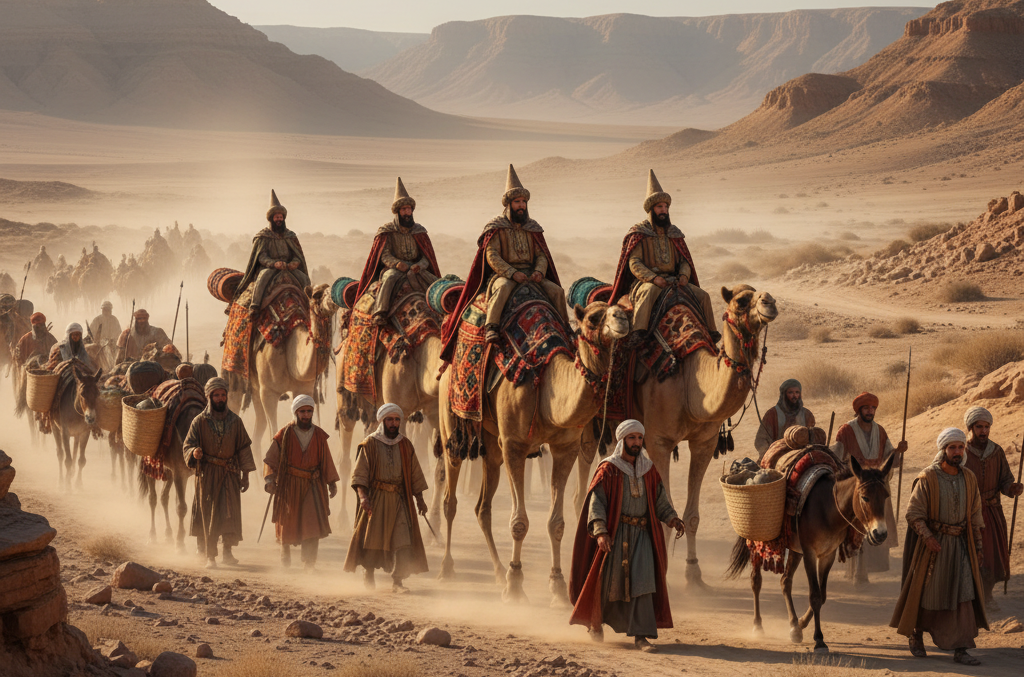
We must also recall that the biblical text nowhere says that these Magi were kings. Neither does it give their number or their names. Matthew simply mentions that they offered gold, frankincense and myrrh (Matthew 2.11). The fact that there are three gifts does not necessarily imply that there were three visitors. They could have been more numerous, accompanied by servants or a caravan. On this point, tradition has embroidered far beyond what Scripture says.

It was gradually, in the history of the Church, that these Magi came to be presented as kings, then were given the number three, and finally names such as Melchior, Caspar and Balthazar. But all this belongs to tradition and not to the text of Matthew. We must therefore carefully distinguish the biblical account from its legendary developments. These additions must not lead us to reject the Gospel text as a fable; they invite us rather to return to the sobriety of the biblical testimony.

The simplest historical reality is therefore the following: Matthew speaks of learned men from the East, probably versed in the observation of the sky, who saw an extraordinary sign, interpreted it as announcing the birth of a king, and then went to Judea to pay him homage (Matthew 2.1-2). Having come to the child, they bow down before him and offer him gifts (Matthew 2.11). This gesture carries strong symbolic weight: it expresses the recognition of the royal dignity of Jesus. Several Christian readers also see in it an echo of prophecies such as (Psalms 72.10-11) and (Isaiah 60.6), where nations come to bring riches to the king promised by God.

In Matthew's argument, the presence of these visitors from the East is therefore not an anecdotal detail. It serves to show that Jesus is an extraordinary child: he is the royal Messiah, recognized not only by Jews, but already by pagans from afar. While Jerusalem and Herod are troubled (Matthew 2.3), these foreigners discern the greatness of the child. The contrast is strong and intentional.

We thus understand why Mark, Luke and John, each pursuing a theological project of his own, did not consider it necessary to report this episode. The absence of this account in the other Gospels does not invalidate it; it simply shows that each evangelist selected certain events to serve his purpose (John 20.30-31).

Finally, it is true that in antiquity kings willingly surrounded themselves with wise men, advisers and observers of the stars to help them in their decisions. Matthew's account therefore fits into a credible historical context. But the essential point is not to praise their knowledge. The central point is that, by means suited to their culture and their quest, God led them to Jesus. Matthew thus wants to show that Christ is worthy of being sought, worshipped and honored by all peoples (Matthew 28.19).
IV. Where did these Magi come from?

In the biblical text we have only the indication given by Matthew: "Magi from the East" (Matthew 2.1). This mention remains deliberately vague and does not allow us to identify with certainty their city of origin. Christian tradition often thinks of Babylon, but ancient testimonies indicate that in the 1st century BC the Greek geographer Strabo found the site largely deserted. Other important urban centers did, however, exist in this vast region.

Here is a rewritten version, more structured and consistent with your intention — integrating your hypothesis about Ctesiphon without imposing it as an established fact:

At that time, the whole of Mesopotamian East belonged to the Parthian Empire. The "wise men of the East" mentioned by Matthew therefore most probably came, according to our interpretation, from this vast territory. They are often associated with Persia, present-day Iran, whose official name was replaced by "Iran" only in 1934, by decree of Shah Reza Pahlavi. However, it is more plausible that they came from the Mesopotamian region, around present-day Baghdad, and more precisely from Ctesiphon, then the royal capital of the Parthians and a great intellectual center. This location fits better with the historical context and the scientific importance of these scholars.

The Parthian sovereign reigning at that time was Phraates IV, who ruled for thirty-six years. His son Phraataces, born of his union with an Italian slave who became queen, Musa, succeeded him and reigned from -AD 2 to 4. The territory remained Parthian, but diplomatic agreements with Rome and the emperor Augustus ensured a certain political stability.

The Magi in whom we are interested were most probably high-ranking advisers at the court of Phraates IV. Now, in the very year in which we place their journey, -2 BC, Phraates IV died, probably assassinated, and power passed to his son Phraates V and to his mother Musa, who ruled jointly.

Such a political upheaval almost inevitably leads to the sidelining of the sovereign's closest advisers. In this context, it is reasonable to think that these scholars, tied to the former king, distanced themselves from the new power. This situation very probably made their departure and prolonged absence easier, making it entirely plausible that they could undertake a journey of several months without particular difficulty.

Let us note finally that, according to the Law of Moses, every occult or divinatory practice was strictly forbidden in Israel (Leviticus 19.31; Leviticus 20.27). This framework therefore rules out the idea that the Magi were diviners. They were rather high-ranking scholars in the service of the Parthian authorities, and notably of King Phraates IV. The fact that God reveals himself to foreign scholars, coming from a milieu where the observation of the stars was part of the scientific culture, all the more highlights the universal scope of the birth of the Messiah.

&nbsThe extraordinary story of Phraates IV and Musa

In view of the geopolitical situation of the time, it was relatively easy to travel from Mesopotamia to the land of Israel. However, the roads remained dangerous: many bands of brigands, more or less organized, were active in the region. Some even maintained tacit arrangements with corrupt officials, seeking to disrupt trade with the East. This context explains why it was important for any traveler to move in a group to ensure his own safety — a reality well known in the Bible itself, where the roads of the Near East are often described as perilous (Luke 10.30).

The royal residence of the Parthians was very probably at Ctesiphon, located about 35 km southwest of present-day Baghdad. This city, the political capital and major intellectual center of the Parthian empire, is a plausible point of origin for the Magi. If they did indeed come from this Mesopotamian region, their journey to Judea could have lasted several months, about six according to the most common estimates, which fits well with the time frame suggested by Herod when he questions the Magi about the appearance of the star (Matthew 2.7).

As for the route they took, it is reasonable to think that they followed one of the great caravan roads linking Ctesiphon to Syria, then to Jerusalem. This hypothesis agrees with the role of Ctesiphon as an administrative and scientific center, where many scholars worked in the service of Parthian power.

It should nevertheless be recalled that these reconstructions, although supported by solid historical and geopolitical data, remain partly speculative. They nonetheless offer valuable insight into the probable context in which the Magi mentioned in the Gospel of Matthew lived, and into the symbolic significance of their coming to the Messiah.

IV. The discovery of the Magi

The Magi, while observing the sky, noticed the appearance of an unusual luminous phenomenon, which Matthew calls a star (Matthew 2.1-2). Even today, it remains difficult to understand with certainty how they established a link between this heavenly manifestation and the birth of a royal figure in Israel. Yet the fact remains: this discovery led them to undertake a long, costly and risky journey, probably of several months.

Such an expedition implies that these men were not mere observers of the sky. They must have belonged to a learned elite, doubtless linked to power, having at once considerable resources, a certain prestige and an unusual freedom of movement. The cost of the journey, the length of their absence and the value of their gifts show that they were considerable figures. The gifts they brought — gold, frankincense and myrrh — were not modest tokens of courtesy, but presents worthy of a king (Matthew 2.11).

One may therefore ask whether these gifts came solely from their personal fortune or whether they had also received the support of the authorities of their country. This hypothesis is not impossible. The Parthian political context of the time seems to have undergone major upheavals, and it is conceivable that a change of government allowed certain scholars or advisers to devote themselves more freely to their research. In this perspective, their departure could have been tolerated, even supported. It remains a hypothesis, but it reminds us that Matthew's account fits into a plausible historical setting.

The most astonishing point nevertheless remains the interpretation they gave of this star. Why did they see in it the sign of the birth of a king of the Jews? Arriving in Jerusalem, they indeed asked: "Where is he who has been born king of the Jews?" (Matthew 2.2). Their question shows that they were unaware neither of the existence of Herod the Great nor of the political importance of the region. They probably first thought of the birth of a royal heir. Yet their approach reveals that they sensed something greater than a mere princely birth.

Several explanations can be put forward, though none can be demonstrated with certainty.

The first is that of a supernatural revelation. The Gospel according to Matthew indeed reports that, later, the Magi were divinely warned in a dream not to return to Herod (Matthew 2.12). If God spoke to them at that moment, it is not impossible that he also enlightened them at the beginning of their journey. This explanation agrees with the logic of the biblical account, in which God can reveal himself to non-Jews to accomplish his purpose.

The second hypothesis is that of contact with the Jewish communities established in the East. Since the successive deportations, many Jews had remained outside the land of Israel, notably in Mesopotamia and the neighboring regions. They had founded communities devoted to their faith and to the messianic hope. The Magi may therefore have heard of the prophecies announcing the coming of a king, of a Messiah promised by God (Isaiah 9.6-7) (Micah 5.2). This possibility is a serious one. However, if this information came directly from the Jews of the diaspora, one may be surprised that the Magi do not seem to know the precise place of birth from the outset. Indeed, the religious leaders consulted by Herod cite Bethlehem without hesitation, in accordance with the prophecy of Micah (Matthew 2.4-6) (Micah 5.2).

The third hypothesis rests on their own reading of the sky. The Magi were probably Eastern scholars, specialists in the observation of the stars and their symbolic interpretation. In ancient cultures, certain heavenly bodies were associated with ideas of kingship, fertility or national power. If a particularly rare phenomenon occurred, they may have understood it as the announcement of the birth of a king in Israel. Without being able to affirm it with certainty, this reading fits well with the profile of these men: they scrutinize signs, interpret events and draw conclusions from them.

Moreover, it is not necessary to set these explanations completely against one another. The Magi may have been influenced at once by their astronomical knowledge, by Jewish traditions known in the East and by a direct intervention of God. Matthew's account precisely lets this convergence appear: a sign in the sky, a sincere search, the consultation of the Scriptures, then a more precise divine guidance (Matthew 2.1-12).

Their coming also has an important theological significance. These men from the East recognize in Jesus a king worthy of worship, even while Jerusalem and Herod show themselves troubled or hostile (Matthew 2.3) (Matthew 2.11). Matthew thus stresses, from the very beginning of his Gospel, that Christ is not destined only for Israel, but that he also draws the nations. This idea joins other biblical texts announcing that peoples would come to the light of God and bring their riches (Isaiah 60.1-6) (Psalms 72.10-11).

Ultimately, we do not have enough evidence to reconstruct in detail the exact motivations of the Magi. Many points remain hypothetical: the precise nature of the star, their exact status, the origin of their gifts, or the way they understood the meaning of this sign. Nevertheless, the whole account remains coherent: Eastern scholars perceive an extraordinary sign, set out with royal gifts, seek the king of the Jews, then discover in Jesus far more than a mere earthly heir (Matthew 2.1-11).

The most likely explanation is that they first understood that an important king had just been born, without immediately grasping the full extent of the event. It was perhaps only on arriving there, through the Scriptures, the guidance of the star and the experience of worship, that they understood that they stood before him whose kingship surpassed all human expectations (Matthew 2.9-11).

V. Our theory

In the study of the account of the Magi, it is reasonable to suppose that they possessed a certain knowledge of Jewish culture, probably acquired through the historical contacts between the East and the scattered Jewish communities. However, had they really consulted Jewish wise men before their departure, they would quickly have learned that the Messiah was to be born in Bethlehem, in accordance with the prophecy of Micah (Micah 5.2). The fact that they go first to Jerusalem and have to question the local authorities clearly shows that they did not have this information.

Moreover, their initial approach — scanning the sky to discern a sign in it — does not correspond to traditional Jewish practices. The observation of the stars was often associated with divination, a practice condemned in the (Deuteronomy 18.10-12). This does not mean that all astronomical observation was forbidden, but it shows that their approach did not come from Judaism. Their method reflects rather the astrological and astronomical knowledge of the ancient East.

A supernatural revelation remains conceivable, especially since God warns them in a dream not to return to Herod (Matthew 2.12). However, nothing indicates that their decision to leave for Judea rests solely on a vision or a divine word. Such an expedition would have required a more structured motivation, probably tied to their interpretation of an exceptional heavenly phenomenon.

The most coherent hypothesis is that they observed an astral configuration symbolizing motherhood, fatherhood and kingship, accompanied by the appearance of a new star. In their culture, such signs could announce the birth of a great king. Their approach is therefore part of a symbolic reading of the sky, not a practice of divination in the biblical sense of the term. They may have consulted local authorities or Jewish wise men once they arrived in Judea, but their primary conviction rested on their own skills as astronomer-astrologers.

It is even possible that they first thought of the birth of an heir of Herod, unaware of the king's declining health and of the imminent political instability. Their journey westward, probably accompanied by a caravan to ensure their safety and transport their goods, is then explained as a diplomatic or scientific mission, rather than a religious pilgrimage.

The death of their sovereign, followed by a political change in their country, may have facilitated their departure and explain the length of their absence. Although it is unlikely that they took their families with them, their expedition doubtless had an official character, engaging their status and their responsibilities.

Thus, this journey appears as a major undertaking, motivated by the interpretation of an exceptional heavenly phenomenon and not by a late legend. Their presence in Jerusalem, then in Bethlehem, bears witness to a sincere search and to an approach consistent with the knowledge and practices of their time. And it is precisely this approach that God uses to lead them to the child, thereby fulfilling the Scriptures (Matthew 2.1-11).

VII. The arrival of the Magi in Jerusalem

When the Magi arrive in Jerusalem, the royal city, they question the inhabitants in search of information about the birth of a king, naturally thinking that this major event could not have escaped public attention. King Herod, alerted to their quest by his spies, then consults the Jewish religious authorities. The prediction of a king is no surprise to them, and they even reveal the expected birthplace of this king, Bethlehem.

Although Jerusalem is already in turmoil as a result of the Magi's inquiries, Herod chooses to summon them secretly. This choice is explained by his wish not to lend further legitimacy to the rumor nor to risk a popular uprising.

For Herod, the only legitimate sovereign of Israel, it is important to minimize the impact of this news and to prevent the population from linking this child to the Messiah awaited by the Jews. A popular uprising, fueled by messianic hope, represents a danger to his position.

Thus, Herod provides the Magi with the information needed to locate Bethlehem, but does so discreetly so as not to encourage the idea of a potential rival to the throne. Bethlehem, less populated and more affordable than Jerusalem during a feast, seems a logical place for Jesus' family to find refuge, especially as they have roots there. At this time, all the pilgrims have gone home and life has resumed its normal pace.

However, the reaction of the Jewish religious authorities seems surprisingly moderate in the face of such momentous news. Their lack of enthusiasm or interest in this event raises questions.

The Magi, seeing that the star continues to shine above them, understand that they are close to their destination. They probably set up camp on the outskirts of Jerusalem or perhaps near Herodium, where the sumptuous palace of King Herod the Great is located.

The next day, armed with the information obtained from Herod, they go to Bethlehem and begin a search similar to the one they had carried out in Jerusalem. In this small village, it is not hard to find a family with an infant, which finally leads them to Jesus.

VII. Herod, a naive king?

The question of whether Herod showed naivety in his handling of the visit of the Magi deserves careful analysis. It is clear that Herod did not take seriously enough the information brought by the Magi, nor even the interpretation of the Jewish wise men concerning the birth of the Messiah in Bethlehem. This underestimation led to a lack of immediate reaction on his part and on that of the Jewish religious authorities.

Herod chose not to send spies or soldiers to Bethlehem to verify this information. This decision seems guided by several factors. On the one hand, he did not want to give importance to the rumor of a potential new king, for fear of stirring up unrest among a population already agitated by messianic hope. On the other hand, it is probable that Herod was preoccupied with more pressing problems, notably his declining health and the questions surrounding his succession.

As for the Jewish wise men, their lack of reaction to the news brought by the Magi is also surprising. Despite their expectation of a Messiah, they did not think it necessary to go to Bethlehem to verify these statements, perhaps doubting the credibility of foreign sources.

Herod therefore decided to bide his time, awaiting the return of the Magi for further information. This lack of immediate reaction seems to be a combination of skepticism, personal concerns, and a strategy aimed at minimizing the impact of the news.

Regarding the place of the interview between Herod and the Magi, Matthew gives no specific details. It is possible that this interview took place either at Herodium or at the Antonia fortress in Jerusalem. Herodium, located about 12 km south of Jerusalem, is a plausible place for such a meeting, especially if Herod resided there after the festivities of Tabernacles. However, in the absence of details from Matthew, this location remains hypothetical.

VIII. A time of surprises

The surprise of the Magi at the lack of general knowledge, in Jerusalem, of the birth of a king is indeed notable. Their expectation of a spectacular royal birth contrasts sharply with the modest reality of the house where they find Jesus.

King Herod, residing at Herodium, an artificial hill located about 6.4 km southeast of Bethlehem and 12 km south of Jerusalem, also had apartments in the Antonia fortress in Jerusalem. These luxurious residences contrast sharply with the simplicity of the house where Joseph, Mary and the child Jesus lived in Bethlehem. The Magi, accustomed to the grandeur of royal palaces, are therefore surprised by the simplicity of the place.

This surprise is shared by Joseph and Mary, who did not expect to receive a visit from such eminent figures. The exchange between the Magi and the family of Jesus, presumably in Aramaic, reveals to each the extraordinary nature of the event. The Magi, who find no outward sign of royalty in the child, must rethink their expectations and their beliefs in the face of the simplicity of the scene. This realization could be attributed to a divine revelation that would have convinced them of the royal nature of Jesus.

The idea that Mary was the of Matthew's information concerning the story of the Magi is plausible, although this point cannot be confirmed categorically. This assumes that Mary shared with Matthew the account of the visit of the Magi, thus enriching the Gospel narrative with details that could only be known by those who had lived through these events.

In conclusion, the account of the Magi in the Gospel of Matthew underlines the difference between human expectations of kingship and the reality of the Messiah's birth in simplicity, a recurring theme in the teachings of the New Testament.

IX. The dream of the Magi

The Magi, having spent a few days in Bethlehem, face a sudden change of plans. As Matthew reports, they are warned in a dream not to return to Herod, an instruction they take very seriously.

This night-time warning, though described simply as a dream, seems to carry a divine message. Matthew does not explicitly mention an angel as the messenger in this dream, unlike the accounts of Joseph's dreams. However, the importance the Magi attach to this dream suggests a supernatural or divine origin.

The immediate reaction of the Magi to this dream reveals their understanding of Herod's malicious intentions, a king whose reputation for cruelty was already known. Sharing this dream with Mary and Joseph triggers a legitimate concern, although they cannot anticipate the extent of the violence that was to follow Herod.

X. The return of the Magi

The Magi, having decided not to pass back through Jerusalem or Herodium, opt for an alternative route for their return, thus avoiding drawing attention to their passage. This increased caution shows their awareness of the potential dangers after having been warned in a dream.

These foreign scholars, despite their status as pagans, not only identified but also honored the King of the Jews, thereby demonstrating a deep understanding of the significance of their discovery. Their worship and their gifts reflect an unshakable certainty about the royal nature of Jesus.

What remains particularly striking is that it was foreigners, and not the Jewish wise men or religious leaders, who recognized and celebrated the coming of the Messiah. This irony underlines a central theme of the New Testament, where divine revelation often transcends ethnic and cultural boundaries.

As for the star that guided the Magi, Matthew gives no details about what became of it. It might still shine in the sky, or perhaps it served its one divine purpose. Nevertheless, it is reasonable to suppose that, once back in their region of origin, these Magi continued to follow the stars and to take an interest in the history of the Jews, in particular that of Jesus.

For Joseph, Mary and the child Jesus, the situation becomes tense following the news of the Magi's dream and their decision not to return to Herod. Aware of the imminent danger that King Herod represents, they must consider measures to ensure their safety. This tension suggests the imminence of crucial decisions for their safety.

Conclusion

The account of the Magi from the East, as reported by Matthew, is not a mere legendary anecdote designed to strengthen his argument. Had that been the case, his contemporaries, who knew the facts, would probably have discredited his account and, by extension, the whole Gospel that bears his name. Luke, although he does not mention this story in his own Gospel, does not contradict it either, supplying other complementary elements.

It seems plausible that the information concerning the visit of the Magi came directly from Mary herself. After the death and resurrection of Jesus, she would have understood the importance of sharing her story, no longer as a personal account, but as a testimony of universal value. This realization would have prompted Mary to share details that she had previously kept to herself, out of modesty or discretion.

The death and resurrection of Jesus may have shed light for Mary on the deep meaning of the events she had lived through, such as the angel's announcement, Simeon's prophecy, and the various visits she had received. These events, once perhaps perceived as isolated or mysterious, took on their full meaning in the light of the resurrection.

For Mary, sharing these experiences, including the visit of these scholars from the East, became essential in order to leave a lasting testimony. This visit, though it may seem anecdotal to Luke, Mark and John, takes on a particular importance for Matthew. In the gifts offered and in the worship of these notables, he sees an additional confirmation that Jesus is the Messiah and the King of the Jews.

In sum, it is crucial not to burden Matthew's account with fictitious marvels. Although the story told is extraordinary, it remains rooted in a real historical context, where reality often surpasses fiction.