

_21 The crowd, gathered in front of Pontius Pilate’s palace, demands the crucifixion. Matthew 27.22 ; Mark 14.11-15 ; Luke 23.23 ; John 19.15.
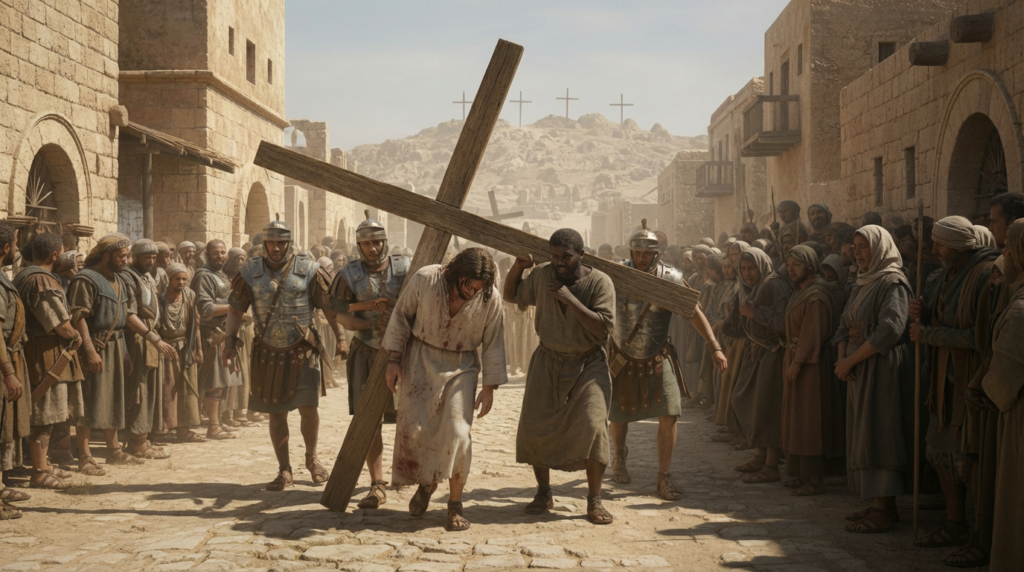
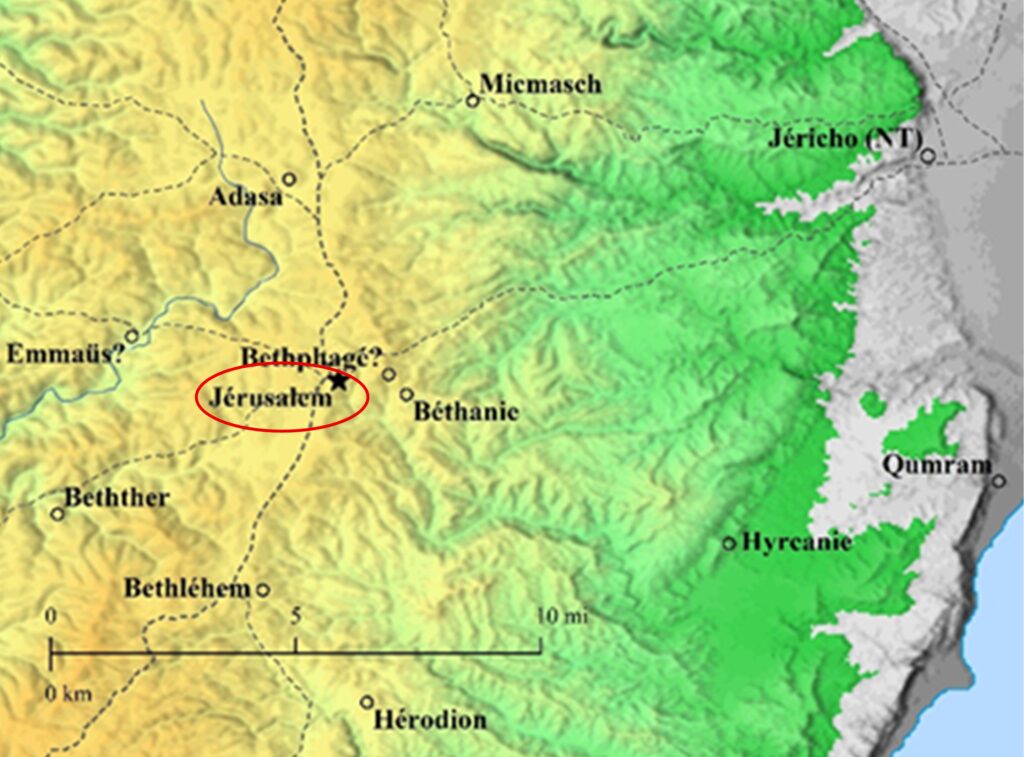
_22 The departure for Mount Golgotha begins before 9 a.m. Matthew 27.32 ; Mark 15.21-22 ; Luke 23.26-33 ; John 19.17.
_23 The placing on the cross therefore takes place around 9 a.m. according to Mark's text. The imprecision of the measurement allows for the time needed to travel to Mount Golgotha. Mark 15.20-41 ; Matthew 27.31-56 ; Luke 23.26-49 ; John 18.17-30.
You can consult the complete chronology in the study ANN026 : The hour of the crucifixion.
Commentary:
Weakened by the scourging, the lack of sleep and the intensity of the events he had lived through since Gethsemane, Jesus can no longer carry the patibulum alone, as Roman practice nevertheless required (Matthew 27.32). His physical condition bears witness to the violence he has already suffered, but also to the endurance he will show all the way to the cross. The soldiers then requisition Simon of Cyrene to carry the cross in his place (Mark 15.21 ; Luke 23.26). Mark mentions that he is the father of Alexander and Rufus, which suggests that these names were known to the early Christian communities, pointing to a direct testimony or a later integration into the Church (Mark 15.21).
Luke alone reports the presence of a large crowd, notably women who weep and lament over Jesus (Luke 23.27). This detail underlines that, despite the hostility of the authorities, part of the people remains moved by what is unfolding. Matthew mentions that a drink mixed with gall is offered to Jesus, probably to ease the pain, but that he refuses it (Matthew 27.34). This refusal shows that he faces suffering fully, without seeking to lessen its intensity.
This journey to Golgotha, although relatively short, is an ordeal in itself. The condemned man, already weakened, must walk under compulsion, exposed to the gaze of a crowd for whom such executions are often a public spectacle. The crucifixion remains inevitable, and every effort is made to bring the condemned man to the place of execution. Thus, these combined elements, compulsion, physical suffering, Simon’s intervention and the reactions of the crowd, highlight the harshness of this road and the human reality of this moment preceding the crucifixion.