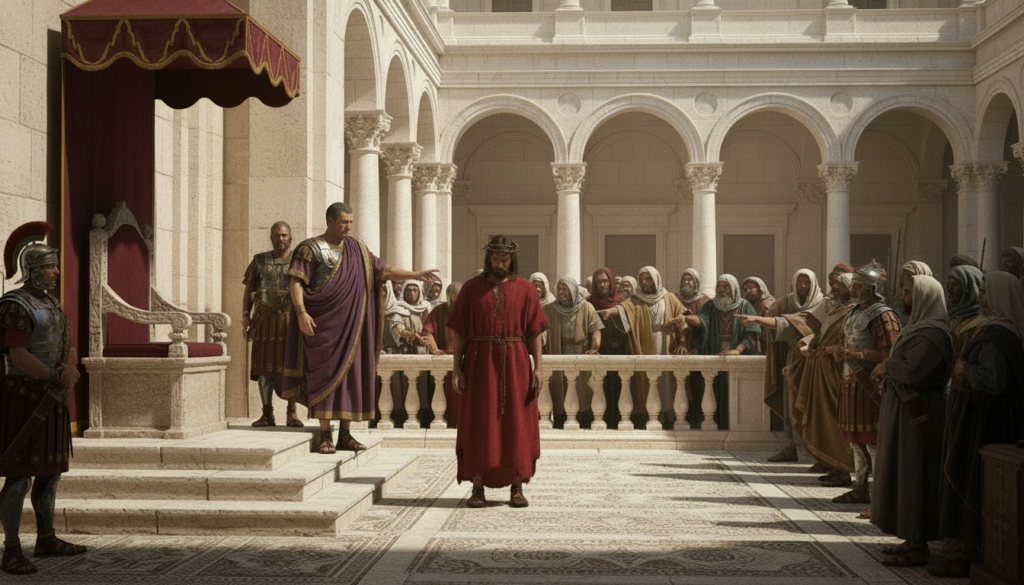


_20 The return to Pontius Pilate takes place around 8 a.m. Mark 15.6-19; Matthew 27.15-30; Luke 23.13-25; John 18.39-40; John 19.1-16.
_21 The crowd, gathered in front of the palace of Pontius Pilate, demands the crucifixion. Matthew 27.22 ; Mark 14.11-15 ; Luke 23.23 ; John 19.15.
You can consult the complete chronology in the study ANN026 : The Hour of the Crucifixion.
Commentary:
Now Pilate comes out again to declare publicly that he finds no ground for condemning Jesus (John 19.4). By presenting him to the crowd after the flogging, crowned with thorns and wearing a robe of mockery, he seems to hope to stir up compassion and avoid a graver outcome (John 19.5). Yet this attempt fails: the chief priests and their supporters insistently demand the crucifixion (John 19.6).
Pilate then reaffirms that Jesus is not guilty, but the religious authorities invoke their law, according to which Jesus must die because he made himself the Son of God (John 19.7). This claim troubles Pilate even more, and he seeks to understand where Jesus comes from and who he is (John 19.8-9). Faced with Jesus’ silence, Pilate reminds him of his authority, but he receives in return a word that puts this power into perspective:
From then on, Pilate redoubles his efforts to release Jesus, but the religious leaders increase the pressure by brandishing a political argument: releasing Jesus would amount to opposing Caesar (John 19.12). This blackmail puts Pilate in a delicate position, in which his loyalty to the Empire is called into question.
Finally, Pilate yields to the pressure and presents Jesus, declaring: “Behold your King!” (John 19.14). The reaction is immediate: “Away with him, away with him, crucify him!” (John 19.15). By asking, “Shall I crucify your King?”, Pilate ironically underlines the responsibility of the religious leaders, who go so far as to disown any authority other than Caesar’s. This passage thus highlights the tension between truth and power, as well as the outcome of a process in which political and religious pressure prevails over acknowledged justice.