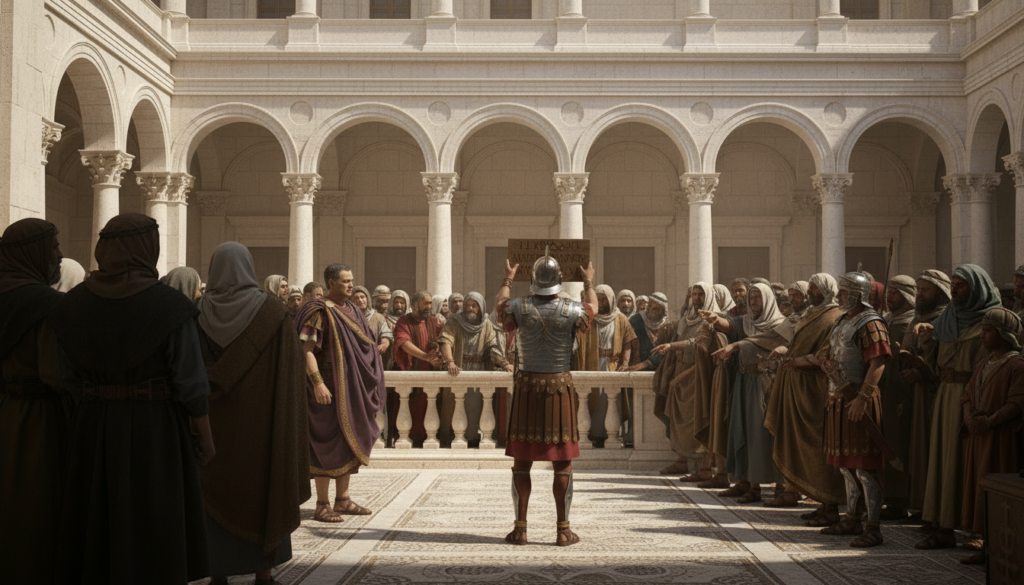


_21 The crowd, gathered in front of Pontius Pilate’s palace, demands the crucifixion. Matthew 27.22 ; Mark 14.11-15 ; Luke 23.23 ; John 19.15.
_22 The departure for Mount Golgotha begins before 9 a.m. Matthew 27.32 ; Mark 15.21-22 ; Luke 23.26-33 ; John 19.17.
_23 The placing on the cross therefore takes place around 9 a.m. according to Mark's text. The imprecision of the measurement allows for the time needed to travel to Mount Golgotha. Mark 15.20-41 ; Matthew 27.31-56 ; Luke 23.26-49 ; John 18.17-30.
You can consult the complete chronology in the study ANN026 : The hour of the crucifixion.
Commentary:
Pilate, evidently irritated by the pressure and the maneuvering of the leaders of the , uses the inscription of the titulus to assert his authority. According to Roman custom, the reason for the condemnation is indicated above the crucified man, and Pilate has this written: “Jesus of Nazareth, the King of the Jews” (John 19.19). This notice goes beyond the merely judicial framework: it takes on a political and provocative dimension.
The inscription is written in three languages — Hebrew (or Aramaic), Latin and Greek — so as to be understood by as many people as possible in a context of great crowds in Jerusalem (John 19.20). Thus the message is made public and accessible, which heightens its impact. By proclaiming Jesus “King of the Jews”, Pilate indirectly highlights the responsibility of the religious authorities for this condemnation.
The chief priests are not fooled and immediately contest the wording, asking that it be written: “He said: I am the King of the Jews” (John 19.21). Pilate refuses to change the text and answers firmly:
By this reply he imposes his decision and flatly rejects those who had nonetheless obtained the crucifixion from him.
This titulus thus becomes a form of tragic irony: in the eyes of the , Jesus is not presented as an ordinary criminal, but as a king. The soldiers themselves take up this idea by mocking him:
Behind this apparent mockery, the inscription underlines a truth that the authorities reject.
Finally, this decision of Pilate reveals both his annoyance and his limits. Although he yields on the condemnation, he retains here a form of authority by imposing this title. He has the last word on the inscription, but not on the outcome he would have wished, revealing all the ambiguity of his position in this trial.