

_21 The crowd, gathered in front of Pontius Pilate’s palace, demands the crucifixion. Matthew 27.22 ; Mark 14.11-15 ; Luke 23.23 ; John 19.15.
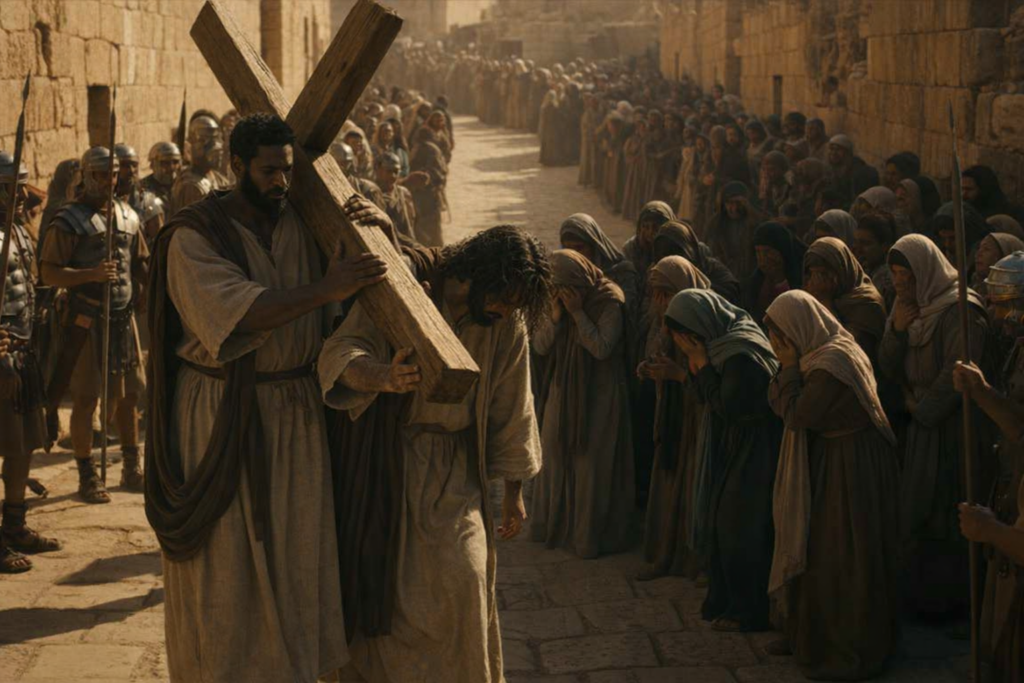
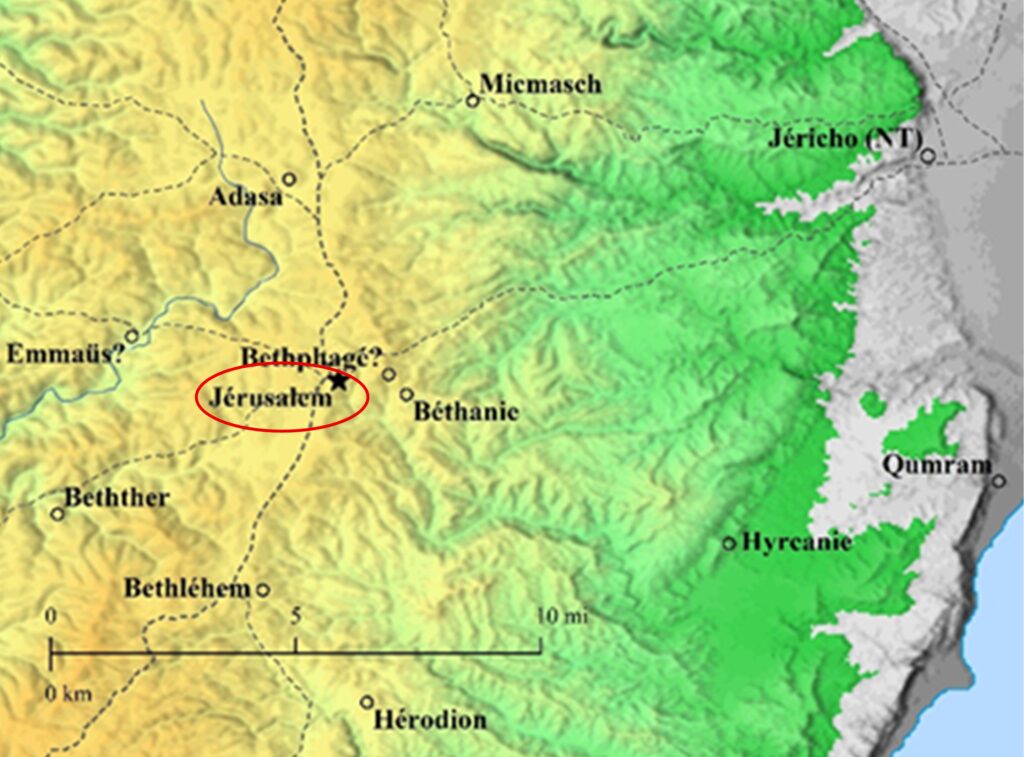
_22 The departure for Mount Golgotha begins before 9 a.m. Matthew 27.32 ; Mark 15.21-22 ; Luke 23.26-33 ; John 19.17.
_23 The placing on the cross therefore takes place around 9 a.m. according to Mark's text. The imprecision of the measurement allows for the time needed to travel to Mount Golgotha. Mark 15.20-41 ; Matthew 27.31-56 ; Luke 23.26-49 ; John 18.17-30.
You can consult the complete chronology in the study ANN026 : The hour of the crucifixion.
Commentary:
In this moment of extreme suffering, Jesus keeps a striking lucidity: he does not withdraw into himself but turns toward others. This attitude is consistent with his whole ministry, in which he comes to seek and to warn rather than to defend himself. Even on the way of the cross, he still speaks.
The “daughters of Jerusalem” can be understood in two ways: either as ordinary women of the people genuinely moved by the scene, or as the customary mourners of funeral processions. The two are not mutually exclusive. In Jewish tradition, women expressed mourning publicly (cf. Matthew 9.23). But here, Luke seems to stress a sincere emotion.
Luke is indeed the only evangelist to report this episode, which fits his particular attention to women and the marginalized (cf. Luke 8.2-3). He clearly places this saying during the climb to Golgotha, in the midst of a great crowd (cf. Luke 23.27).
Jesus then completely reverses the perspective:
He does not deny his suffering, but he announces that the real tragedy is yet to come. It is not his death that is the most tragic, but the judgment drawing near for Jerusalem.
The next words are very strong: “Blessed are the barren…” (cf. Luke 23.29). In a culture where motherhood is a blessing, this declaration is paradoxical. It announces a distress so great that having no children will be considered an advantage. A similar idea is found in the announcements of judgment in the Old Testament (cf. Hosea 10.8).
When Jesus speaks of those who will say “Fall on us” (cf. Luke 23.30), he directly takes up this prophetic language of catastrophe, associated with God’s judgment. This shows that what he announces goes beyond a mere political event: it is a major spiritual crisis.
Verse 31 is a key:
Jesus, innocent, is compared to the green wood. If he suffers such violence, what will become of a people who are spiritually “dry,” that is, hardened and lifeless? The image suggests an unavoidable and more severe judgment.
Historically, this saying finds a striking echo in the destruction of Jerusalem in AD 70, during the Jewish revolt against (cf. Luke 19.43-44). The city is besieged, famine rages, and the slaughter is terrible. Even though Masada (73) leaves its mark on people’s minds, it is above all the fall of Jerusalem that corresponds directly to this prophecy.
Finally, this passage shows that Jesus is not seeking human compassion for himself. Rather, he calls for repentance and awareness. This is not a scene of mere tragedy, but a prophetic warning: the rejection of the Messiah has profound consequences.
In the midst of his suffering, Jesus still speaks as a prophet, not to arouse pity, but to awaken consciences.