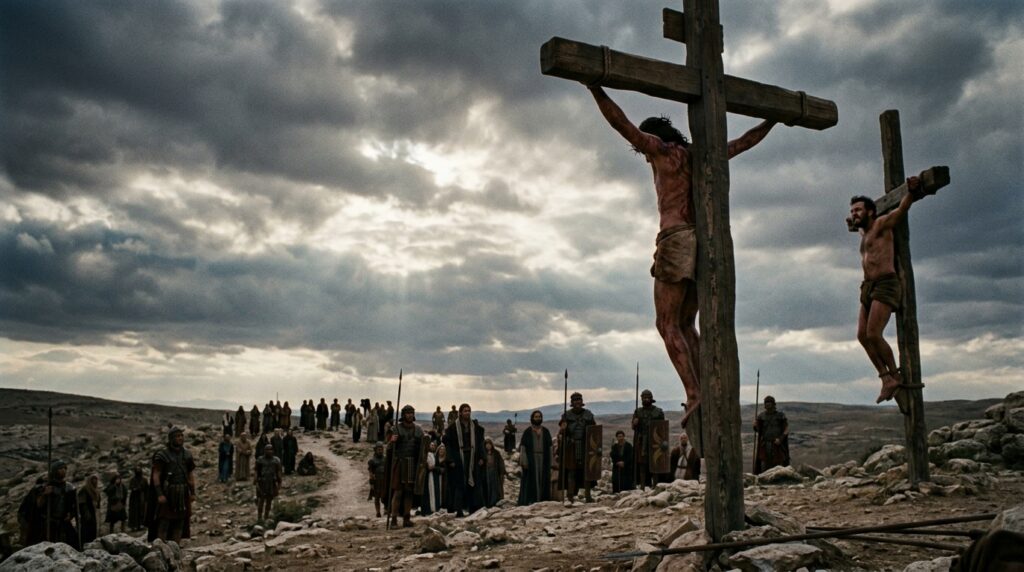

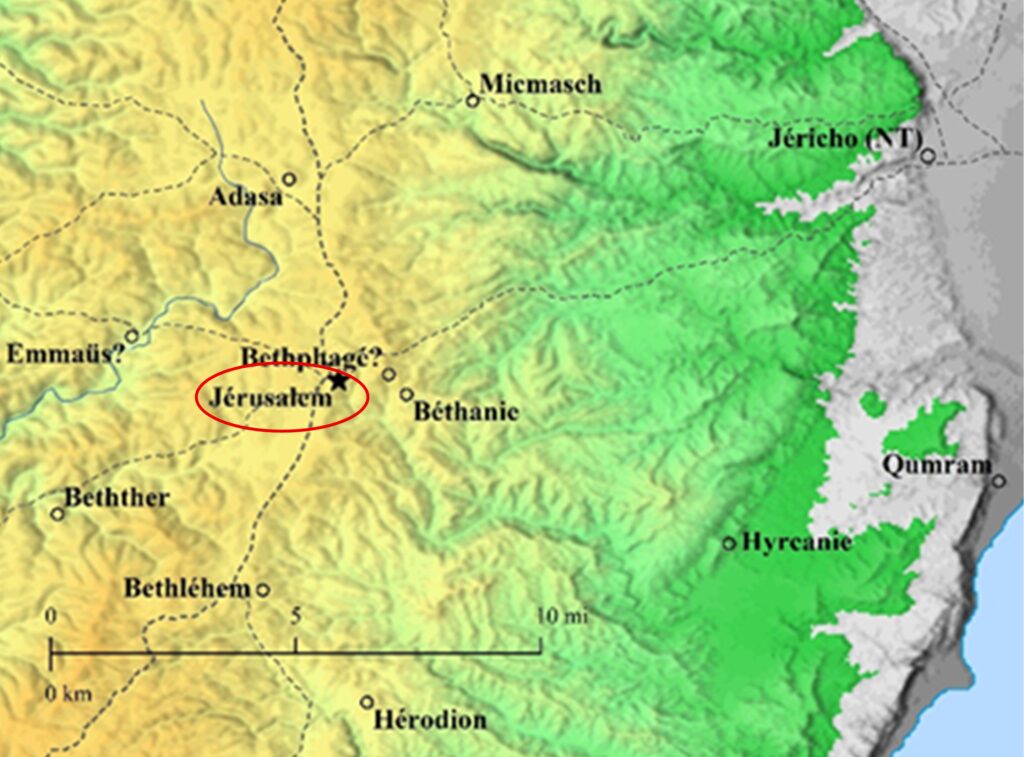

_23 The placing on the cross therefore takes place around 9 a.m. according to Mark's text. The imprecision of the measurement allows for the time needed to travel to Mount Golgotha. Mark 15.20-41 ; Matthew 27.31-56 ; Luke 23.26-49 ; John 18.17-30.
_24 All these members of the can now take part in the family Passover feast, rested in spirit after what they regard as a magnificent victory. But events are not going to unfold as they imagined!
You can consult the complete chronology in the study ANN026 : The hour of the crucifixion.
Commentary:
The other gospels do mention the presence of two criminals crucified with Jesus (cf. Matthew 27.38 ; Mark 15.27) and even specify that they join in the insults (cf. Matthew 27.44 ; Mark 15.32). But only Luke reports how the scene develops and brings to light a deeply moving dialogue (cf. Luke 23.39-43).
In the midst of a spectacle of extreme violence — bodies on display, public suffering, mockery — Luke introduces an unexpected word. One of the criminals persists in derision:
In reality, he is repeating the mockery he has heard all around him. His request is not faith but provocation: he expects a Messiah who would prove his power by escaping the cross.
The other criminal takes a radically different attitude. He rebukes his companion: “Do you not fear God…?” (cf. Luke 23.40). He first acknowledges his own guilt: “for us, it is just” (cf. Luke 23.41). Then he affirms the innocence of Jesus: “this man has done nothing wrong” (cf. Luke 23.41). In a few words, he expresses genuine repentance: acknowledgment of his fault, fear of God, and discernment about the person of Jesus.
His request is remarkable for its simplicity:
He does not ask to be delivered from the cross, but to be welcomed into the coming kingdom. This shows that he recognizes a king in Jesus, despite his apparent weakness. His faith shows itself precisely where everything seems to contradict this kingship.
Jesus' answer is immediate and solemn:
Even in the midst of suffering, Jesus speaks with authority. He does not point to a distant future: salvation is announced “today.” The word “paradise” evokes communion with God, a promise of life beyond death.
This passage reveals a striking contrast: two men, placed in the same situation, react in opposite ways, and their destinies diverge. One remains in refusal, the other opens himself to grace. The cross thus becomes a place where hearts are revealed.
Luke also brings out a central point: Jesus saves even though he seems unable to save himself. The mockers demand a visible demonstration of power; Jesus displays spiritual authority by offering salvation. It is precisely by remaining on the cross that he fulfills his mission.
Finally, this dialogue underlines that salvation depends neither on the past nor on works, but on trust placed in Jesus. This man, at the end of his life, with no possibility of making amends, nevertheless receives a full and immediate promise.