
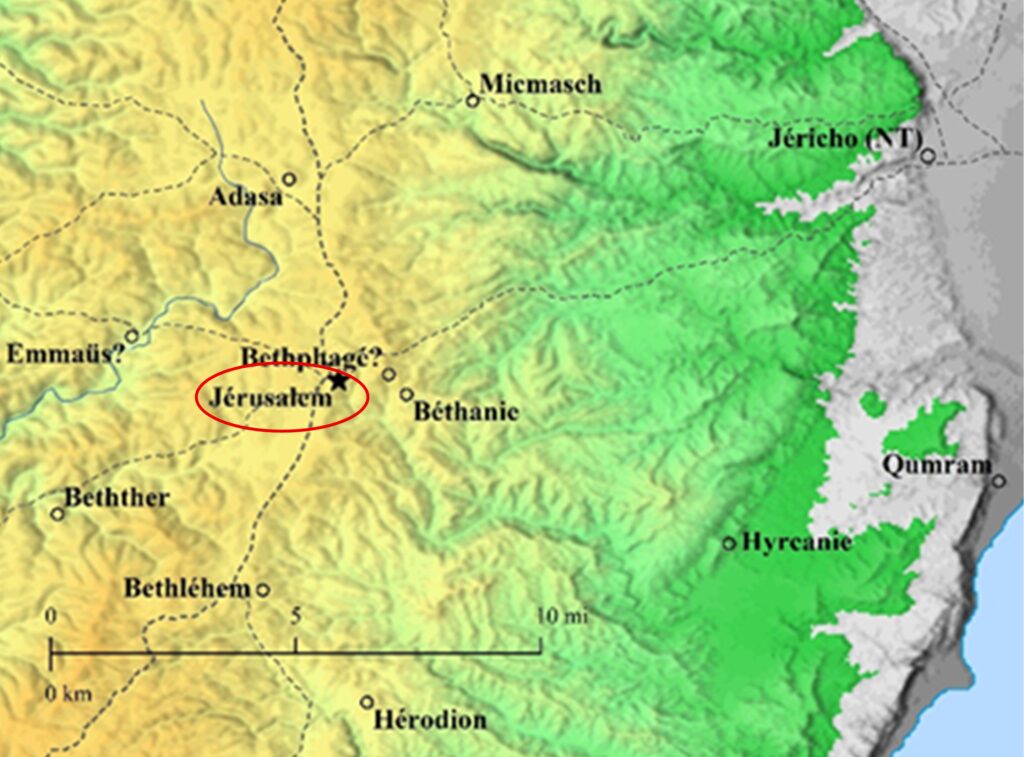

_23 The placing on the cross therefore takes place around 9 a.m. according to Mark's text. The imprecision of the time measurement makes it possible to fit in the travel time to Mount Golgotha. Mark 15.20-41 ; Matthew 27.31-56 ; Luke 23.26-49 ; John 18.17-30.
_24 All these members of the can now take part in the family Passover feast, rested in spirit after what they regard as a magnificent victory. But events will not unfold as they imagined!
You can consult the complete chronology in the study ANN026 : The Hour of the Crucifixion.
Commentary:
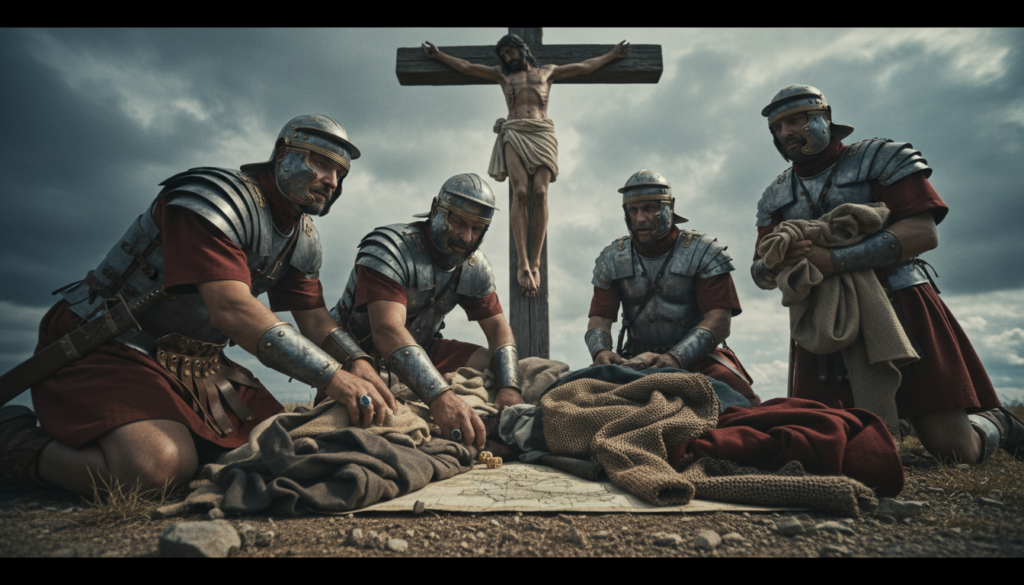
Traditional depictions often show Jesus covered with a cloth, but Roman practice indicates that crucified men were generally naked, which heightened the public humiliation. This nakedness is an integral part of the shame associated with crucifixion, a punishment designed to break dignity as much as the body.
All four Gospels mention the division of Jesus’ garments by the soldiers (cf. Matthew 27.35 ; Mark 15.24 ; Luke 23.34 ; John 19.23-24). This gesture, commonplace for soldiers, to whom the belongings of the condemned man fell, takes on a particular significance here. John specifies that the tunic, woven in one piece, is not torn but cast lots for (cf. John 19.23-24).
This detail explicitly fulfills the prophecy of Psalms 22.19, establishing a direct link between the suffering of the righteous man in the Old Testament and that of Jesus. Matthew also emphasizes this fulfillment (cf. Matthew 27.35). Thus, even in apparently insignificant actions, the Scriptures find their fulfillment.
John locates the crucifixion precisely: Jesus carries his cross to the place called Golgotha, “the place of the skull” (cf. John 19.17), where he is crucified between two other men (cf. John 19.18). This central position underscores both his identification with sinners and his unique place.
Luke reports an essential saying of Jesus: “Father, forgive them, for they do not know what they are doing” (cf. Luke 23.34). Even as he suffers injustice and violence, Jesus intercedes for his executioners. This saying reveals the depth of his love and gives the scene a spiritual meaning: the cross becomes a place of forgiveness.
Mark, for his part, highlights the cry of Jesus: “My God, my God, why have you forsaken me?” (cf. Mark 15.34). This saying, taken from Psalms 22.2, expresses real distress. It does not signify a definitive break with God, but shows the depth of the abandonment felt by the one who bears sin.
The scene is also marked by mockery and incomprehension (cf. Matthew 27.39-44). The passersby and the religious leaders challenge Jesus to save himself. Yet it is precisely because he does not come down from the cross that he fulfills his mission.
Finally, the presence of the women and of the disciple John (cf. John 19.25) introduces a striking contrast: in the face of the soldiers’ indifference or mockery, some remain faithful in suffering. Their gaze offers another reading of the event, more intimate and painful.
A tension runs through this whole passage: on one side, an ordinary scene of Roman crucifixion, marked by brutality and indifference; on the other, a unique event in which the Scriptures are fulfilled, forgiveness is offered, and the suffering of Jesus takes on a universal significance.