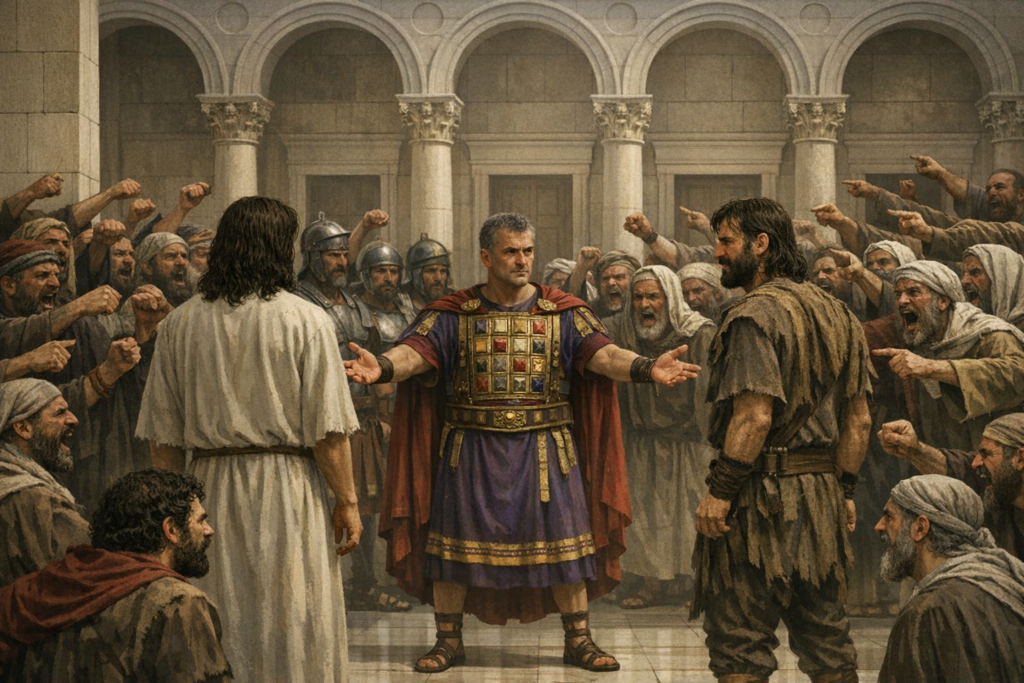


_20 The return to Pontius Pilate takes place around 8 a.m. Mark 15.6-19; Matthew 27.15-30; Luke 23.13-25; John 18.39-40; John 19.1-16.
_21 The crowd, gathered in front of the palace of Pontius Pilate, demands the crucifixion. Matthew 27.22 ; Mark 14.11-15 ; Luke 23.23 ; John 19.15.
You can consult the complete chronology in the study ANN026 : The Hour of the Crucifixion.
Commentary:
Pilate gradually finds himself trapped by the pressure of the crowd and the fear of public disorder. The leaders of the have maneuvered skillfully, and the sentence is finally pronounced:
All the events described by the Gospels seem to fall within a relatively short span of time, from the arrest to the condemnation. Without going back over the many irregularities of the trial in detail — a night-time judgment (Matthew 26.57-68), the use of false testimony (Mark 14.55-59), a hasty condemnation — it appears that only the result mattered: the elimination of Jesus.
Regarding John 19.14, the mention of “the preparation of the Passover” corresponds to the Jewish custom of calling Friday the day of preparation. The question of the “sixth hour” has given rise to various interpretations. Two main possibilities are considered: either John uses the system of hours, in which the day begins at midnight, which would place the event around 6 a.m.; or he uses the Jewish system, in which the sixth hour corresponds to noon, counting from sunrise (John 4.6). Some exegetes propose another approach, recalling that the Gospels often mention hours in multiples of three (Mark 15.25; Matthew 27.45), which could reflect an approximate division of the day into major periods. However, this explanation remains imprecise.
According to the concordant data, the crucifixion takes place from the third to the ninth hour, that is, approximately from 9 a.m. to 3 p.m. (Mark 15.25; Matthew 27.45). Thus, it is plausible that John places the appearance before Pilate early in the morning, at around 6 o'clock, shortly after Peter's denial and the crowing of the rooster (John 18.27-28).
The expression “about” also underlines the absence of absolute precision and refers rather to an observed time marker. In this context, the situation gradually slips out of Pilate's control. The crowd, stirred up by the religious leaders, becomes more and more hostile and demands crucifixion (Luke 23.21).
We present a detailed analysis of this information provided by John in appendix ANN026 : The Hour of the Crucifixion.
Fearing a riot and a denunciation to Caesar (John 19.12), Pilate finally yields. Behind this decision emerge both a political weakness and the strategic success of the , which manages to force the representative to pronounce a condemnation that he knew to be unjust (Luke 23.22).