

PER293

The questions of the foreigners to the Messiah Jesus

An episode unique to John (John 12.20-50), set on Holy Tuesday in the Court of the Gentiles. Some Greeks ask to see Jesus, which triggers the announcement of the hour of his glorification. Through the image of the grain of wheat, Jesus reveals that his death is the source of universal life. The cross is presented as a glorious lifting up that draws all people to him, opening salvation to all nations.

16 min foreigners’ questions Greeks at the Temple John 12 glorification of the Son grain of wheat 20 verses 2 books

Resources

Biblical texts

Matthew
Matthew (King James Version) not cited in the book
Mark
Mark (King James Version) not cited in the book
Luke
Luke (King James Version) not cited in the book
John
John 12.20-50 (King James Version)

And there were certain Greeks among them that came up to worship at the feast:

The same came therefore to Philip, which was of Bethsaida of Galilee, and desired him, saying, Sir, we would see Jesus.

Philip cometh and telleth Andrew: and again Andrew and Philip tell Jesus.

And Jesus answered them, saying, The hour is come, that the Son of man should be glorified.

Verily, verily, I say unto you, Except a corn of wheat fall into the ground and die, it abideth alone: but if it die, it bringeth forth much fruit.

He that loveth his life shall lose it; and he that hateth his life in this world shall keep it unto life eternal.

If any man serve me, let him follow me; and where I am, there shall also my servant be: if any man serve me, him will my Father honour.

Now is my soul troubled; and what shall I say? Father, save me from this hour: but for this cause came I unto this hour.

Father, glorify thy name. Then came there a voice from heaven, saying, I have both glorified it, and will glorify it again.

The people therefore, that stood by, and heard it, said that it thundered: others said, An angel spake to him.

Jesus answered and said, This voice came not because of me, but for your sakes.

Now is the judgment of this world: now shall the prince of this world be cast out.

And I, if I be lifted up from the earth, will draw all men unto me.

This he said, signifying what death he should die.

The people answered him, We have heard out of the law that Christ abideth for ever: and how sayest thou, The Son of man must be lifted up? who is this Son of man?

Then Jesus said unto them, Yet a little while is the light with you. Walk while ye have the light, lest darkness come upon you: for he that walketh in darkness knoweth not whither he goeth.

While ye have light, believe in the light, that ye may be the children of light. These things spake Jesus, and departed, and did hide himself from them.

But though he had done so many miracles before them, yet they believed not on him:

That the saying of Esaias the prophet might be fulfilled, which he spake, Lord, who hath believed our report? and to whom hath the arm of the Lord been revealed?

Therefore they could not believe, because that Esaias said again,

He hath blinded their eyes, and hardened their heart; that they should not see with their eyes, nor understand with their heart, and be converted, and I should heal them.

These things said Esaias, when he saw his glory, and spake of him.

Nevertheless among the chief rulers also many believed on him; but because of the Pharisees they did not confess him, lest they should be put out of the :

For they loved the praise of men more than the praise of God.

Jesus cried and said, He that believeth on me, believeth not on me, but on him that sent me.

And he that seeth me seeth him that sent me.

I am come a light into the world, that whosoever believeth on me should not abide in darkness.

And if any man hear my words, and believe not, I judge him not: for I came not to judge the world, but to save the world.

He that rejecteth me, and receiveth not my words, hath one that judgeth him: the word that I have spoken, the same shall judge him in the last day.

For I have not spoken of myself; but the Father which sent me, he gave me a commandment, what I should say, and what I should speak.

And I know that his commandment is life everlasting: whatsoever I speak therefore, even as the Father said unto me, so I speak.

Technical details

Year AD 33

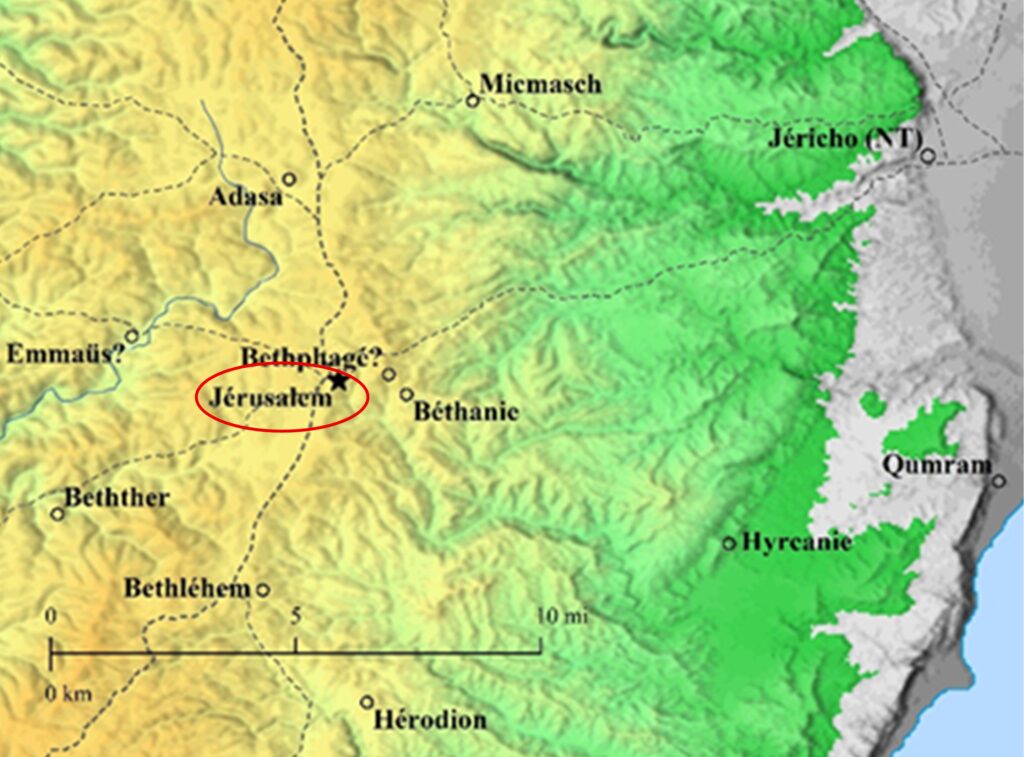
Location: The Court of the Gentiles of the Temple in Jerusalem

Date: Tuesday, March 29, AD 33

Method: We now return to John

Note on the method: John is the only one to relate this episode

Map of Jerusalem and its region
Bar graph Tuesday, March 29

Jesus the Messiah answers the questions of foreigners.

Comments

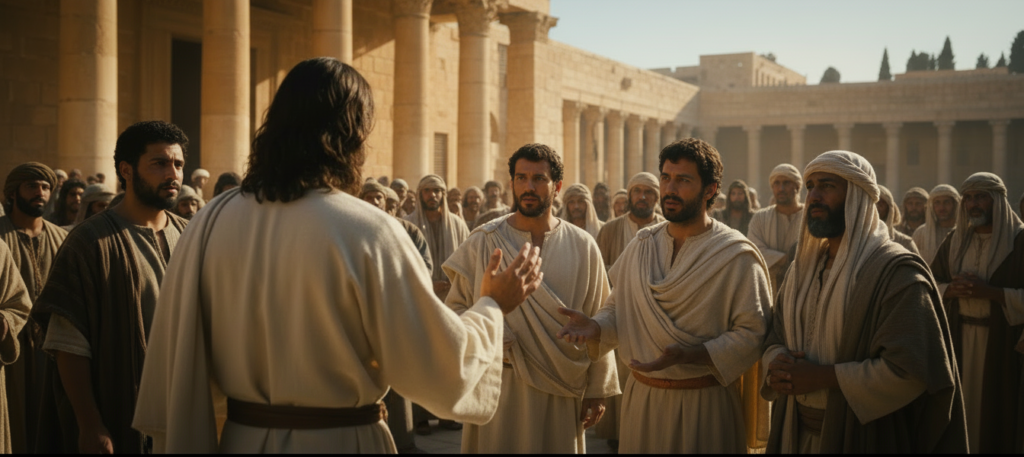
This scene, related by John alone, takes place in the Court of the Gentiles, because those questioning Jesus the Messiah are foreigners, most likely Greeks. They did not approach him directly, probably out of respect, but asked his disciples, and Philip in particular, for an interview.

John gives the detail that Philip came from in Galilee. This border village saw Jews and Gentiles living side by side, so Philip, whose name is Greek, was very much at ease with these non-Jews. It may even have been he who encouraged this contact.

The passage of John 12.20-50 marks a decisive turning point in the fourth Gospel. Set immediately after Jesus’ triumphal entry into Jerusalem, it forms the last public discourse before the Passion. The episode opens with the arrival of Greeks who came to worship during the feast (John 12.20-22), a singular and deeply symbolic detail: non-Jews approach the Messiah of Israel. The Gospel of John sees in this an announcement of the universal character of salvation, now open to all nations.

Their request — “We would like to see Jesus” — introduces a central declaration: “The hour has come for the Son of Man to be glorified” (John 12.23). Until then, Jesus had repeatedly said that his hour had not yet come (John 2.4; John 7.30; John 8.20). The arrival of the Greeks therefore marks the eschatological trigger: the time of glorification has come, that is, the hour of the cross, understood here as lifting up and revelation. In John, the cross is not merely an execution: it is the moment when the glory of God is manifested in the obedience of the Son (John 17.1).

Jesus illustrates this truth through the image of the grain of wheat (John 12.24). The grain must die in order to bear fruit: the death of Christ thus becomes the principle of life for the world. This agricultural theme expresses the mystery of the fruitfulness of sacrifice: it is only by falling into the earth, by surrendering to death, that divine life multiplies. The call of v. 25 extends this logic: whoever loves his life loses it, but whoever hates it in this world will keep it for eternal life. The disciple is invited to follow the same paradoxical path of renunciation and total trust.

In what follows (John 12.27-33), John introduces a dramatic scene in which Jesus, troubled, expresses his anguish at the approaching hour. This prayer recalls the Gethsemane episode reported by the Synoptics, but John sets it in public, not in a garden. The object of the prayer is not the avoidance of suffering, but the glorification of the Father’s name. A voice from heaven answers: “I have glorified it, and I will glorify it again.” This theophany recalls the baptism and the transfiguration, but here it takes on a soteriological dimension: the Father endorses the work of his Son.

The announcement of:

John 12.32 (King James Version) :
And I, if I be lifted up from the earth, will draw all men unto me.

It condenses the theological meaning of the passage. The lifting up (ἐψώθην) is at once crucifixion, resurrection and exaltation. John unites these three dimensions to present the cross as the glorious moment when Christ becomes the universal center of attraction. The expression “all people” echoes the coming of the Greeks: the cross is the gateway through which the whole world enters into salvation.

John 12.34-36 reports the reaction of the crowd, which remains captive to its earthly messianic expectations: how could the Messiah die, when the Scripture presents him as ? Jesus the Messiah does not answer directly, but invites them to believe in the light while it is still among them. This extends the Johannine themes of luminous revelation (cf. John 8.12): to refuse the light is to sink into darkness.

The final section (John 12.37-50) forms a theological conclusion to the public ministry. John comments there on Israel’s blindness before the signs. Despite the miracles, many do not believe, thus fulfilling the prophecy of Isaiah:

Isaiah 6.10 (King James Version) :
Make the heart of this people fat, and make their ears heavy, and shut their eyes; lest they see with their eyes, and hear with their ears, and understand with their heart, and convert, and be healed.

John 12.40 (King James Version) :
He hath blinded their eyes, and hardened their heart; that they should not see with their eyes, nor understand with their heart, and be converted, and I should heal them.

John insists on the spiritual responsibility of the refusal, but also on the mystery of the divine purpose. Some, however, do believe, notably among the rulers, but remain in fear of exclusion. This tension between timid faith and open unbelief illustrates the complexity of the relationship to Christ in the Gospel.

The discourse closes with a christological synthesis (John 12.44-50): to believe in Jesus is to believe in God who sent him. His mission is one of light: he came as a light into the world to save, not to judge (John 12.46-47, John 3.17). Judgment comes only in a second stage, as a consequence of rejecting the Word. The final revelation thus links faith, light and life: whoever receives Christ enters into the light, whoever rejects him excludes himself from life.

Conclusion

John 12.20-50 is a narrative and theological hinge. It is at once the end of the public ministry and the threshold of the Passion. The call of the Greeks symbolizes the opening of salvation to all nations; the cross is proclaimed as the true place of glory; and the people’s final response confronts everyone with the ultimate question: to believe or to refuse the light. In a few verses, this page concentrates the whole of Johannine theology: the glory of God is revealed in the love that gives itself even to death.