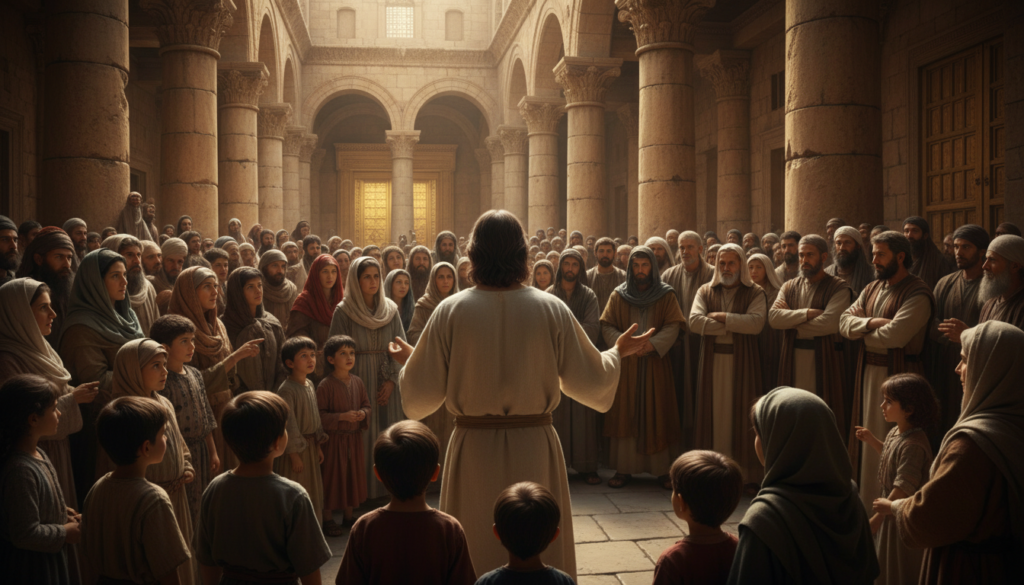


Even though the events described take place on a Monday, everything indicates that Jesus, the Messiah, and his disciples went to the Temple of Jerusalem every day. For them it was a central place, not only of prayer, but above all of teaching. There, in the midst of the crowds gathered for the feast of Passover, Jesus seized every opportunity to proclaim the good news of the Kingdom of God. Pilgrims came from every direction, and each one wanted to hear this man whose words touched souls and awakened the hope of a new world.
Luke, in his account, immediately stresses the reaction of the religious authorities. The chief priests, the scribes and the elders were deeply troubled. Their anger grew as Jesus’ influence increased. Fearing that they would lose their authority over the people, they kept looking for a way to silence him for good, even going so far as to consider putting him to death. But they hesitated, because the people, fascinated and attentive, hung on his every word. The crowds recognized in him a prophet, perhaps even more, and the leaders knew that a brutal arrest could provoke a riot.
Luke takes care, in his gospel, to explain who these different religious groups are: the scribes, specialists of the Law; the teachers, guardians of tradition; the , drawn from the priestly aristocracy; and the , zealous defenders of ritual purity. His concern comes from the fact that he is writing for a non-Jewish audience, unfamiliar with these distinctions.
Thus, two camps clearly take shape: on one side, the people, amazed and nourished by the words of the Messiah Jesus, finding in him a new light; on the other, the religious authorities, anxious and jealous, seeing in him a direct threat to their power and privileges. The atmosphere grows more and more tense, at the crossroads of the spiritual and the political, as the proclamation of the Kingdom of Heaven overturns the established order.