
It is therefore during this journey that we place the account of this of the minas proclaimed by the Messiah Jesus, precisely as he passed through Jericho.
PER272
The Parable of the Minas
This study deals with the parable of the minas in Luke 19.11-27, a story told by Jesus at Jericho, highlighting the period between Hanukkah and Passover. It examines the chronology of events in Jesus’ ministry, including his interactions with Lazarus, Bartimaeus and Zacchaeus.
5 min
parable
minas
Jericho
Jesus
1 verse
1 book
Resources
You can consult:
Biblical texts
Mark
Mark (King James Version) not cited in the book
Luke
Luke 19.11-27 (King James Version)
And as they heard these things, he added and spake a parable, because he was nigh to Jerusalem, and because they thought that the kingdom of God should immediately appear.
He said therefore, A certain nobleman went into a far country to receive for himself a kingdom, and to return.
And he called his ten servants, and delivered them ten pounds, and said unto them, Occupy till I come.
But his citizens hated him, and sent a message after him, saying, We will not have this man to reign over us.
And it came to pass, that when he was returned, having received the kingdom, then he commanded these servants to be called unto him, to whom he had given the money, that he might know how much every man had gained by trading.
Then came the first, saying, Lord, thy pound hath gained ten pounds.
And he said unto him, Well, thou good servant: because thou hast been faithful in a very little, have thou authority over ten cities.
And the second came, saying, Lord, thy pound hath gained five pounds.
And he said likewise to him, Be thou also over five cities.
And another came, saying, Lord, behold, here is thy pound, which I have kept laid up in a napkin:
For I feared thee, because thou art an austere man: thou takest up that thou layedst not down, and reapest that thou didst not sow.
And he saith unto him, Out of thine own mouth will I judge thee, thou wicked servant. Thou knewest that I was an austere man, taking up that I laid not down, and reaping that I did not sow:
Wherefore then gavest not thou my money into the bank, that at my coming I might have required mine own with usury?
And he said unto them that stood by, Take from him the pound, and give it to him that hath ten pounds.
(And they said unto him, Lord, he hath ten pounds.)
For I say unto you, That unto every one which hath shall be given; and from him that hath not, even that he hath shall be taken away from him.
But those mine enemies, which would not that I should reign over them, bring hither, and slay them before me.
King James Version (1769), domaine public — texte : eBible.org
John
John (King James Version) not cited in the book
Technical details

Location: In the city of Jericho
Date: February or early March AD 33
Method: We continue with Luke
Note on the method: Luke is the only one to report this
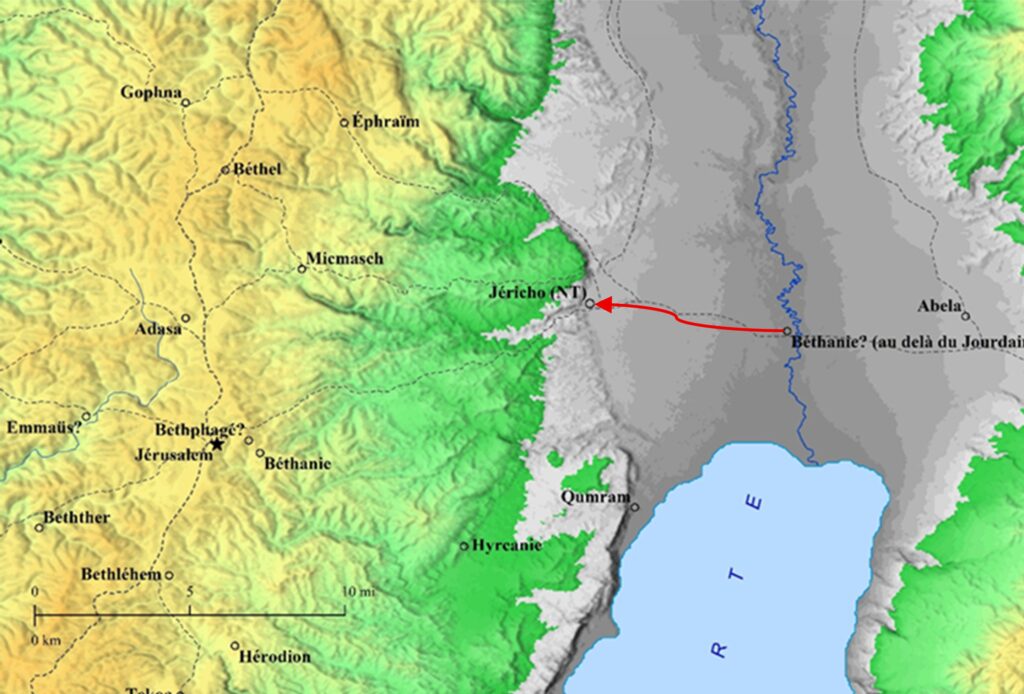
On arriving at Jericho, the Messiah Jesus addresses to the crowd a likely to raise many questions.
Chronology
Comments
The Messiah Jesus has just met Zacchaeus at Jericho. The crowd is still stunned by this mercy shown to a tax collector, and many imagine that the arrival in Jerusalem will immediately trigger the visible manifestation of God’s reign. It is precisely to correct this expectation that Jesus tells the .
The Messiah Jesus describes a man of noble birth who goes to a distant country to receive a kingdom. This image evokes both his own mission and a familiar historical context: some listeners may have thought of Archelaus, son of Herod, who had gone to to receive royal authority, despite the opposition of his fellow citizens. This allusion gives the a realistic color: a legitimate but contested king is away for a time before returning to exercise his authority.
The nobleman entrusts ten servants with an identical sum, one mina, and asks them to make that money bear fruit during his absence. The term used explicitly evokes the idea of investing, of trading, of taking initiative. Unlike the of the talents, where the amounts vary, here each receives exactly the same sum. Luke therefore stresses less the differing abilities than faithfulness in the same responsibility.
While the servants are at work, the citizens of the country send a delegation to oppose the nobleman’s kingship. Their refusal is categorical: they do not want him to reign over them. This hostility structures the : there are not only faithful or negligent servants, but also declared enemies.
When the king returns, he summons the servants to learn the results.
- The first has multiplied the mina tenfold. The king commends him and entrusts him with authority over ten cities.
- The second has multiplied the mina fivefold and receives five cities. The reward far exceeds the financial gain: faithfulness in a small matter opens the way to considerable political responsibility.
A third servant has done nothing. He explains that he was afraid, that he considers his master a hard, demanding man who reaps what he did not sow. The king judges him by his own words: if he really believed his master to be so demanding, he could at least have deposited the money in the bank to earn interest. His passivity is therefore inexcusable. The mina is taken from him and given to the one who has ten
The king states a principle: “To everyone who has, more will be given, but from the one who has nothing, even what he has will be taken away.” This is not injustice but an observation: fruitfulness calls for fruitfulness, whereas inaction leads to loss.
The ends abruptly: the king’s enemies, those who rejected his reign, are executed before him. This forceful image does not describe behavior to imitate, but underscores the gravity of rejecting the reign of God. It sets the patience of the time of waiting against the severity of the final judgment.
The teaches that:
- The reign of God does not manifest itself immediately; there is a time of waiting.
- During this apparent absence of the king, the disciples must be active, creative, responsible.
- Faithfulness, even in small things, prepares for a greater mission.
- Rejecting the reign of God is not neutral: it commits the person to an opposition that leads to judgment.
We offer detailed studies of the 42 parables proclaimed by the Messiah Jesus. You can therefore consult this information:
PAR040: The ten minas
PAR018: The talents.
?