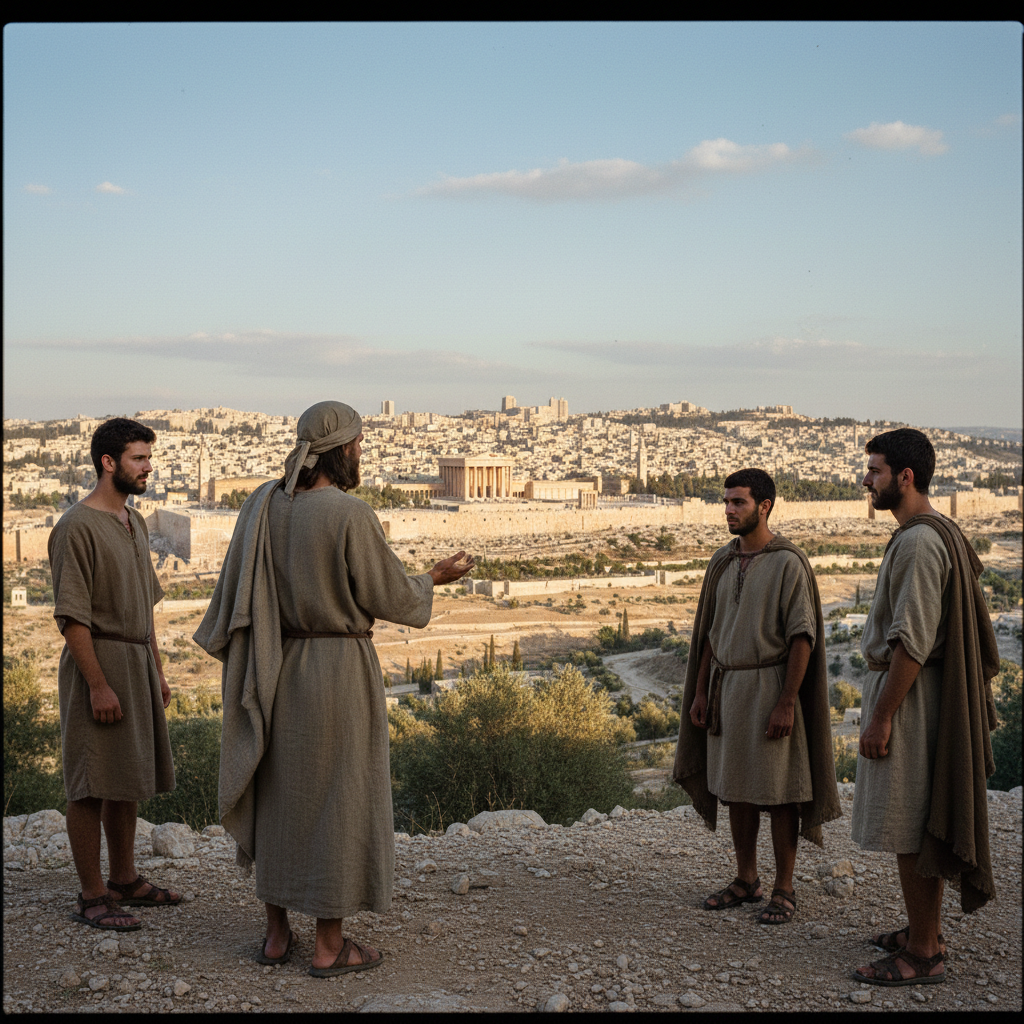

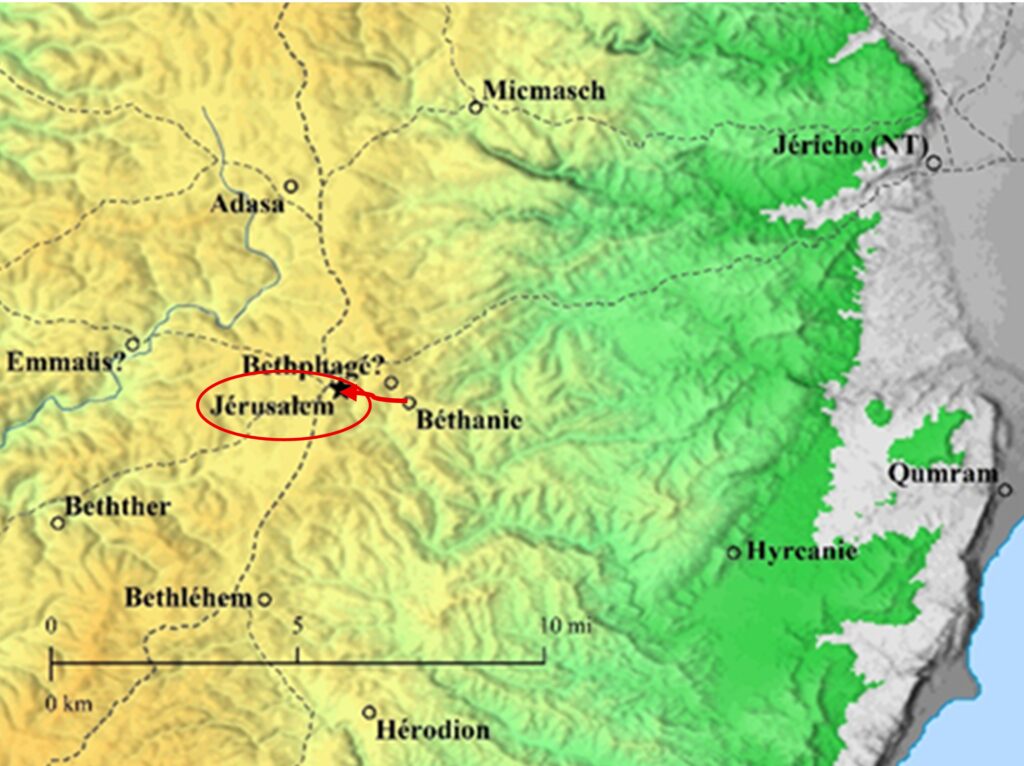

In Luke 19.41-44, the Messiah Jesus approaches Jerusalem, gazes at it and bursts into tears because he knows that the city has not recognized the visitation of God offered in his person, which reveals a deep spiritual incomprehension and a missed opportunity for peace.
He then foretells with precision the siege, the encirclement and the destruction that the will carry out in 70, showing that this judgment is not arbitrary but the tragic consequence of rejecting the Messiah.
This passage highlights both the compassion of the Messiah Jesus, who weeps sincerely over those who reject him, and the gravity of rejecting divine revelation. The other Gospels do not report this episode at the same point or in this form: Matthew and Mark announce the destruction of the Temple from the Temple esplanade, and Matthew contains a lament over Jerusalem in chapter 23, but only Luke places this scene on the road down from the and describes the tears of Jesus as he sees the city.
It is understandable that the Messiah Jesus may have repeated certain words on various occasions, in keeping with the context in which he was speaking.
Everything suggests that the twelve apostles are present, so that Judas Iscariot also listens to the Master. It seems hard to imagine that this apostle could have deceived those around him in this way, yet that is what actually happened. In such circumstances, how was it possible for him to go on with his life?
The Messiah Jesus, for his part, knows the nature of the events that are about to unfold.
Several elements in the Gospels show that the Messiah Jesus knew he was close to his death: he announces his passion several times, explaining that he is “going up to Jerusalem” to be delivered up, condemned and put to death Mark 10.32-34; he describes in detail what is going to happen to him, which shows that he is fully aware of it Luke 18.31-33; he speaks of his “hour” drawing near, especially in the Gospel of John, where he says that his hour has come to pass from this world to the Father John 13.1 and John 12.23-27; he prepares his disciples for this event by explaining that he must suffer, be rejected and die, and then rise again Mark 8.31; he willingly agrees to go to Jerusalem despite the warnings and the obvious danger Luke 9.51; he institutes the Lord’s Supper by directly linking his body and his blood to an imminent death Luke 22.19-20. All these indications converge to show that the Messiah Jesus was not going to his death by accident but in full knowledge of what awaited him and as a voluntary act.
In the Gospel of John, the idea that the Messiah Jesus knew from the beginning that Judas would betray him appears clearly in John 6.64 and John 6.70-71. In John 6.64, it is written that the Messiah Jesus knew “from the beginning” who did not believe and “who it was that would betray him.” Then in John 6.70-71, the Messiah Jesus says to the Twelve: “Did I not choose you, the twelve? And one of you is a devil,” and John immediately explains that he was speaking of Judas. These two passages show that, according to John, the Messiah Jesus knew very early of Judas’s future betrayal.
Regarding the announcement of the future destruction of Jerusalem, it is notable that some commentators on the Gospels have disputed the prophetic nature of these words. According to them, the Gospels would have been written after the events, which would explain the precision of the predictions. This critical approach rests on the idea that the texts incorporated historical facts that had already been fulfilled, thereby calling into question their prophetic authenticity.
This reasoning is also found in the study of the book of Daniel, particularly with regard to Daniel 11.11-35. Whereas our analysis places the writing of this text in the 6th century BC, some scholars put forward a much later date, in the 2nd century BC, after the coming of Antiochus Epiphanes. This divergence of interpretation illustrates the difficulty of determining the exact dating of biblical writings.
Ultimately, the biblical text retains an element of mystery for those who do not embrace the faith. God sometimes reveals future events in it, but this prophetic dimension remains misunderstood or disputed by those who do not believe in it.