

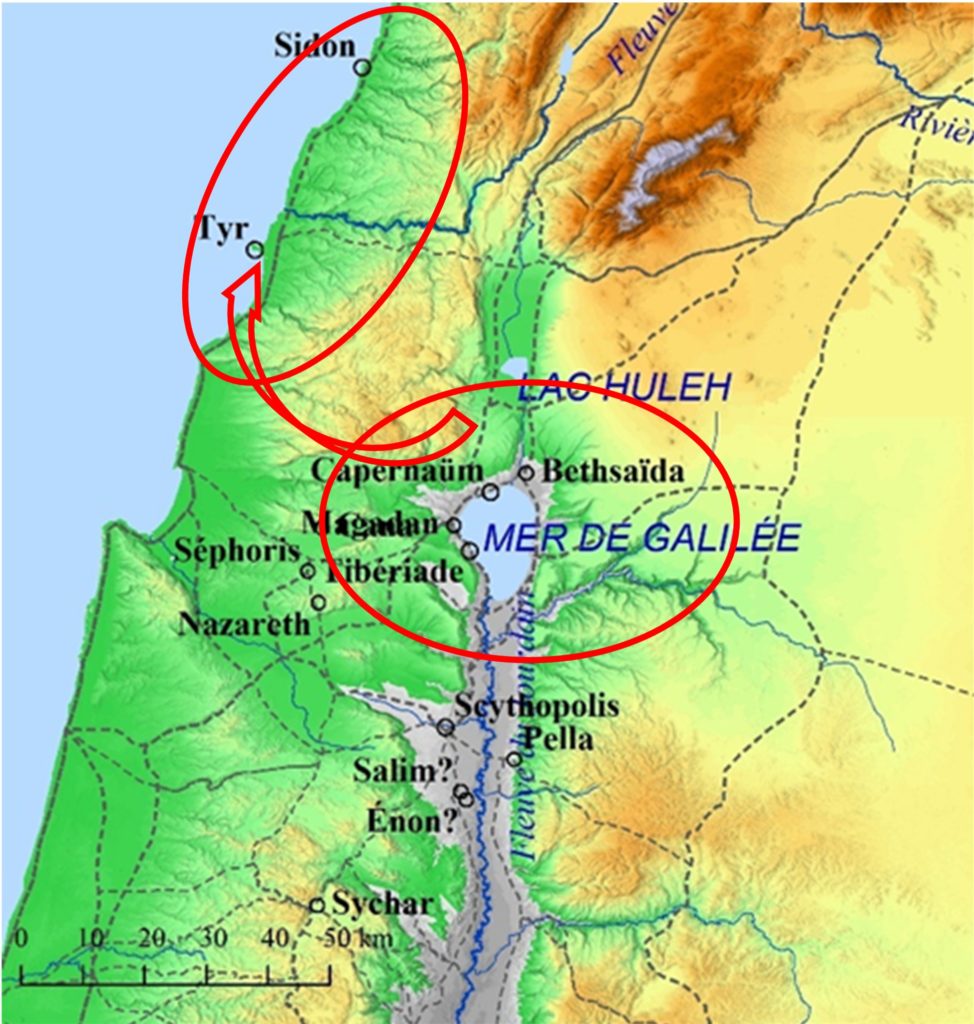
Mark and Matthew report that Jesus the Messiah, accompanied by his disciples, left Galilee and went to Phoenicia, to the north of the land of Israel. The reasons for this journey are not stated. However, Jesus the Messiah told a woman who was asking for the healing of her daughter: “I was sent only to the lost sheep of the house of Israel.” This statement makes this journey outside Israel hard to understand. It is possible that the presence of the was a threat, prompting Jesus the Messiah to withdraw for a time. Mark also stresses that Jesus the Messiah sought refuge in a house in order to hide. However, his reputation had preceded him, and the local people quickly recognized who he was.
Is it possible to compare the encounter with the Syrophoenician woman to the one with the mentioned in John 4.1-42, where it is written that he had to pass through Samaria (John 4.4)? It is conceivable that this encounter with the woman was also necessary.
Let us now examine the texts in detail
The texts of Matthew 15.21-28 and Mark 7.24-30 relate the same event: the encounter between Jesus and a Syrophoenician (or Canaanite) woman. These passages highlight the openness of the message of Jesus the Messiah to non-Jews, while underlining certain theological and cultural elements. Here is a detailed analysis and comparison:
Analysis of Matthew 15.21-28
In this passage, Jesus the Messiah withdraws to the region of Tyre and Sidon, an area inhabited by non-Jews. A comes to meet him, begging for the healing of her daughter, who is possessed by a demon. Jesus the Messiah at first remains silent, which prompts the disciples to ask him to send her away. When he answers her, he states that he was sent to the lost sheep of Israel, suggesting that his mission is primarily intended for the Jews.
The woman persists and kneels before him, pleading once more for his help. Jesus the Messiah answers her with an apparently harsh sentence: “It is not good to take the children’s bread and throw it to the little dogs.” She replies humbly that the little dogs eat the crumbs that fall from their masters’ table, which marks her acceptance of a salvation extended to the nations. Impressed by her faith, Jesus the Messiah immediately heals her daughter.
Analysis of Mark 7.24-30
Mark takes up the same account, but with notable differences. Jesus the Messiah enters a house and tries to keep his stay discreet, but the Syrophoenician woman finds him and begs for his help. Unlike Matthew, Mark does not mention the disciples intervening in the scene.
The and that of the woman are similar to those in Matthew. However, Mark gives less detail about the exchange and the woman’s emotions. Jesus the Messiah quickly acknowledges her faith and announces to her the healing of her daughter. Mark’s account is therefore more concise and centered on the immediate effect of the miracle.
Comparison between Matthew 15.21-28 and Mark 7.24-30
Recipients and theological perspective :
Matthew writes for a Jewish audience, and so he insists on Jesus’ initial role toward Israel and on the extension of salvation to the nations after a demonstration of faith.
Mark addresses a wider audience, probably non-Jewish, and places less emphasis on the progressive aspect of salvation.
The role of the disciples :
In Matthew, the disciples play an active role by asking Jesus to send the woman away, which heightens the dramatic tension of the account.
In Mark, they are absent, which refocuses the interaction on Jesus and the woman.
Structure and style :
Matthew is more narrative and dramatic: the dialogue is longer, with several exchanges before Jesus acknowledges the woman’s faith.
Mark is briefer and more factual: he shortens the dialogue and the scene is more direct.
Tone and emotional impact :
Matthew highlights the woman’s persistence and humility.
Mark places more emphasis on the immediate effectiveness of the miracle.
Conclusion
Both accounts illustrate a crucial moment when Jesus the Messiah shows that his salvation reaches beyond Israel. Matthew emphasizes the process by which faith is recognized, whereas Mark presents a quicker and more pragmatic version of the miracle. This difference of perspective reflects their editorial aims: Matthew wants to show the progression of the Messiah’s message, whereas Mark seeks to underline the effectiveness of Jesus’ power. The attitude of Jesus the Messiah toward this woman seems forbidding. Thanks to her mother’s insistence and perseverance, the daughter will be healed of her illness according to Matthew, whereas Mark attributes this illness to a demon.
The attitude of Jesus the Messiah, in this particular case, seems highly exceptional, because he usually encouraged people and urged them to have faith (John 11.40). However, Jesus the Messiah knew this woman’s conviction and showed that, despite the obstacles, her faith remained unshakable. By rejecting her requests, he showed that nothing could hinder her determination. Thus the faith of this foreign woman became an example for the Church. No obstacle should stand in the way of faith.