
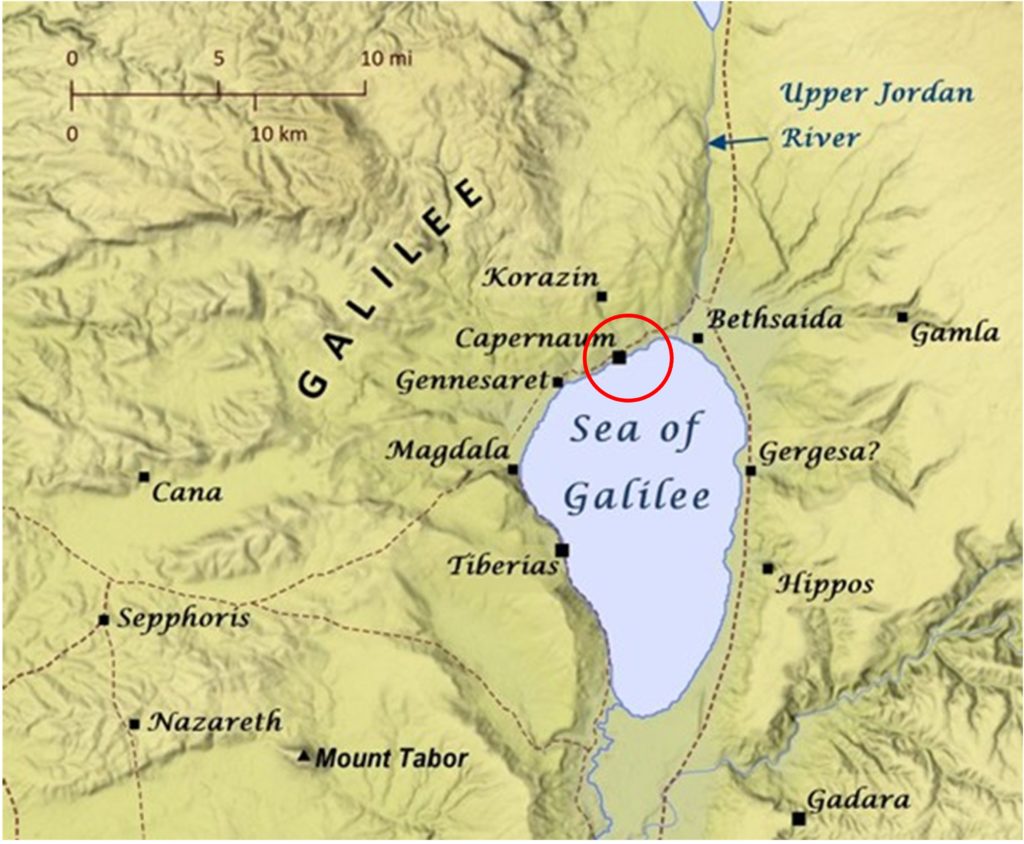
Mark indicates that the Messiah Jesus, accompanied by his disciples, left Phoenicia and returned to Galilee, to the shore of the . They probably went to the region of Capernaum.
Matthew reports that the Master performed many miracles, while Mark focuses on one particular case. He describes the healing of a deaf man who had difficulty speaking. This healing is remarkable because the Messiah Jesus uses his own , which he applies to the man's tongue after putting his fingers in his ears. The result of this intervention is immediate: the man recovers his hearing and the ability to speak.
A similar example is described in Mark 8.22-37 and John 9.6, where a blind man is healed after the Messiah Jesus applies mixed with dust to his eyes.
The plural used in Mark 7.36 suggests that the sick man was accompanied. This healing took place in the presence of witnesses other than the disciples of the Messiah Jesus.
Matthew, for his part, mentions the lame, the blind, the mute, the crippled and many other sick people, all of whom were healed by the Master.
We note that the crowd's welcome is positive and that the potential reasons for a hostility of the , which could have led to the departure for Phoenicia, are no longer present. It would be worthwhile to consider another hypothesis concerning this departure. The Master was aware of the importance of his meeting with this Syrophoenician woman.
Under these conditions, this would recall the visit of the Messiah Jesus and his disciples to Samaria and their encounter with a woman whose name is not mentioned, just like the Syrophoenician woman, the (John 4.4). These two episodes present many similarities.
Matthew highlights the size of the crowd and the extent of the healings, thus illustrating the significant impact of the Messiah Jesus on the people. Mark, on the other hand, focuses on one particular case, stressing that despite the pressure of the crowd, the Messiah Jesus takes the time to attend to one individual, namely a deaf man who had difficulty speaking.
We observe that the accounts of Matthew and Mark, although they describe the same scene, present significant differences. It is therefore essential to compile, as far as possible, all the texts relating the same event and to carry out a comparative analysis of them in order to obtain a more complete view of the event described.