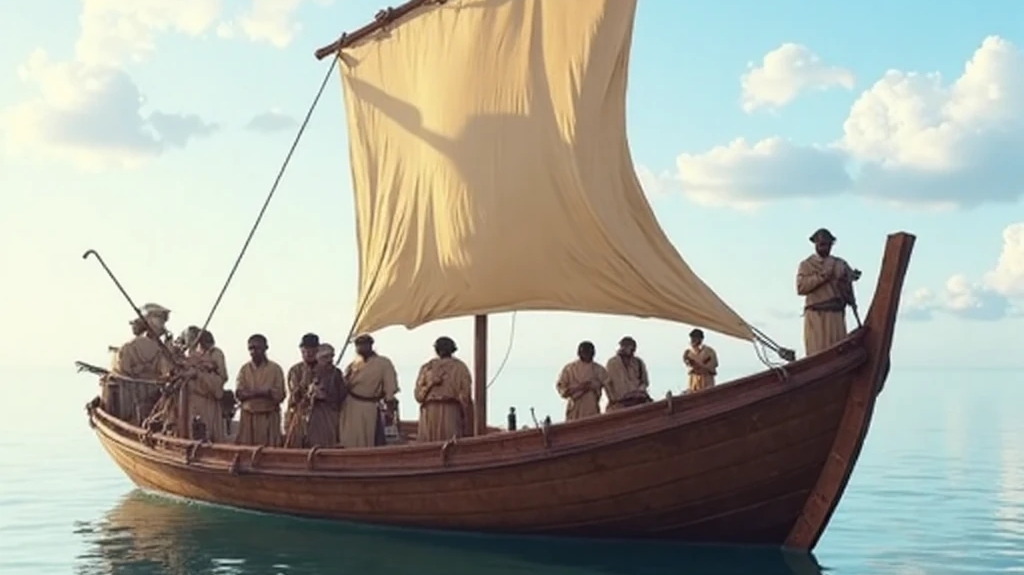

We find the same principle as in the first and fish: after the event, the disciples and the Messiah Jesus take the boat again. It was a way to find calm and rest. This time, the sea remained calm.
Summary and comparison of the texts
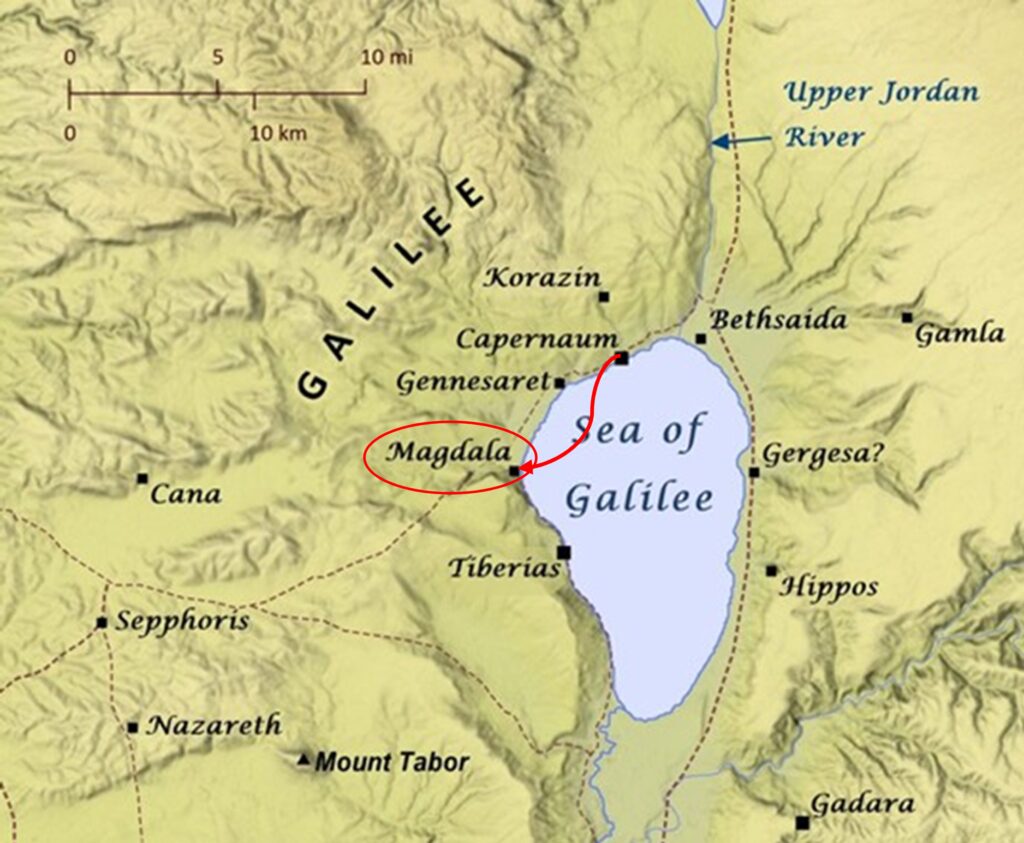
Verses Matthew 15.39 and Mark 8.10 relate the departure of the Messiah Jesus after the second . In Matthew 15.39, Jesus gets into a boat and goes to the region of . In Mark 8.10, the account is similar, but the destination mentioned is Dalmanutha.
Although these two passages describe the same event, they differ in the name of the place where Jesus arrives. This variation may be attributed to differences in the manuscript tradition or to the use of alternative names for the same region.
Difference between Magdala and Dalmanutha
- Magdala is a well-identified town on the western shore of the . It is often associated with Mary of Magdala (Mary Magdalene) and was a center of fishing and trade in the time of Jesus.
- Dalmanutha, by contrast, is a place whose exact location remains uncertain. Some scholars think it may have been close to Magdala, or even another name for the same region. Other hypotheses suggest it may designate a neighboring area on the western coast of the .
Location of these places
- Magdala is located on the western shore of the , near the present-day town of Migdal in Israel.
- Dalmanutha has not been formally identified, but archaeological excavations have suggested that it may correspond to an ancient town near Ginosar, where a fishing boat dating from the time of the Messiah Jesus was discovered.
- Magdala and Ginosar are close to each other.
- In the biblical context, is mentioned only in Matthew 15.39, where the Messiah Jesus goes after the . However, some manuscripts and translations use Magdala instead of , which has led to debates about the exact identity of this place. It is possible that is a variant of Magdala, which was a well-known town on the western shore of the
These differences illustrate the variations in the transmission of the Gospel accounts and underline the importance of historical and archaeological study for a better understanding of the places mentioned in the Gospels.