
This subject, addressed exclusively by Matthew, sheds light on the concepts of judgment and the distinction between the righteous and the unrighteous. He also treats this question from different angles, drawing on other teachings of Jesus the Messiah, notably the of the net (Matthew 13.47-50, PER149) and the of the ten virgins (Matthew 25.1-13, PER287).
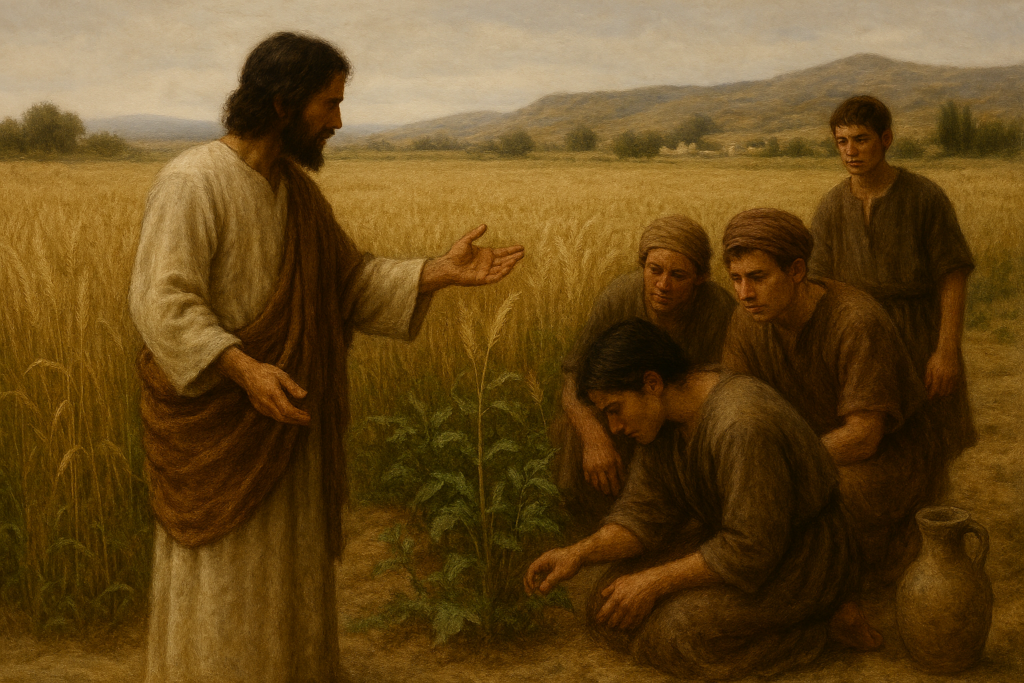
This is the second recorded by Matthew after that of the sower (Matthew 13.1-23, PER138), which addresses a similar theme. In this , however, an enemy intervenes to harm the farmer. We thus learn that, although the first seed is good, a second seed, this time bad, is sown secretly and grows alongside the good seed. Both grow.
Is it necessary to remove these weeds?
The Master answers no, stressing that there is a risk of harming the good plants. A careful sorting will take place at harvest time.
The problem is thus presented, and this account engages the listeners, most of whom cultivate a plot of land. Although no explicit interpretation is provided, it is clear that the discussion concerns the notions of good and bad, or good and evil.
The main themes are therefore:
Coexistence of good and evil: The shows that good and evil coexist in the world until the day of judgment. The righteous and the wicked live together, and it is not always easy to distinguish them.
Patience and delayed judgment: The owner of the field shows patience by not wanting to pull up the weeds immediately, for fear of damaging the wheat. This reflects God's patience in delaying the final judgment to allow everyone to repent.
Final judgment: At the end of time, there will be a separation between the righteous and the wicked, symbolized by the harvest. The wicked will be punished and the righteous rewarded.
This of the weeds appears only in Matthew's Gospel. The themes of judgment, the separation of good and evil, and the growth of the kingdom of God also appear in other teachings of Jesus in Matthew.
of the net (Matthew 13.47-50): This uses the image of a fishing net to illustrate the separation of the righteous and the wicked at the end of time.
of the ten virgins (Matthew 25.1-13): It highlights the importance of being prepared for the Lord's return and the separation between those who are ready and those who are not.
Matthew places particular emphasis on this coexistence of good and evil, of true disciples and unbelievers. Like the prophet Habakkuk 1.2-13, who did not understand this coexistence, Matthew follows the same path.
The apparent prosperity of the wicked is discussed in several biblical passages, notably in the Psalms and the Prophets.
Psalms 73.3-12: The psalmist Asaph expresses his distress at seeing the prosperity of the wicked despite their unjust behavior. He observes that the wicked seem to prosper and to be spared the sufferings of others.
Jeremiah 12.1-2: The prophet Jeremiah complains to God about the prosperity of the wicked: "Why does the way of the wicked prosper? Why do all the treacherous live in peace?"
Job 21.7-13: Job wonders why the wicked live, grow old, and become powerful, apparently enjoying material blessings despite their wickedness.
These passages highlight a profound question and a common human observation about the apparent injustice in the prosperity of the wicked. However, the Bible also teaches that the prosperity of the wicked is temporary and that God's final judgment will set everything right.
Avec la tombée de la nuit, la foule finit par se disperser, laissant le Messie Jésus seul avec ses disciples. C’est à ce moment-là qu’ils lui demandent d’expliquer la . Matthew 13.36-43 relate cette discussion (PER146).