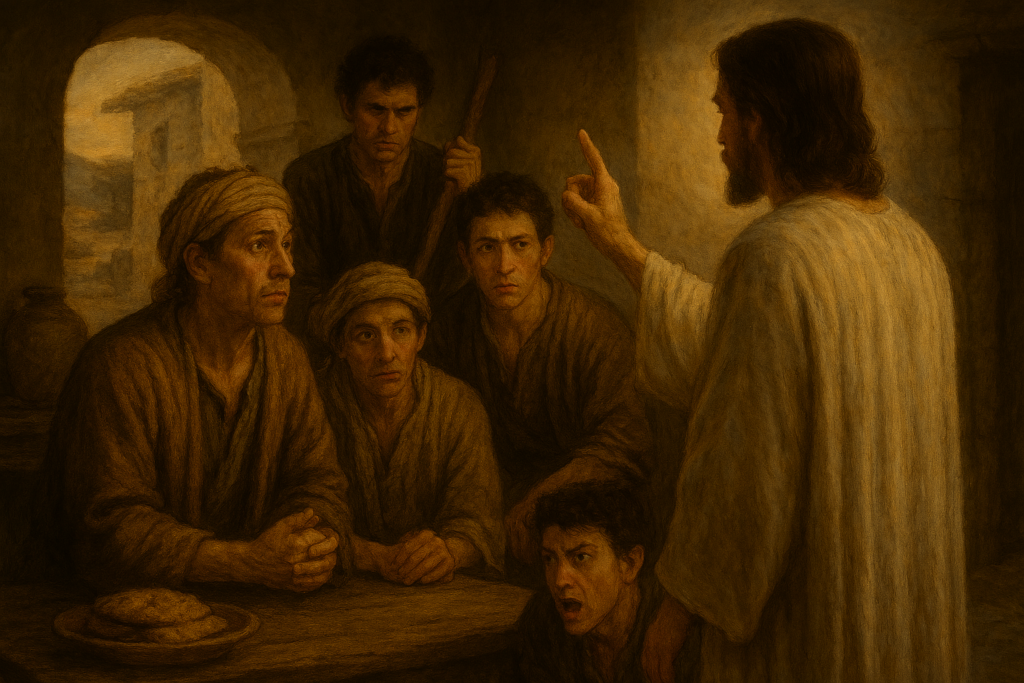


Luke's text and Matthew's display notable similarities. However, their authors do not place these passages in the same period; a difference of about two years separates them.
This is not surprising, since Jesus often returned to the same theme in various places and circumstances.
The Messiah Jesus speaks here of the behavior of a steward or servant. He describes two possibilities. In the first, the steward is responsible for several employees; he works and evidently performs his role properly during the master's absence. When the master returns, he finds that this servant has been faithful in his work and, aware of the servant's abilities, entrusts him with additional responsibilities. He does not fail to praise this steward, this good and faithful servant.
This theme recalls the parables of the talents (Matthew 25.14-30, PER288) and the minas (Luke 19.11-27, PER257). Although they had not yet been told at that point, they emphasize the importance of the subject that the Messiah Jesus chooses to repeat in different forms.
We observe that this steward's task was to ensure that the workers were well fed, an essential duty he performed with dedication. A connection can be made with spiritual nourishment, implying that the workers would be religious leaders in this context.
In the second possibility in this , the servant behaves differently, mistreating his subordinates. Knowing that his master is slow to return, he abuses his power and takes on responsibilities that were not intended for him.
Instead of caring for the servants for whom he is responsible, he beats them in order, as he sees it, to obtain better results. He enjoys life's pleasures, eating and drinking to excess. As in the first case, the master returns and sees the result.
In both cases, the master returns unexpectedly.
A sentence allowing no appeal is pronounced, and this servant is punished with no possibility of rehabilitation
How should we interpret this ? Luke 12.47-48 provides a detailed explanation. This concerns the scenario in which the servant behaves badly. The first case presents no ambiguity.
The servant is a disciple who serves his master, God. He understands his master's will and therefore cannot justify negligence or a bad attitude. However, the Messiah Jesus also adds a clarification in his conclusion, emphasizing the importance of responsibility proportionate to knowledge of the master's will.
In the of the talents, it is important to note that not everyone received the same number of talents.
For the same action, two individuals could be judged differently, because knowledge can influence judgment and condemnation. Thus, the more someone receives, the greater the expectations of them will be.
Matthew does not address the question of judgment based on a person's knowledge. He simply distinguishes the good servant, who will be saved, from the bad servant, who will be condemned.
This clearly targets the and the teachers of the law.