
Thus Matthew alone adds these three details to the discourse of Jesus the Messiah.
The first is a using the image of a tree. The purpose seems clear: Jesus the Messiah urges his listeners to choose their path. The tree bearing good fruit symbolizes Jesus the Messiah and his work. Most of the crowd who witnessed his miracles acknowledged that these deeds were performed by the power of God.
The bad tree symbolizes the and their actions. Moreover, much of the population was aware of the reprehensible acts committed by many of them and no longer understood the subtleties of the law of Moses proclaimed in their every .
‘Then choose whom you want to follow,’ proclaims Jesus the Messiah. Here we find a message similar to Joshua's (Joshua 24.15).
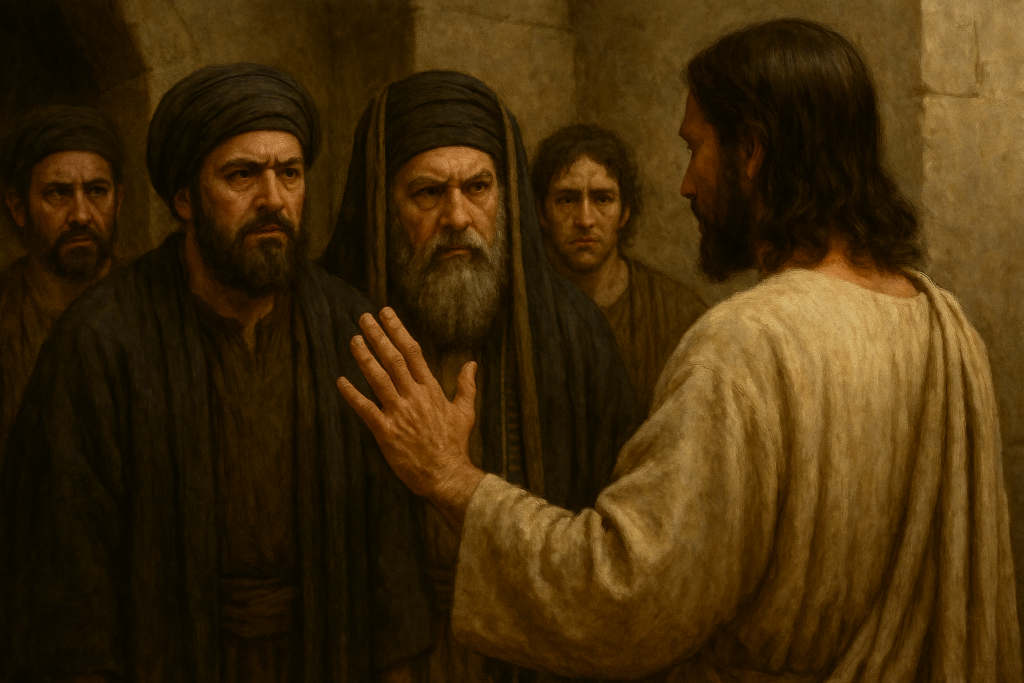
The second point reinforces the first and even makes it more precise. The words of our mouths reflect the feelings of our hearts. Here too, Jesus the Messiah rebukes these , calling them a brood of vipers whose hearts are full of evil feelings.
He concludes by generalizing the principle that a virtuous man, such as Jesus the Messiah, brings good things through the purity of his heart, whereas a malicious person will produce harmful deeds because of his corrupt nature. The treasure symbolizes our true feelings.
The last point is also addressed by Mark and Luke in the preceding pericope. Jesus the Messiah states that every individual will have to give an account of all the idle or malicious words they have spoken. He explains that each person will be judged on the basis of these words. This statement requires careful interpretation to grasp its full significance.
Words reveal our true feelings, thus showing our real nature, regenerated or not, saved or lost. In other words, conversion transforms our speech into something new and unexpected.