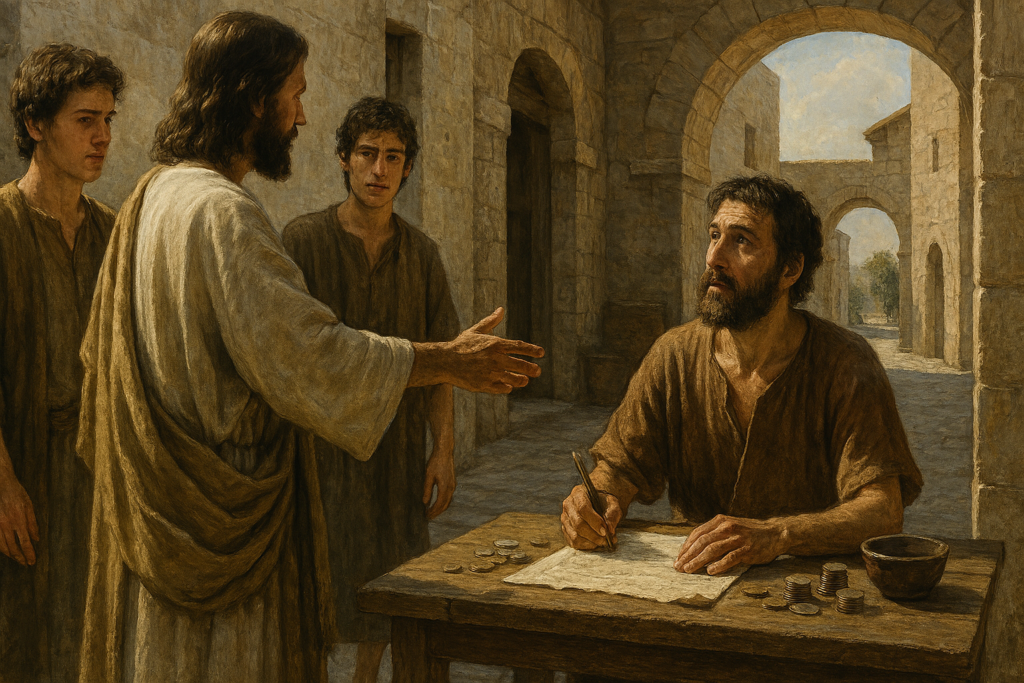

Jesus the Messiah called a fifth disciple, Matthew, after Simon Peter, Andrew, James and John. The Synoptic Gospels tell us only the story of these five men. John adds Philip and Nathanael to this list. These seven disciples, who belong to Jesus the Messiah's inner circle, will be called apostles.
Matthew's companions will entrust him with the task of writing down their testimony after the Teacher's death. It is worth observing that Mark and Luke call him Levi, whereas the author of the first Gospel seems to prefer his name Matthew.
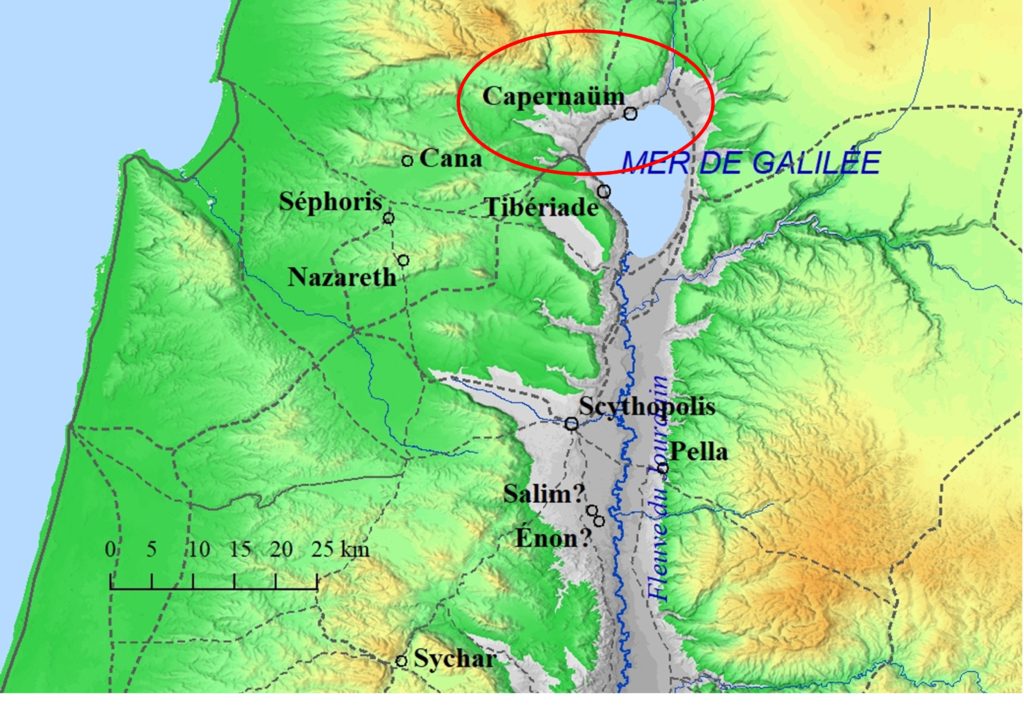
The precise location where Matthew practised his trade is unknown, but the three Synoptic Gospels indicate that Jesus the Messiah went out of Capernaum. Since the tax office was near the town of Capernaum, it is plausible to suppose that Matthew came from this locality.
Matthew will hold a great banquet for all his friends and colleagues, with a distinguished guest: Jesus the Messiah, together with the other disciples (PER067). Like the others, Matthew will give up everything, including his lucrative work as a tax collector.
The Synoptic Gospel writers describe this conversion in detail. They seem to be introducing the man who will become their spokesman by writing down their testimony, thereby revealing his abilities. His obvious intellectual talents doubtless led the group of apostles to choose him.
Clearly, Jesus the Messiah's call for Matthew to follow him is the culmination of a process begun earlier. Indeed, how could a man abandon everything essential to his life to follow a stranger?
In our view, Matthew must also have associated with John the Baptist, though perhaps less regularly than Simon Peter, Andrew, James and John because of his demanding work. This would explain why he is not mentioned with them.
In any event, he must have known Jesus the Messiah before making the extremely important decision to follow him.
Was he present at the (PER036)?
Did he meet the Teacher at Bethany or Aenon (PER042 and PER045)?
In Galilee, Jesus the Messiah called men who had already been his disciples since the baptism in Judea. Indeed, in his speech reported by Luke in the Acts 1.21-22, Peter makes clear that the apostles followed Jesus the Messiah from the very beginning, that is, from the baptism.
Why should Matthew be an exception to this rule?
This disciple stands out clearly from the others because he is the group's only intellectual. He therefore has little in common with his friends and never appears in the major events that marked Jesus the Messiah's life.
Under these circumstances, what is the point of emphasising his calling in Capernaum, like that of Simon Peter, Andrew, James and John?
The answer seems simply to be that he is the future writer of the testimony of the Twelve.