
PER065

Healing of a paralysed man

The article addresses Jesus' healing of a paralysed man in Capernaum, highlighting his divinity, proclaimed through the forgiveness of sins, which shocks the experts in the law and widens the gulf between Jesus and the religious authorities.

4 min healing paralysed man Jesus Capernaum 3 verses 3 books

See also

Bible texts

Matthew
Matthew 9.1-8 (King James Version)

And he entered into a ship, and passed over, and came into his own city.

And, behold, they brought to him a man sick of the palsy, lying on a bed: and Jesus seeing their faith said unto the sick of the palsy; Son, be of good cheer; thy sins be forgiven thee.

And, behold, certain of the scribes said within themselves, This man blasphemeth.

And Jesus knowing their thoughts said, Wherefore think ye evil in your hearts?

For whether is easier, to say, Thy sins be forgiven thee; or to say, Arise, and walk?

But that ye may know that the Son of man hath power on earth to forgive sins, (then saith he to the sick of the palsy,) Arise, take up thy bed, and go unto thine house.

And he arose, and departed to his house.

But when the multitudes saw it, they marvelled, and glorified God, which had given such power unto men.

Mark
Mark 2.1-12 (King James Version)

And again he entered into Capernaum after some days; and it was noised that he was in the house.

And straightway many were gathered together, insomuch that there was no room to receive them, no, not so much as about the door: and he preached the word unto them.

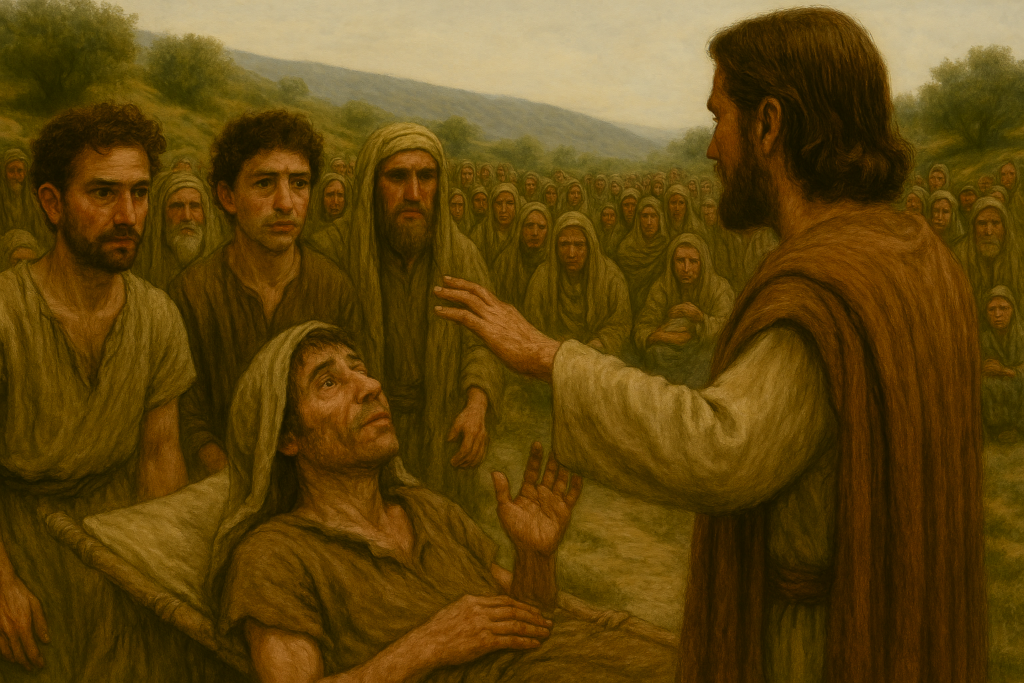
And they come unto him, bringing one sick of the palsy, which was borne of four.

And when they could not come nigh unto him for the press, they uncovered the roof where he was: and when they had broken it up, they let down the bed wherein the sick of the palsy lay.

When Jesus saw their faith, he said unto the sick of the palsy, Son, thy sins be forgiven thee.

But there were certain of the scribes sitting there, and reasoning in their hearts,

Why doth this man thus speak blasphemies? who can forgive sins but God only?

And immediately when Jesus perceived in his spirit that they so reasoned within themselves, he said unto them, Why reason ye these things in your hearts?

Whether is it easier to say to the sick of the palsy, Thy sins be forgiven thee; or to say, Arise, and take up thy bed, and walk?

But that ye may know that the Son of man hath power on earth to forgive sins, (he saith to the sick of the palsy,)

I say unto thee, Arise, and take up thy bed, and go thy way into thine house.

And immediately he arose, took up the bed, and went forth before them all; insomuch that they were all amazed, and glorified God, saying, We never saw it on this fashion.

Luke
Luke 5.17-26 (King James Version)

And it came to pass on a certain day, as he was teaching, that there were Pharisees and doctors of the law sitting by, which were come out of every town of Galilee, and Judæa, and Jerusalem: and the power of the Lord was present to heal them.

And, behold, men brought in a bed a man which was taken with a palsy: and they sought means to bring him in, and to lay him before him.

And when they could not find by what way they might bring him in because of the multitude, they went upon the housetop, and let him down through the tiling with his couch into the midst before Jesus.

And when he saw their faith, he said unto him, Man, thy sins are forgiven thee.

And the scribes and the Pharisees began to reason, saying, Who is this which speaketh blasphemies? Who can forgive sins, but God alone?

But when Jesus perceived their thoughts, he answering said unto them, What reason ye in your hearts?

Whether is easier, to say, Thy sins be forgiven thee; or to say, Rise up and walk?

But that ye may know that the Son of man hath power upon earth to forgive sins, (he said unto the sick of the palsy,) I say unto thee, Arise, and take up thy couch, and go into thine house.

And immediately he rose up before them, and took up that whereon he lay, and departed to his own house, glorifying God.

And they were all amazed, and they glorified God, and were filled with fear, saying, We have seen strange things to day.

John
John (King James Version) not mentioned in the book

Technical details

Bar chart for the year 31

Location: In the town of Capernaum

Date: Shortly before the Passover festival on Monday, March 24, AD 31, and their return from Jerusalem around April 5, AD 31

Approach: We follow Mark's chronology

Note on the approach: In this particular account, we encounter Matthew and Luke again

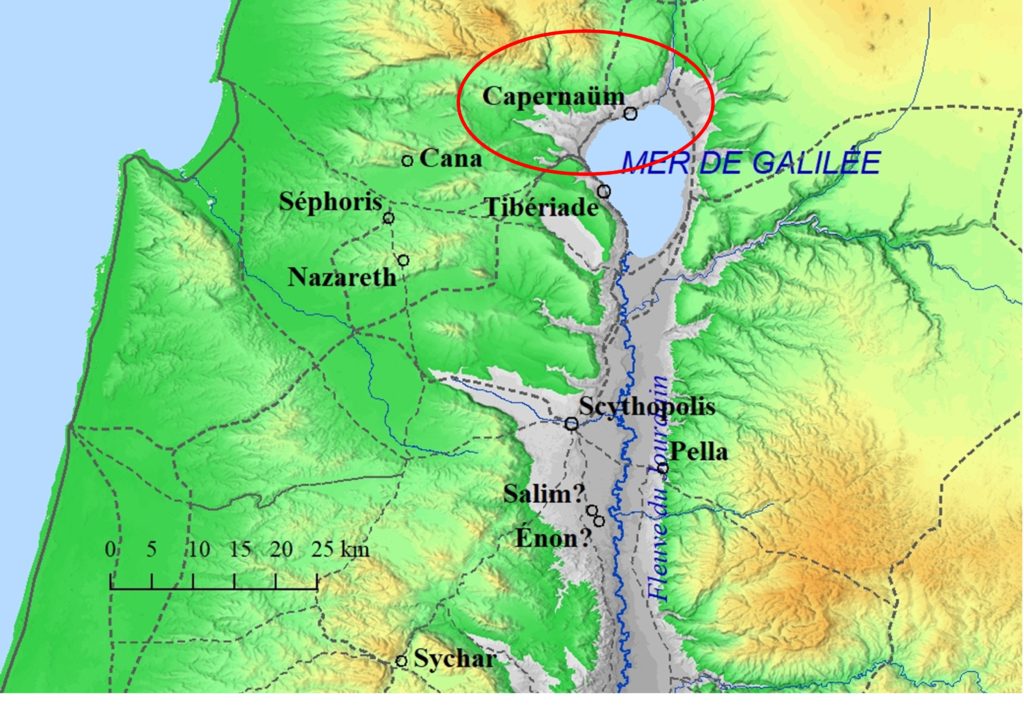
The Capernaum region

What we have here is more than another extraordinary healing: it is an affirmation of the divinity of Jesus the Messiah.

The healing of a paralysed man

Healing of a man with a disability

Commentary

We follow Mark's chronology. His expression, ‘A few days later, Jesus returned to Capernaum’, means that, after healing the man with leprosy, he returned to Capernaum. Matthew specifies that he crossed the by boat, suggesting that he must have been a few kilometres from his town.

He may have crossed one or more coves of this sea. Travelling by boat spared him being jostled by the crowd.

In a house in Capernaum, he debates with experts in the law; Luke adds the . His arrival has not gone unnoticed, and people flock there, all eager to see this new Teacher.

A paralysed man, carried by four men according to Mark, cannot get through the crowd and is taken up onto the house's flat roof. They make an opening and use ropes to lower the unfortunate man into the middle of the room.

This unforgettable scene highlights a point beyond the man's healing. ‘My friend, your sins are forgiven.’ This expression seems blasphemous, since God alone possesses this power. The experts in the law understand the difficulty of the situation.

The gulf continues to widen between Jesus the Messiah and these unbelieving religious men. The reasoning in this account, cited by the three Synoptic authors, inevitably demonstrates his divinity.

That is the message! We are witnessing more than another healing: this is an affirmation of the divinity of Jesus the Messiah.