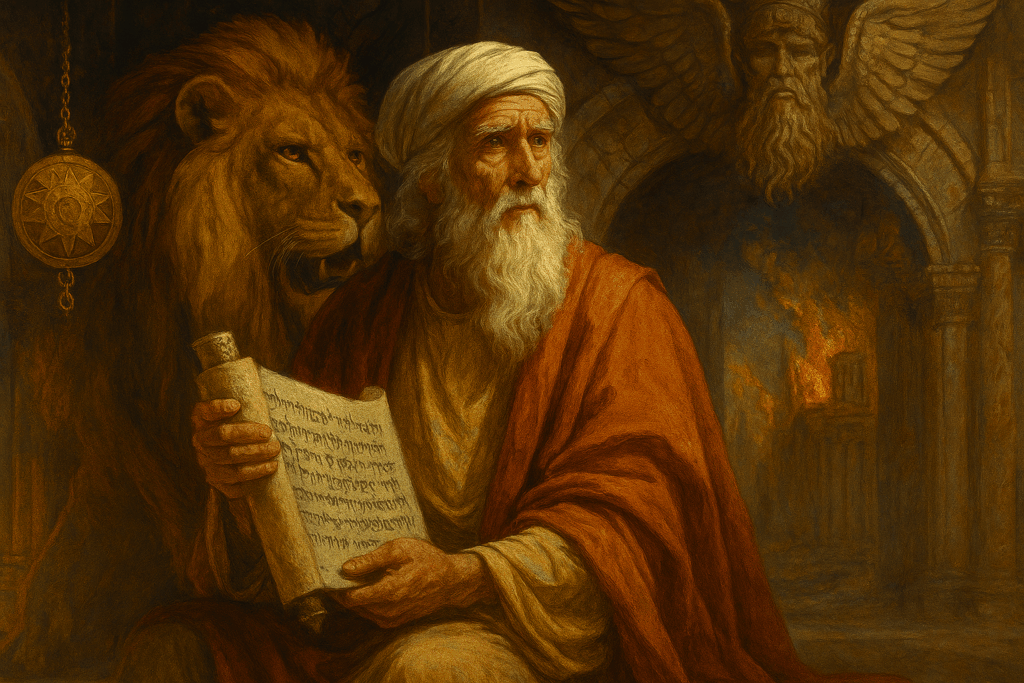
The book of Daniel tells the story of a young Judean deported to Babylon who remains faithful to God in a world profoundly different from his own. But Daniel is much more than an account of exile. Through dreams and visions, the book sweeps across the history of kingdoms, announces their disappearance and leads step by step toward the Messiah, the time of the end and the hope of the resurrection.
DAN000
General introduction to the book of Daniel
General introduction to the book of Daniel, a major prophetic text of the Old Testament. This article lays the historical, literary and theological foundations needed to understand this apocalyptic book, addressing its structure, author, main themes and the exegetical debates over its date and reliability.
14 min
Daniel
prophecy
apocalyptic
Old Testament
Babylon
11 verses
2 books
Further information
You can consult:
Introduction - Discovering the book of Daniel
In brief
Daniel lives in a time when everything seems to be collapsing.
Judah is subject to Babylon. Jerusalem is attacked. Part of the population is deported and, a few years later, the Temple will be destroyed.
Daniel is one of the young Judeans taken to Babylon. According to the chronological hypothesis adopted in this study, he would have been about fourteen years old at the time of his deportation, around 605 BC.
Yet he will live through decades and see the empire that carried him into captivity disappear.
His story then raises a question that runs through the whole book:
who really directs history?
1. A young exile in the heart of Babylon
Daniel and several of his companions are chosen to receive training intended to bring them into the king's service (Daniel 1.3-6).
They must learn a new language, receive a new education and live in a culture very different from that of Jerusalem.
Even their names are changed.
Daniel becomes Belteshazzar, Hananiah becomes Shadrach, Mishael becomes Meshach and Azariah becomes Abednego (Daniel 1.6-7).
Yet this integration does not mean giving up their faith.
From the very first chapter, Daniel decides to remain faithful to God (Daniel 1.8).
This faithfulness is one of the great themes of the book.
2. Empires that seem invincible
Daniel lives under several rulers.
He knows the power of Nebuchadnezzar and of the Babylonian Empire. He then sees the successors of the great king gradually lose that stability.
Finally, Babylon falls to the Persians in 539 BC.
This succession of political powers becomes one of the great subjects of Daniel's prophecies.
In the dream of the statue in Daniel 2, several kingdoms follow one another before a kingdom established by God replaces them for good (Daniel 2.31-45).
The message emerges gradually:
human kingdoms are powerful, but none of them is eternal.
3. Stories that are easy to remember
The first chapters contain several of the best-known stories of the Bible.
Daniel's companions are thrown into a furnace because they refuse to worship the statue set up by Nebuchadnezzar (Daniel 3).
Nebuchadnezzar must learn that his power has limits (Daniel 4).
Belshazzar sees a mysterious inscription appear on the wall a few hours before the fall of his kingdom (Daniel 5).
Daniel is thrown into the lions' den because he refuses to give up his practice of prayer (Daniel 6).
These stories have one thing in common: faithfulness to God is put to the test by human power.
4. Then come the great visions
From Daniel 7 onward, the book becomes more difficult.
Daniel sees strange beasts, horns, kingdoms in conflict and events that seem to go far beyond his own time.
These visions, however, are not independent of one another.
They often take up the same great periods of history while gradually adding new information.
Daniel 2 presents the great statue.
Daniel 7 presents four beasts.
Daniel 8 shows a ram and a goat.
Daniel 9 contains the famous prophecy of the seventy weeks.
Daniel 10 to 12 develop further the succession of conflicts and lead on to the time of the end.
To understand Daniel, one must therefore proceed step by step.
Each vision brings a new piece of the puzzle.
5. Does Daniel really announce the future?
This question lies at the heart of the debate about the book.
Much modern scholarship holds that the final form of Daniel should be dated to the 2nd century BC, notably because certain prophecies describe events of the Greek period with remarkable precision.
The position adopted in this study is different.
It regards Daniel as a prophet of the 6th century BC and therefore accepts that the visions can truly announce future events.
This position does not prevent us from examining the historical difficulties or the other interpretations.
The academic version of this study will treat this question much more precisely.
6. The great message of Daniel
Prophecies can sometimes make us forget what is essential.
Daniel does not seek merely to supply a chronology of empires.
The book affirms above all that human history does not escape the sovereignty of God.
Daniel sums it up this way:
“He changes times and seasons; he removes kings and sets up kings” (Daniel 2.21).
Nebuchadnezzar himself will have to learn that “the Most High rules in the kingdom of men” (Daniel 4.17).
This conviction runs through the whole book.
Kings appear.
They become powerful.
They disappear.
Others take their place.
But God's purpose remains.
7. An important place for the Messiah
The visions of Daniel do not speak only of empires.
Daniel 7 presents “one like a son of man” receiving an everlasting dominion (Daniel 7.13-14).
Daniel 9 also mentions an “anointed one,” or Messiah, in the prophecy of the seventy weeks (Daniel 9.24-26).
These passages will take on considerable importance in the Christian reading of the book.
Jesus the Messiah himself will refer to the prophet Daniel in his teaching about future events (Matthew 24.15).
Daniel thus becomes an important link between the prophecies of the Old Testament and the hope developed in the New Testament.
8. From Babylon to the resurrection
One of the most remarkable features of Daniel appears when we compare its beginning and its end.
In chapter 1, a young man is taken into captivity in Babylon.
In chapter 12, the perspective reaches the resurrection:
"Many of those who sleep in the dust of the earth shall awake" (Daniel 12.2).
The book has therefore travelled an immense road.
It began with the deportation of a young Judean.
It has passed through the history of empires.
It has announced conflicts and persecutions.
It has spoken of the Messiah.
It finally leads to deliverance and resurrection.
9. How will this study be carried out?
Each chapter will be studied separately.
We must first understand what the text says, then examine its historical context, and finally study the different interpretations.
An important distinction will be maintained throughout, between:
what the Bible explicitly affirms;
what history allows us to establish;
what interpretation seeks to reconstruct.
This method will be particularly important for the visions and the chronological calculations.
It will also make it possible to understand gradually how the different prophecies of Daniel complement one another.
Key points
The book of Daniel rests on a few simple, great ideas:
- Daniel remains faithful to God despite exile and trials.
- Human kingdoms are powerful, but temporary.
- The different visions complement one another and become progressively more precise.
- Daniel leads from the history of Babylon to the Messiah, the time of the end and the resurrection.
- The central message of the book is that of God's sovereignty over history.
This educational version presents the main outlines of the book. The academic version allows you to go much further, notably on the date of Daniel's composition, its historical context, the succession of empires, the different prophetic interpretations and the method used to study the visions.
The discovery can now begin with Daniel 1: Daniel and his companions in Babylon.
Conclusion
The book of Daniel tells the story of a faithful man, but above all it opens an immense perspective on human history. Empires follow one another, rulers disappear, and periods of persecution can give the impression that evil triumphs. Yet Daniel affirms that history has a direction and that no human kingdom has the last word.
Daniel himself does not immediately understand everything he receives.
At the end of the book, he acknowledges:
“And I heard, but I understood not” (Daniel 12.8).
Yet he keeps going.
This is also how we should approach this book: gradually, chapter after chapter, letting each story and each vision add a new element to the whole.
The study therefore begins where Daniel's story begins: in Jerusalem, at the moment when Nebuchadnezzar extends his power over Judah and a young man is taken to Babylon.
Everything then seems to announce the victory of human empires.
The twelve chapters of Daniel will show why this first impression is misleading.