The Writings of the New Testament and Their Translation
The article deals with the origin and translation of the writings of the New Testament. It examines the Greek manuscripts and various critical editions, as well as their importance for the accuracy of modern translations.
11 min
New Testamenttranslationmanuscriptscritical editions
The New Testament is made up of 27 books, recognized by both Protestant and Catholic Bibles. These works were written in the years following the resurrection of Jesus. Nine authors contributed to its writing.
This study aims to examine the origin of our modern translations.
I. The Original Texts
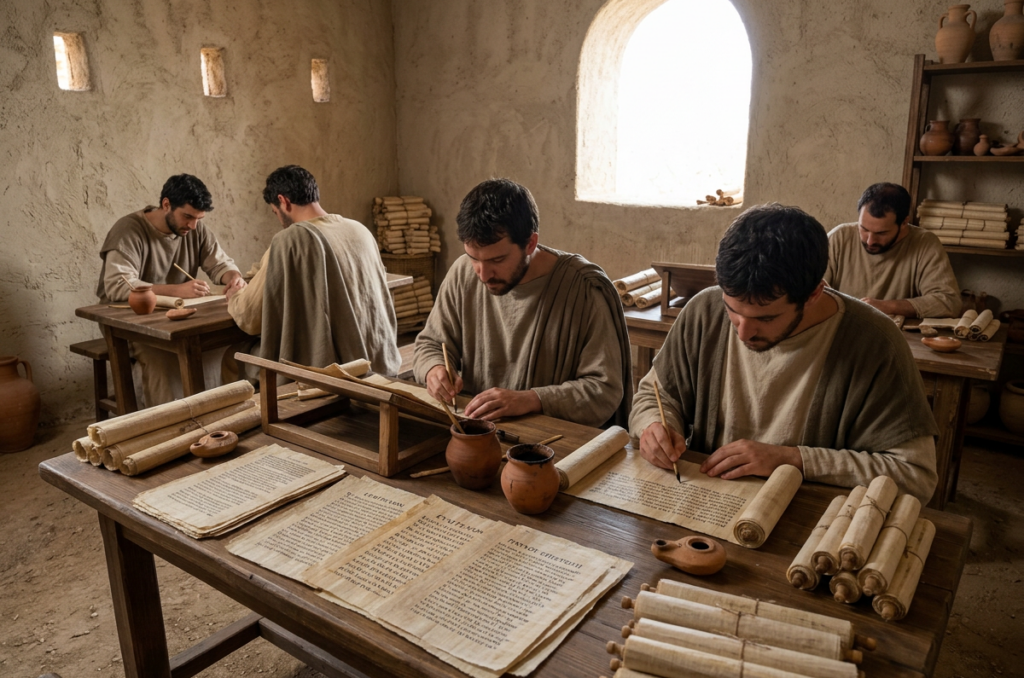
For the New Testament, the original manuscripts, called autographs, no longer exist. What we possess today are copies made by scribes over the centuries. Here is an overview of the main sources for current translations:
Important Greek Manuscripts
Sinaiticus: A fourth-century manuscript, discovered by Constantin von Tischendorf at Saint Catherine's Monastery on Sinai. It contains a complete version of the New Testament.
Vaticanus: Another fourth-century manuscript, kept in the Vatican Library. It is considered one of the most reliable.
Papyrus P52:The oldest known fragment of the New Testament, dating from around AD 125, containing parts of the Gospel of John.
The Alexandrinus: A fifth-century manuscript, containing a large part of the New Testament and the Old Testament in Greek.
Critical Editions
Modern translations often rely on critical editions of the Greek manuscripts, which compare and analyze the different versions in order to produce a text as close as possible to the originals:
Nestle-Aland (NA28): One of the most widely used editions of the Greek New Testament. United Bible Societies (UBS5): Another widely used critical edition.
Other sources
Translators also consider manuscripts in ancient languages such as Latin (Vulgate), Syriac (Peshitta), Coptic, and others, in order to gain an overall view of the textual variants.
These different sources make it possible to produce modern translations of the New Testament that seek to be as faithful as possible to the original texts.
Critical editions of the New Testament are versions of the Greek text that compile and analyze the different variations found in the ancient manuscripts. They aim to reconstruct the text as close as possible to the originals by using rigorous methods of textual criticism. Here are some of the most important critical editions:
Main Critical Editions
Nestle-Aland (NA28)
Editor: Eberhard Nestle, Kurt Aland and others.
Latest Edition: 28th edition (2012).
Features: Includes a detailed critical apparatus listing the textual variants of the main manuscripts, papyri, and ancient versions.
United Bible Societies (UBS5)
Editor: Kurt Aland, Bruce Metzger, and others.
Latest Edition: 5th edition (2014).
Features: Similar to the Nestle-Aland but with a more simplified critical apparatus, intended mainly for Bible translators.
The Greek New Testament According to the Majority Text
Editor: Zane C. Hodges and Arthur L. Farstad.
First Edition: 1982.
Features: Based on the (or Byzantine text), which reflects the most common readings in the majority of Greek manuscripts.
Editor: Erasmus, Robert Estienne, and others.
First Edition: 1516 (Erasmus).
Features: Used as the basis for the translation of the New Testament in the King James Version (1611). Less used in modern studies.
Aims of Critical Editions
Analyzing the Variants: By listing the different readings found in the ancient manuscripts. Reconstructing the Original Text: By choosing the most probable or the oldest readings. Facilitating Translation:By providing a solid basis for Bible translators.
These critical editions are essential tools for scholars and translators, because they allow a more precise and nuanced understanding of the text of the New Testament.
III. The Translator's Craft
The translation of the New Testament is a meticulous and rigorous task that rests on several foundations. Here is how translators generally proceed:
Main Stages of the Translation Work
1) Selection of the Source Manuscripts
Critical Editions: Translators use critical editions such as the Nestle-Aland (NA28) and the United Bible Societies (UBS5), which compile the textual variations of the ancient manuscripts. Ancient Greek Manuscripts: They rely on the oldest and most reliable Greek manuscripts, such as the Sinaiticus, the Vaticanus and other papyrus manuscripts.
2) Textual Analysis
Textual Criticism:Translators compare the different readings of the manuscripts to determine the most probable original text. Textual Variants:They take into account the textual variants, the historical and cultural contexts, and the linguistic usages of the period.
3) Understanding the Historical and Cultural Context
Historical Context: Understanding the historical, cultural and religious context of the New Testament is essential for an accurate translation. Ancient Languages: Translators must be well versed in the ancient languages, especially Koine Greek, Hebrew and Aramaic.
4) Choosing Lexical Equivalents
Faithfulness to the Text: Translators seek to be faithful to the original text while making it understandable to contemporary readers. Linguistic Adaptation: They sometimes have to adapt certain terms or expressions so that they make sense in the target language, while preserving the original meaning.
5) Proofreading and Revision
Review Committees: Translations are often reviewed by committees of specialists to ensure their accuracy and consistency. Successive Revisions: Translations go through several phases of revision and comparison with other translations and manuscripts.
Foundations Used by Translators
Ancient Manuscripts: The oldest and most reliable Greek manuscripts of the New Testament. Critical Editions: Nestle-Aland, UBS, etc. Linguistic Studies:In-depth knowledge of the ancient languages and their nuances. Historical Research: Understanding of the historical and cultural context of the New Testament.
Commentaries and Studies: Consultation of Bible commentaries, theological studies and academic works for additional insights.
The translation of the New Testament is a complex process that requires a combination of linguistic expertise, textual criticism and cultural understanding. Translators work carefully to produce versions that are both faithful to the original texts and accessible to modern readers.
IV. The Time Needed for a Translation
The time needed to translate the Old Testament and the New Testament varies considerably depending on several factors, including the working method, the available resources and the team of translators involved. Here is a general estimate:
New Testament
Approximate Duration: 2 to 3 years Influencing Factors: Complexity of the texts and textual variants.
Translators' level of familiarity with Koine Greek.
Stages of proofreading and revision by committees.
Old Testament
Approximate Duration: 5 to 7 years
Influencing Factors: Larger volume of texts.
Variety of the original languages (Hebrew, Aramaic).
Complexity of the poetic and prophetic texts.
Complete Translation (Old and New Testament)
Approximate Duration: 7 to 10 years Influencing Factors: Coordination between the translators of the two Testaments.
Thorough proofreading and revision to ensure consistency and faithfulness.
Practical Cases
The Translation of the Bible into French:For example, the translation of the Jerusalem Bible took about 15 years to complete, with a team of specialized translators and revisers.
Modern Translations: Contemporary translations, such as the , often involve teams of translators, revisers and consultants working together over several years.
These durations may vary depending on the methods used and the specifics of each translation project. It is a meticulous and rigorous process, requiring a combination of linguistic expertise, textual criticism and theological understanding.
V. Translating the Bible with AI (Artificial Intelligence)
For some years now, Artificial Intelligence (AI) has established itself as an extremely promising research tool. Given the relevance of the answers it generates, it is possible to imagine a new translation of the Bible produced by a machine.
The idea of using artificial intelligence (AI) to translate the Bible is fascinating and arouses a lot of interest. Indeed, projects like HelloBible are already exploring the use of AI to enrich Bible study and offer personalized translations. However, it is important to note that AI cannot completely replace the work of human translators, especially for texts as complex and nuanced as the Bible.
Potential Advantages of AI in Bible Translation
Speeding Up the Process: AI can help speed up certain stages of translation, such as text recognition and the suggestion of translations based on pre-existing models. Access to More Manuscripts: AI can analyze a large number of ancient manuscripts quickly, which can help identify textual variants and propose more accurate translations. Personalization: Tools like HelloBible use AI to offer explanations and translations tailored to users' questions and needs.
This site is a relevant example to illustrate the current and future issues linked to assistance by artificial intelligence. As an additional example, we can mention Bible Logos, a platform that we use daily and that has recently integrated artificial intelligence into its search modules.
We should not assume that machines will replace human intelligence (HI). According to our analyses, they will be an increasingly valuable and probably indispensable assistance for speeding up progress and obtaining optimal results.
Challenges and Limits
Complexity and Sensitivity:The Bible contains poetic, prophetic and theological texts that require a deep understanding of the cultural and historical context. Minority Languages: Less documented languages may not fully benefit from the advances of AI, which may accentuate linguistic disparities. Ethics and Reliability: It is crucial to ensure that AI-generated translations are faithful to the original text and respect theological and cultural sensitivities.
In summary, although AI can be a valuable tool to help in translating the Bible, it must be used in addition to the skills and expertise of human translators. This ensures a translation that is accurate, respectful and faithful to the original texts.
The first Christians knew how to distinguish inspired accounts from those that were not. We can in no way imagine that a machine could be inspired by the Spirit of God, unlike a human being. In the religious domain, this spiritual dimension makes all the difference.
Conclusion
The writings of the New Testament are supported by an abundance of documents, making the loss of the original texts less problematic. Current translations, drawn from the synthesis of a great deal of information, reach a remarkable level of reliability for such ancient texts.
The translation of the Bible, and in particular of the New Testament, remains unquestionably the domain of specialists. Indeed, it is not enough to have a few notions of Greek to undertake the translation of such a complex text. These skills go far beyond the capabilities of machines, because the essential element, namely the mind of the interpreter, is absent from this process.
This is why we see AI as a valuable aid in the service of man. But man can, in certain cases, become an instrument in the hands of God. It is at this stage that translation acquires a higher, even spiritual, dimension. It should be noted that the major authoritative translations today are essentially produced by translators with Christian commitments.
Knowledge and competence are essential, but the influence of the Spirit of God also remains crucial.
A title, a person, a place, a reference (“Luke 15”)…
opens in a new window
Bible reference
INF039
Information note
INF039 - The Catholic Bible
The Catholic Bible
The Catholic Bible is made up of two major sections: the Old Testament and the New Testament. Here is an overview of its makeup:
Old Testament
The Old Testament of the Catholic Bible contains 46 books, including the following: Pentateuch: Genesis, Exodus, Leviticus, Numbers, Deuteronomy. Historical books:Joshua, Judges, Ruth, 1 Samuel, 2 Samuel, 1 Kings, 2 Kings, 1 Chronicles, 2 Chronicles, Ezra, Nehemiah, Tobit, Judith, Esther, 1 Maccabees, 2 Maccabees. Poetic and wisdom books: Job, Psalms, Proverbs, Ecclesiastes (Qoheleth), Song of Songs, Wisdom, Sirach (Ecclesiasticus).
Prophetic books: Isaiah, Jeremiah, Lamentations, Baruch, Ezekiel, Daniel, Hosea, Joel, Amos, Obadiah, Jonah, Micah, Nahum, Habakkuk, Zephaniah, Haggai, Zechariah, Malachi.
New Testament
The New Testament of the Catholic Bible contains 27 books: Gospels: Matthew, Mark, Luke, John. Acts of the Apostles: History of the early days of the Christian Church. Epistles of Paul:Romans, 1 Corinthians, 2 Corinthians, Galatians, Ephesians, Philippians, Colossians, 1 Thessalonians, 2 Thessalonians, 1 Timothy, 2 Timothy, Titus, Philemon. Catholic Epistles: Hebrews, James, 1 Peter, 2 Peter, 1 John, 2 John, 3 John, Jude. Revelation: The Book of Revelation, or the Apocalypse of John.
Distinctive features of the Catholic Bible
Deuterocanonical books: The Catholic Bible includes certain books called deuterocanonical that are not present in the Hebrew Bible or in Protestant versions, such as Tobit, Judith, Wisdom, Sirach, Baruch, and the additions to Esther and Daniel. Canonization: The canon of the Catholic Bible was fixed at the Council of Trent in the 16th century, in response to the Protestant Reformation.
The Catholic Bible offers a rich collection of sacred, historical, poetic and prophetic texts, each bringing a unique perspective to the faith and religious practice of Catholics.
INF040
Information note
INF040 - The Protestant Bible
The Protestant Bible
The Protestant Bible consists of the Old Testament and the New Testament, just like the Catholic Bible, but there are some notable differences in the canon. Here is an overview:
Old Testament
The Protestant Bible follows the Hebrew canon of the Old Testament, which comprises 39 books: Pentateuch: Genesis, Exodus, Leviticus, Numbers, Deuteronomy. Historical books: Joshua, Judges, Ruth, 1 Samuel, 2 Samuel, 1 Kings, 2 Kings, 1 Chronicles, 2 Chronicles, Ezra, Nehemiah, Esther. Poetic and wisdom books: Job, Psalms, Proverbs, Ecclesiastes (Qoheleth), Song of Songs. Prophetic books: Isaiah, Jeremiah, Lamentations, Ezekiel, Daniel, Hosea, Joel, Amos, Obadiah, Jonah, Micah, Nahum, Habakkuk, Zephaniah, Haggai, Zechariah, Malachi.
New Testament
The New Testament of the Protestant Bible is identical to that of the Catholic Bible and comprises 27 books: Gospels: Matthew, Mark, Luke, John. Acts of the Apostles: History of the early days of the Christian Church. Epistles of Paul:Romans, 1 Corinthians, 2 Corinthians, Galatians, Ephesians, Philippians, Colossians, 1 Thessalonians, 2 Thessalonians, 1 Timothy, 2 Timothy, Titus, Philemon. Catholic Epistles: Hebrews, James, 1 Peter, 2 Peter, 1 John, 2 John, 3 John, Jude. Revelation: The Book of Revelation, or the Apocalypse of John.
Key differences from the Catholic Bible
Deuterocanonical books: The Protestant Bible does not include the deuterocanonical (or apocryphal) books found in the Catholic Bible, such as Tobit, Judith, Wisdom, Sirach, Baruch, and the additions to Esther and Daniel. Canon: The canon of the Protestant Bible is based on the Hebrew version of the Tanakh for the Old Testament, whereas the Catholic Bible includes additional books based on the Septuagint, an ancient Greek translation of the Hebrew Scriptures.
These differences reflect the theological and historical divergences that emerged during the Protestant Reformation in the 16th century.
INF048
Information note
INF048 - The Codex Sinaiticus
The Codex Sinaiticus
The Codex Sinaiticus is one of the oldest and most important biblical manuscripts. Here are some key facts about it:
History
Date: Around AD 325-360. Discovery: The manuscript was discovered by Constantin von Tischendorf at Saint Catherine's Monastery on Mount Sinai in 1844. Composition: It contains the complete text of the Christian Bible in Greek, including the Old Testament and the New Testament, as well as additional texts such as the Epistle of Barnabas and the Shepherd of Hermas.
Importance
Text: The Codex Sinaiticus is an Alexandrian text, which means that it is very close to the original versions of the Scriptures. Condition:It is one of the few manuscripts to have been preserved in its entirety. Study: It is of crucial importance for textual criticism and the history of the biblical texts.
Preservation
Division: The manuscript is currently held in four parts: the British Library in London, the National Library of Russia in Saint Petersburg, Leipzig University and Saint Catherine's Monastery on Mount Sinai. Digitization: In 2005, an international project was launched to digitize the Codex Sinaiticus and make it accessible online. The Codex Sinaiticus website allows the manuscript to be consulted in high definition and translated into several languages.
The Codex Sinaiticus offers a unique window on the earliest biblical texts and on the way they were copied and transmitted down the centuries.
INF049
Information note
INF049 - Tischendorf's Discovery
Tischendorf's Discovery
The story of Constantin von Tischendorf's discovery of the Codex Sinaiticus at Saint Catherine's Monastery is one of the most famous in the history of biblical research:
Discovery
1844: On his first journey to Saint Catherine's Monastery on Mount Sinai, Constantin von Tischendorf noticed a basket full of old parchments destined to be burned. Searching through it, he found several leaves of what would prove to be one of the oldest manuscripts of the Bible, the Codex Sinaiticus. Tischendorf managed to recover 43 leaves, mainly from the Old Testament. 1853: On his second journey, he did not find any other parts of the manuscript. 1859: On his third journey, financed by Tsar Alexander II of Russia, he persuaded the monks to show him the complete manuscript, hidden in a cellar. Realizing the importance of his discovery, he managed to obtain permission to take the manuscript to Saint Petersburg so that it could be studied.
Importance
The Codex Sinaiticus is one of the oldest and most complete manuscripts of the Greek Bible, dating from the 4th century. It contains parts of the Old Testament, the complete New Testament, as well as additional texts such as the Epistle of Barnabas and the Shepherd of Hermas.
Consequences
Publication: Tischendorf published a first facsimile edition of the Codex Sinaiticus in 1862, arousing great interest in the academic and religious world. Preservation: The manuscript is divided among several institutions: the British Library in London, the National Library of Russia in Saint Petersburg, Leipzig University and Saint Catherine's Monastery.
This discovery had a major influence on textual criticism and the history of the biblical text, and it remains an emblematic example of the passion and perseverance of researchers in their quest for knowledge.
INF050
Information note
INF050 - The Codex Vaticanus
The Codex Vaticanus
The Codex Vaticanus is one of the oldest and most important biblical manuscripts. Here are some key facts about it:
History
Date: Around AD 300-325. Discovery: Preserved in the Vatican Apostolic Library for centuries, it was digitized and made accessible online in 2019. Composition: It contains the complete text of the Christian Bible in Greek, including the Old Testament and the New Testament, as well as additional texts such as the Epistle of Barnabas and the Shepherd of Hermas.
Importance
Text: The Codex Vaticanus is an Alexandrian text, which means that it is very close to the original versions of the Scriptures. Condition: It is one of the few manuscripts to have been preserved in its entirety. Study: It is of crucial importance for textual criticism and the history of the biblical texts.
Preservation
Location: The manuscript is currently held in the Vatican Apostolic Library in Rome. Digitization: In 2019, the Codex Vaticanus was digitized and made accessible online, allowing all researchers and enthusiasts to consult this precious document.
The Codex Vaticanus offers a unique window on the earliest biblical texts and on the way they were copied and transmitted down the centuries.
INF061
Information note
INF061 - The P52 papyrus
The P52 papyrus
The story of the discovery of Papyrus P52 is just as fascinating! Here is how it happened:
Discovery
Early 20th century: Bernard Pyne Grenfell and Arthur Surridge Hunt, two scholars from the University of Oxford, were digging through ancient rubbish heaps in the Fayum region of Egypt when they unearthed hundreds of papyrus fragments. 1920: Grenfell acquired a small papyrus fragment measuring about 9 cm by 6 cm. This fragment was among others acquired for the John Rylands Library in Manchester.
Identification
1935 : Colin Henderson Roberts, also of the University of Oxford, was sorting these ancient papyri for the library. He noticed a fragment with familiar Greek words1. 1936 : Roberts published his conclusions in an article entitled "An Unpublished Fragment of the Fourth Gospel in the John Rylands Library". He identified the fragment as verses from the Gospel according to John (John 18.31-33 on the front and John 18.37-38 on the back).
Importance
Dating: Using a method called paleography, Roberts was able to estimate that the fragment dated from the first half of the 2nd century, which makes it the oldest known fragment of the New Testament. Preservation: Papyrus P52 is now kept at the John Rylands Library in Manchester.
This unexpected discovery among the rubbish has made it possible to better understand the history and transmission of the biblical texts. It is a wonderful story of perseverance and passion for historical research!
INF051
Information note
INF051 - The Codex Alexandrinus
The Codex Alexandrinus
The Codex Alexandrinus is a Christian manuscript of the fifth century. Here are some key facts about it:
History
Date:Around AD 400-440. Discovery: It takes its name from the city of Alexandria, where it is supposed to have been written. It was given to King Charles I of England by Patriarch Cyril Lucaris in 16282. Current owner: It is currently held in the British Library in London.
Composition
Text:It contains most of the Old Testament and the New Testament in Greek. Format: Written in uncials with two columns on each page, each column contains between 46 and 52 lines and each line between 20 and 25 letters. Materials: It is made up of 773 leaves of vellum.
Importance
Text:It belongs to the Byzantine family of the text, which means that it is very close to the original versions of the Scriptures. Condition: It is one of the few manuscripts to have been preserved in its entirety. Study: It is of crucial importance for textual criticism and the history of the biblical texts.
The Codex Alexandrinus is a precious witness to the history of the biblical text and the transmission of the Scriptures down the centuries.
INF067
Information note
INF067 - Critical Editions
Critical Editions
Critical editions of the original texts of the Bible are scholarly versions of the biblical manuscripts that aim to reconstruct the text as close as possible to the original. Here are some key points about these editions:
Goals
Restoring the Text: The main goal is to reconstruct the text most faithful to the original manuscripts. Analysis of Variants: They analyze the various textual variants found in the ancient manuscripts. Critical Notes: They include critical notes that explain the textual choices and the differences between manuscripts.
Methodology
Collation of Manuscripts:They are based on the examination and comparison of many ancient manuscripts. Evaluation of Variants: Researchers evaluate the variants to determine the most probable readings. Critical Apparatus: It includes a detailed critical apparatus, listing the variants and the manuscript sources.
Examples of Critical Editions
Biblia Hebraica Stuttgartensia (BHS): A critical edition of the Hebrew Bible based on the Leningrad Codex. Nestle-Aland (NA): A critical edition of the Greek New Testament, widely used in biblical studies. Septuaginta (LXX): A critical edition of the Septuagint, the Greek version of the Old Testament.
Importance
Textual Accuracy: They are essential for researchers, theologians, and translators, ensuring the accuracy of translations and studies. Historical Understanding: They help us understand the development and transmission of the biblical texts through the centuries.
Critical editions are therefore indispensable tools for a rigorous and in-depth study of the biblical texts.
INF068
Information note
INF068 - The Vulgate
The Vulgate
The Vulgate is a Latin translation of the Bible made mainly by Saint Jerome at the end of the 4th century. Here are some key details about this translation:
Origin and Background
Jerome: In 382, Pope Damasus I asked Saint Jerome to revise the older Latin translations of the Scriptures. Language: The Vulgate is written in Latin, which was the common language of the Western Church at that time.
Contents
Old Testament: Jerome translated directly from the Hebrew for the Old Testament, although he also used the Septuagint (the Greek version of the Old Testament) for some books. New Testament: He revised the existing Latin translations of the New Testament.
Importance
Standardization: The Vulgate became the standard version of the Bible for the Roman Catholic Church for more than a thousand years. Council of Trent: In the 16th century, the Council of Trent decreed that the Vulgate was the authentic edition of the Bible for the Catholic Church.
Legacy
Influence: It had a major influence on Western culture, literature and theology. Use: The Vulgate is still used today in some liturgies and theological studies, although more modern translations are often preferred for everyday reading.
The Vulgate is thus a monumental work of the Christian tradition, marking a turning point in the history of Bible translation.
INF069
Information note
INF069 - The Peshitta
The Peshitta
The Peshitta is one of the oldest Bible translations in Syriac (Aramaic), used mainly by the Syriac Churches. Here are some key points about it:
Origin and Contents
Old Testament: Probably translated from Biblical Hebrew in the 2nd century AD. New Testament:Translated from Koine Greek at the beginning of the 5th century.
Importance
Use: It is the standard version of the Bible for the Syriac Churches, including the Syriac Orthodox Church, the Syriac Catholic Church, and others. Etymology: The word "Peshitta" means "simple" or "common" in Syriac, indicating that it is meant to be accessible to everyone.
Influence
Transmission: It played a crucial role in preserving and transmitting the biblical texts in the Syriac tradition. Manuscripts:Many ancient manuscripts of the Peshitta have been preserved, offering valuable insights into textual transmission.
The Peshitta is therefore an essential Bible translation for the Syriac Churches and an important work in the history of the Bible.
INF071
Information note
INF071 - Artificial Intelligence (AI)
Artificial Intelligence (AI)
Artificial intelligence (AI) is a field of computer science that aims to create systems capable of performing tasks that normally require human intelligence. Here are some key aspects of AI:
Definition and Goals
Definition: AI is the simulation of human intelligence processes by machines, especially computer systems. Goals: It aims to create machines capable of reasoning, learning, perceiving and acting autonomously.
Types of AI
Weak AI (or narrow AI): Designed to perform a specific task, such as virtual assistants (e.g. Siri, Alexa). Strong AI (or general AI): Hypothetically capable of understanding, learning and performing any intellectual task that a human can do (still in the research and development phase).
Techniques Used
Machine Learning:Machines learn from data to improve their performance over time. Neural Networks:Models inspired by the human brain, used for complex tasks such as image recognition and natural language understanding. Natural Language Processing (NLP): Enables machines to understand and respond to human language in a natural way.
Applications Virtual Assistants: Siri, Alexa, Microsoft Copilot. Image Recognition: Used in medicine to analyze X-rays. Autonomous Vehicles: Cars able to drive without human intervention.
Challenges and Ethics
Technical Challenges: These include creating more efficient algorithms and managing large amounts of data. Ethics: This involves questions about transparency, privacy, and algorithmic bias.
AI is a constantly evolving field that is transforming many aspects of our daily lives and opening up new prospects for the future.
INF070
Information note
INF070 - HelloBible
HelloBible
HelloBible is an innovative platform that uses artificial intelligence to help users explore the Bible in a personalized way. Here are some key points:
Personalized Conversations: Users can ask questions about the Bible and receive personalized answers based on the teachings of Jesus. Help with Prayer: HelloBible offers prayer topics and words of Jesus Christ to help users in their spiritual life. Data Security: The personal data collected by the AI is stored securely and is not passed on. Accessibility: The app will be available in several languages, including French, and will be accessible free of charge with a voluntary payment system.
HelloBible is an initiative of the team of Eric Célérier, pastor and co-founder of several high-impact ministries. The app is designed to offer easy, personalized access to the Word of God.
This site is a relevant example to illustrate present and future issues. Spiritual assistance is no longer provided directly by a person, but by a machine which, although under the responsibility of an individual, raises important questions. Despite its avant-garde nature, many people (more than 700,000 at the time of writing this article, 12/12/2024). connect to this site, thus demonstrating its appeal.
As a further example, though without going as far, we can mention Logos Bible Software, which we use daily and which has recently integrated artificial intelligence (AI) into its search modules.
INF081
Information note
INF081 - The Nouvelle Bible Segond (NBS)
The Nouvelle Bible Segond (NBS)
The Nouvelle Bible Segond (NBS) is a revised version of Louis Segond's translation, published by the Geneva Bible Society. Here are some key points about this version:
Background and aims
Publication date: 2002 Modernisation: The NBS aims to modernise the language of Louis Segond's translation while remaining highly faithful to the original Hebrew and Greek texts. Clarity and accessibility: The emphasis is on making the text clear and accessible to contemporary readers.
Main features
Faithfulness to the original texts: The NBS draws on the most reliable ancient manuscripts to ensure an accurate and faithful translation. Linguistic revision: The language was revised to reflect modern French usage better while preserving the richness and depth of the biblical text. Notes and references: The version often includes explanatory notes and references to help readers understand and study Scripture.
Importance
Widespread use: The NBS is widely used in French-speaking Protestant circles, particularly for Bible study and personal reading.
Accessibility: Its modernised language makes it accessible to a wider audience, including new generations of readers.
The Nouvelle Bible Segond is therefore an important version that has helped keep Louis Segond's translation relevant while meeting the needs of modern readers.
INF086
Information note
INF086 - The Majority Text
The Majority Text
The Majority Text (or Byzantine Text) is a textual tradition of Greek New Testament manuscripts that represents the majority of surviving manuscripts. Here are some key points to understand:
Characteristics of the Majority Text
Prevalence: The Majority Text is so called because it reflects the reading found in the majority of Greek New Testament manuscripts. Origin: It was preserved mainly in the Byzantine Empire, hence the name ‘Byzantine Text’. Uniformity: Compared with other textual traditions, such as the Alexandrian Text, the Majority Text is more uniform as a result of gradual standardisation over the centuries. Use: This text was widely used in the Greek Orthodox Church and influenced several Bible translations, including some early Protestant versions.
Comparison with other texts
Alexandrian Text: Represents an older and more diverse manuscript tradition. Modern editions of the New Testament, such as Nestle-Aland and the United Bible Societies edition, often draw on the Alexandrian Text. Western Text: Another textual tradition, less standardised than the others, found mainly in certain early Latin manuscripts and a few Greek manuscripts.
The Majority Text has considerable influence on the understanding and transmission of the New Testament text, and its study is crucial for biblical scholars.
INF072
Information note
INF072 - The Textus Receptus
The Textus Receptus
The Textus Receptus is a compilation of the Greek text of the New Testament that was widely used for Bible translations during the 16th and 17th centuries. Here are some key points about the Textus Receptus:
Origins and Development
Compilation: The Textus Receptus was compiled from several Greek manuscripts available at the beginning of the Renaissance. Erasmus of Rotterdam: The first edition was published in 1516 by Erasmus, a Dutch scholar. Erasmus used a limited number of Greek manuscripts for his compilation, which were generally rather late. Revisions: The text was revised and published several times after Erasmus's first edition. Robert Estienne (or Stephanus), a Parisian printer, published several editions between 1546 and 1551. Beza's version and finally the edition of the Elzevir brothers also contributed.
Use
Translations: The Textus Receptus served as the basis for several important translations of the Bible, including the King James Version in English and Martin Luther's Bible in German. Influence: It had a great influence on Christian theology and culture during the Reformation and beyond.
Criticism and Evolution Later Discoveries: In the 19th century, the discovery of older and more complete manuscripts, such as Codex Sinaiticus and Codex Vaticanus, showed that the Textus Receptus contained errors and additions compared with the original manuscripts. Modern Editions: Today, modern editions of the Greek New Testament, such as the Nestle-Aland and the UBS (United Bible Societies), draw on a wide range of ancient manuscripts and seek to present a more faithful and critical text.
Despite its limitations, the Textus Receptus remains an important witness to the history of the transmission of the New Testament text and to its influence on Bible translations.
INF048
Information note
INF048 - The Codex
The Codex
A codex is a type of handwritten book made of sheets of paper, parchment or vellum bound together along one side, which makes it a forerunner of modern books. Unlike scrolls, which were in use before the invention of the codex, the codex allows the text to be consulted more easily and more quickly.
Characteristics of the Codex
Format: Made up of individual leaves (called folios) that are bound together and can be turned, as in modern books. Materials: Mainly parchment (prepared animal skin), vellum (a finer form of parchment), or later paper. Use: Used for religious, legal, literary and scientific texts. The first codices were often copies of the Bible, classical works and official documents. Durability: More resistant and practical than scrolls, because the individual pages could be protected by a rigid cover.
History of the Codex
Origins: The codex appeared at the beginning of the Christian era (1st century AD), gradually replacing the scrolls used previously.
Adoption by the Christians: The early Christians adopted the codex for the transmission of the Scriptures, because it allowed quick access to different parts of the text. Development: Over time, the codex became the standard for manuscripts, developing with the introduction of paper and more advanced binding techniques.
Famous Examples
Codex Sinaiticus: One of the oldest complete manuscripts of the Greek Bible. Codex Vaticanus: Another important ancient manuscript of the Bible, held in the Vatican Library. Codex Alexandrinus: A manuscript of the Greek Bible, comprising the Old and New Testaments.
The codex was a major innovation in the history of the book and contributed to the spread and preservation of knowledge.