BIB006

The Dead Sea Scrolls

The article details the discovery of the Dead Sea Scrolls near Qumran. Found by a Bedouin in the 1940s, these scrolls revolutionized the understanding of biblical texts. Their release was delayed for political and technical reasons, but these manuscripts shed unique light on ancient texts.

8 min manuscripts Qumran biblical text

Further information

Introduction

The discovery of ancient documents in the caves of Qumran near the Dead Sea in Israel promises to revolutionize the field of biblical text translation. Indeed, many documents have been brought to light, raising various questions. Will these new finds call into question our established translations, or confirm them?

This discovery aroused worldwide interest, drawing the attention of believers and atheists alike to the conclusions of the experts. This document will trace the history of this remarkable discovery.

A great many books have been published on this subject, testifying to the worldwide interest in this discovery.

I. The Discovery

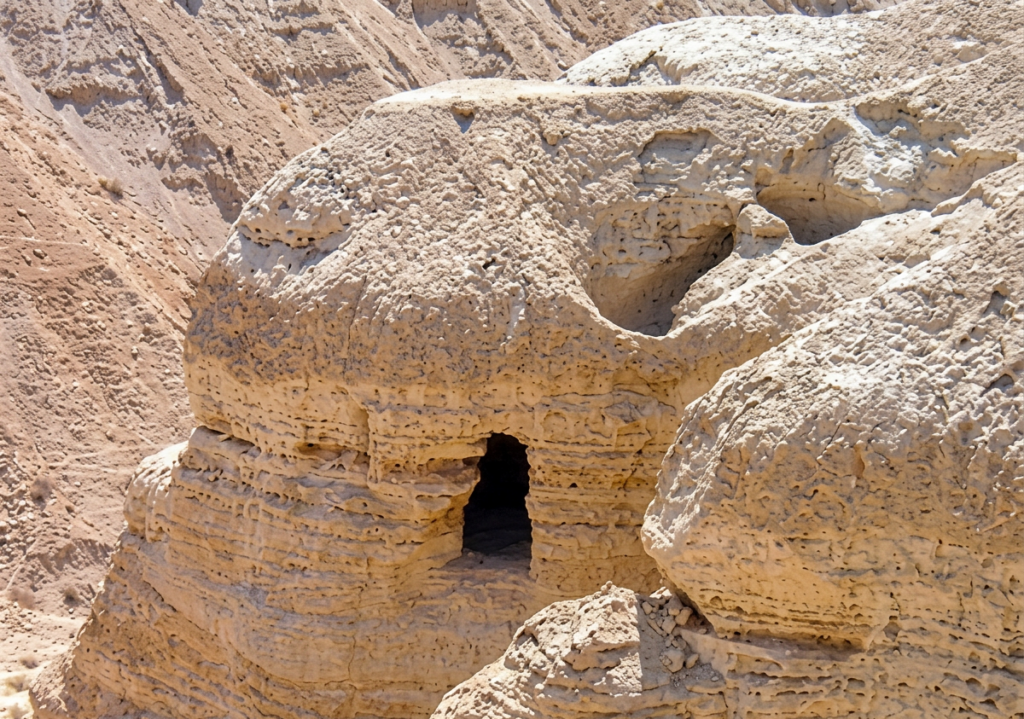
Between November 1946 and the spring of 1947, a young Bedouin named Muhammed edh-Dhib was searching for one of his goats in the Qumran region, located in the West Bank, near the northwestern shore of the Dead Sea. During this time, Muhammed discovered the first scrolls in a cave near Qumran while looking for his lost goat.

Throwing a stone into a small cave to see whether his goat was inside, Muhammed heard the sound of breaking pottery. Exploring further, he discovered several clay jars containing leather scrolls bearing Hebrew inscriptions.

Muhammed and his brother Jum'a sold the scrolls to a local antiquities dealer, who then resold them to scholars and institutions. This initial discovery attracted the attention of archaeologists and researchers, leading to systematic excavations in the region and to the discovery of 11 other caves containing thousands of manuscript fragments.

This accidental discovery revealed one of the greatest biblical treasures in history, offering a unique glimpse into the ancient texts and their transmission down the centuries.

II. The Release of Information Is Delayed

The publication of the Dead Sea Scrolls took place gradually. This period of waiting gave rise to various speculations. However, as we shall see, the delay is explained by technical and political reasons, not religious ones.

It is possible to trace the chronology of events precisely.

1947 : After the initial discovery by Muhammed edh-Dhib, the scrolls were sold to a local antiquities dealer, Kando, who then resold them to the Syriac Orthodox Archbishop Athanasius Samuel.
1948 : Athanasius Samuel displayed the scrolls at the French Biblical and Archaeological School of Jerusalem, and John C. Trever, an American researcher, took the first photographs of the manuscripts, helping with their identification and initial study.
1949 : The official announcement of the discovery was made by Eleazar Sukenik, an Israeli archaeologist, after he had acquired some of the scrolls through Kando.

Reasons for the Delay

Political Context: The discovery came during a period of great instability in Palestine, with the end of the British Mandate and the start of the Arab-Israeli war in 1948, which complicated the immediate release and study of the manuscripts.
Authentication and Acquisition: The process of acquiring the manuscripts by various institutions and verifying their authenticity took time.

Consequences

Additional Excavations: The initial announcements aroused great interest, leading to systematic excavations in the Qumran region, which lasted until 1956 and brought to light many more fragments.
Scientific Studies: The study of the manuscripts was long and complex, requiring years of work by international teams of specialists to analyze and publish the texts.

The delays in releasing this information gave rise to speculation, contributing to a climate of mistrust.
There was no official withholding of information concerning the discovery of the Dead Sea Scrolls by Muhammed edh-Dhib. The release of this discovery was gradual because of the historical context and the need for authentication and thorough study of the manuscripts.

III. The Nature of the Documents

The Qumran manuscripts are extremely varied and cover a wide range of subjects. Here are some of the types of documents found:

Biblical Texts

Old Testament: About 250 manuscripts are copies of books of the Old Testament, including very ancient versions of the Book of Isaiah and the Psalms.

Sectarian Texts

Essenes: Many manuscripts are attributed to the Essenes, a mystical Jewish sect. They include rules of life, prayers, and apocalyptic texts3.
War Rule: A text describing the rules of warfare and military strategies.
Solar Calendar: A calendar of 364 days.

Non-Biblical Texts

Commentaries: Commentaries on biblical books.
Liturgical Texts: Prayers and religious rituals.
Administrative Texts: Documents on the organization and management of the community.

These manuscripts offer a unique window on the religious and social life of the time, and they have greatly enriched our understanding of biblical and Jewish history.

IV. The Biblical Texts

Many biblical texts were discovered at Qumran. Here is the list:

Books of the Old Testament

Isaiah: One of the most famous manuscripts is the Great Isaiah Scroll (1QIsa), a complete copy of the Book of Isaiah dating from the 2nd century BC. It offers important textual variants compared with the Masoretic text.
Psalms: Several fragments of the Psalms were found, some corresponding closely to the Masoretic text, others showing significant variations.
Genesis and Exodus: Fragments of the first books of the , revealing minor textual differences from the Masoretic and versions.

Other Books of the

Deuteronomy: Several fragments, including interesting textual variants.
Ruth, Leviticus, Numbers: Fragments that have made it possible to study the textual variants and to understand the liturgical and legal practices of the time.

Prophetic and Historical Books

Jeremiah and Ezekiel: Fragments of these prophetic books with variations from the Masoretic texts.
Book of Kings: Fragments that have made it possible to compare the texts and to understand the development of the composition of the historical books.

Non-Canonical Texts

Jubilees, Enoch: Apocryphal and pseudepigraphal texts that are not part of the traditional but that were important to the Qumran community.

These Old Testament manuscripts are among the oldest witnesses to the , and they provide invaluable insights into the history of the biblical text and its development.

No text of the New Testament has been identified among the archaeological finds made at the Qumran site.

Conclusion

The discovery of the Dead Sea Scrolls near Qumran represents one of the greatest archaeological finds of the 20th century. Discovered in 1947 by a young Bedouin shepherd, these manuscripts transformed our understanding of ancient Judaism and of the origins of Christianity.

These manuscripts, dating from the 3rd century BC to the 1st century AD, offer a unique glimpse into the religious beliefs and practices of that period.

The manuscripts include copies of the Hebrew biblical texts, , as well as sectarian documents. They illustrate the diversity of religious thought and ways of life of the Jewish communities, notably those of the Essenes.

The manuscripts make it possible to compare the ancient versions of the biblical texts, often confirming the integrity of their transmission down the centuries.

They have revealed information about the Essenes, an ascetic Jewish sect, their beliefs, their practices and their apocalyptic view of the world.

A large part of these manuscripts is kept at the Israel Museum in Jerusalem, in the Shrine of the Book. This exhibition allows the public and researchers to examine these precious historical artifacts directly.

In short, the Dead Sea Scrolls are a notable discovery that continues to provide information to researchers, offering insights into religious traditions and ancient texts.

The main point of interest for us concerns the validation of the quality of the texts of the , confirmed by this exceptional discovery.