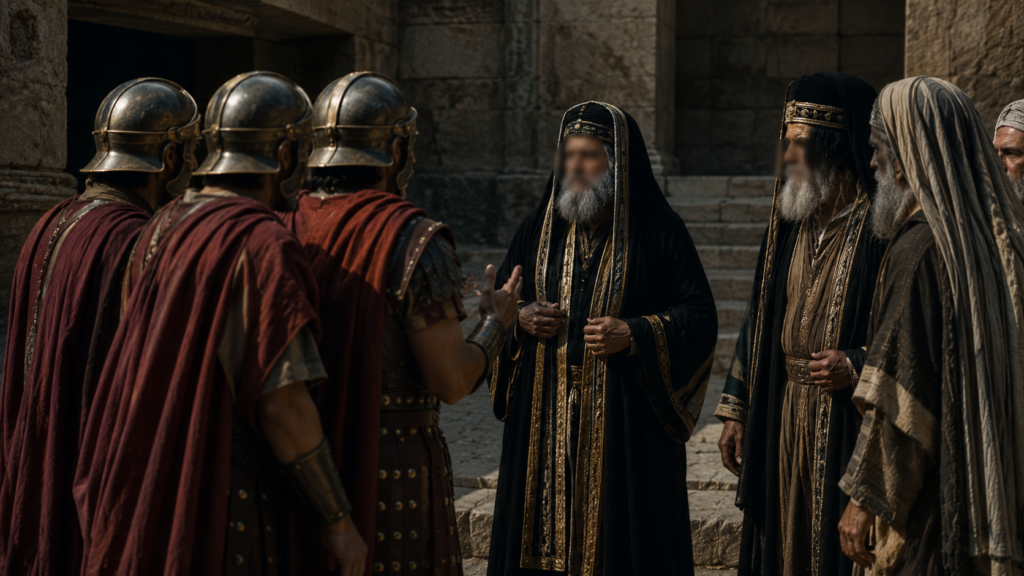

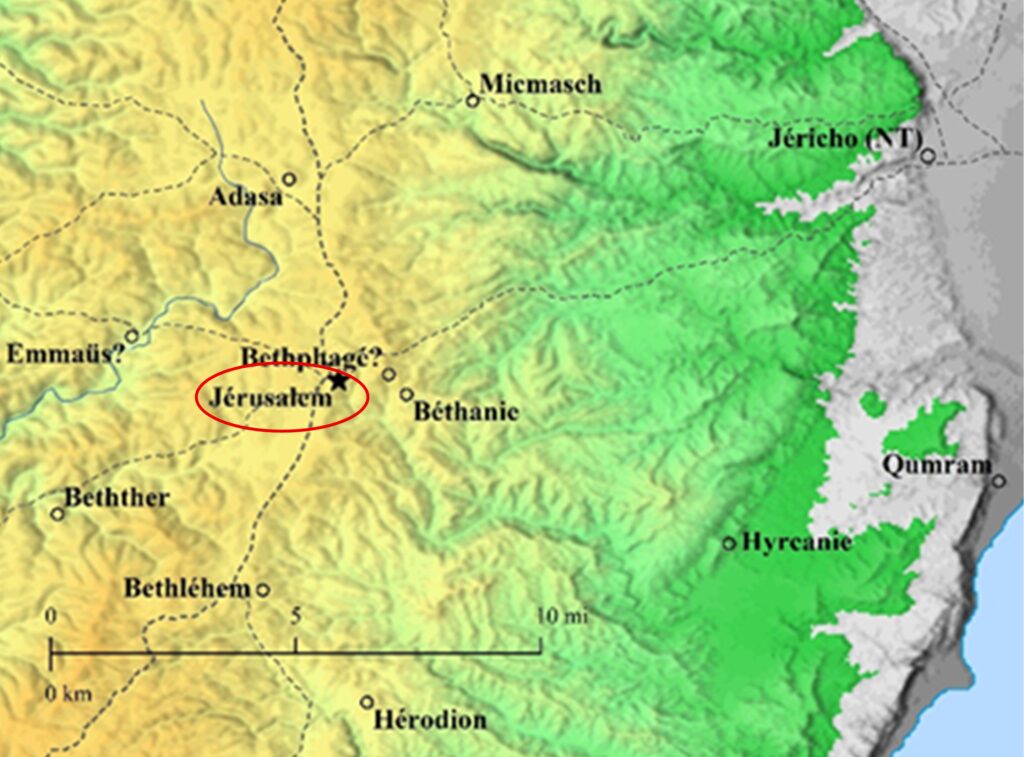

_29 One last small point remains to be dealt with: the Messiah Jesus had spoken of resurrection, so it is safer to place guards in front of the tomb. This is the request made to Pilate on the very day of the ; nothing stops these devout men. Matthew 27.62-66.
_30 The resurrection takes place on Sunday morning at dawn. We indeed have the 3 days and 3 nights according to the Jewish inclusive reckoning. Matthew 28.2-4 ; Mark 16.2-4 ; Luke 24.1-3. We take into account the night at midday.
_31 Now come the various appearances of the living Messiah Jesus, starting on Sunday, April 3, AD 33, early in the morning. John 20.11-18 ; Matthew 28.8-10 ; Mark 16.8 ; John 20.24-34 ; Mark 16.13-14 ; Luke 24.13-35 ; Mark 16.14 ; Luke 24.36-49 ; John 20.26-31 ; John 21.1-14.
You can consult the complete chronology in the study ANN026 : The hour of the crucifixion.
Commentary:
1- The testimony of the tomb guards
The guards assigned to watch the tomb were deeply shaken by the extraordinary events they had witnessed. Matthew reports that, following the earthquake and the appearance of the , they were seized with such terror that they became “like dead men” (Matthew 28.2-4).
After recovering their senses, some of them went to the chief priests to report to them “all the things that had happened” (Matthew 28.11). This detail is of particular importance, because the first witnesses of the events are not disciples of Jesus, but men foreign, even hostile, to the Christian movement.
2- Unwitting witnesses of the resurrection
These soldiers were subject to particularly strict discipline. According to military custom, negligence in the performance of their duty could bring severe penalties. They therefore had no obvious interest in inventing a story likely to compromise them.
Their testimony is all the more interesting in that it comes from unwitting witnesses who, at first sight, were not favorable to the disciples of Jesus. From this perspective, their approach to the religious authorities appears as the natural reaction of men trying to give an account of events that they could not explain themselves.
3- The difficulty of the official explanation
The chief priests and the elders then gathered in council and decided to give a large sum of money to the soldiers so that they would spread an official version of the facts (Matthew 28.12-13). They told them to say that the disciples had come and stolen the body while they were asleep.
This explanation, however, raises an obvious difficulty. If the guards were really asleep, how could they have identified the perpetrators of the alleged theft? Moreover, even supposing that they had been momentarily dozing, the violent earthquake mentioned by Matthew (Matthew 28.2) would in all likelihood have interrupted their sleep.
These remarks do not in themselves constitute a proof, but they highlight the internal weaknesses of the version put forward by the religious authorities.
4- The attitude of the religious leaders
Faced with these unexpected events, the members of the do not call into question in the least their judgment of Jesus. On the contrary, they seek to control the consequences of the disappearance of the body by arranging for the spread of an alternative interpretation (Matthew 28.12-14).
They even go so far as to promise the soldiers their protection in the event that the Roman governor should be informed of the matter (Matthew 28.14). This attitude reveals their determination to preserve their authority and to prevent the events that had occurred from leading the people to recognize Jesus as the promised Messiah.
Their behavior recalls that observed during the public ministry of the Lord, when several religious leaders refused to believe despite the signs performed before their eyes (John 12.37-40). This rejection is in keeping with what the Scriptures had foretold about the suffering Servant, despised and rejected by men (Isaiah 53.3), as well as with the warning given by Jesus himself about the stone rejected by the builders (Matthew 21.42).
5- A controversy still alive in Matthew’s time
Matthew specifies that this version of the facts “has been widely circulated among the Jews to this day” (Matthew 28.15). This remark indicates that, at the time of the writing of his Gospel, several years after the events, this controversy was still alive.
The very fact that the adversaries of Christianity felt the need to explain the disappearance of the body is indirectly an admission of the reality of the empty tomb. The debate therefore did not concern the existence of the body of Jesus, but the interpretation of its absence.
6- The origin of the information reported by Matthew
How Matthew came to know of this internal deliberation of the remains unknown. Several hypotheses have been put forward.
It is possible that some of the information was passed on by a member of the council favorable to Jesus, such as Joseph of Arimathea (Matthew 27.57 ; Mark 15.43) or Nicodemus (John 19.39). Other commentators have considered the possibility that one or more soldiers themselves reported these events.
None of these hypotheses, however, can be demonstrated with certainty. They should therefore be considered with caution.
7- An attempted cover-up with unexpected consequences
Paradoxically, this attempted cover-up helped to preserve the memory of these events. Far from putting an end to the matter, the religious authorities found themselves confronted with a reality they could not prevent: the proclamation of the resurrection was now going to spread well beyond the borders of Judea.
A few weeks later, the apostles began to proclaim publicly that God had raised Jesus from the dead (Acts 2.22-24 ; Acts 3.15). In accordance with the words of the Lord, this testimony was gradually to reach Jerusalem, Judea, Samaria, and the ends of the earth (Acts 1.8).
Thus, the attempt of the religious authorities to stifle the matter could not prevent the spread of the central message of Christianity: Jesus Christ is risen and he is alive (Acts 4.33).