

_29 One last small point remains to be dealt with: the Messiah Jesus had spoken of resurrection, so it is safer to place guards in front of the tomb. This is the request made to Pilate on the very day of the ; nothing stops these devout men. Matthew 27.62-66.
_30 The resurrection takes place on Sunday morning at dawn. We indeed have the 3 days and 3 nights according to the Jewish inclusive reckoning. Matthew 28.2-4 ; Mark 16.2-4 ; Luke 24.1-3. We take into account the night at midday.
_31 Now come the various appearances of the living Messiah Jesus, starting on Sunday, April 3, AD 33, early in the morning. John 20.11-18 ; Matthew 28.8-10 ; Mark 16.8 ; John 20.24-34 ; Mark 16.13-14 ; Luke 24.13-35 ; Mark 16.14 ; Luke 24.36-49 ; John 20.26-31 ; John 21.1-14.
You can consult the complete chronology in the study ANN026 : The hour of the crucifixion.
Commentary:
1- A Mysterious but Firmly Attested Appearance
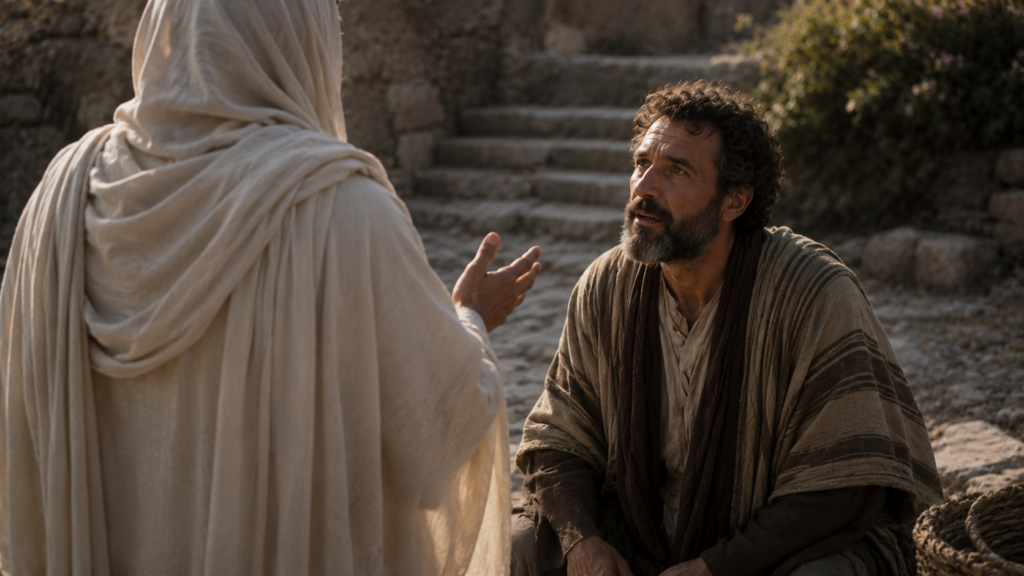
Among the appearances of the risen Christ reported in the New Testament, the one granted to Simon Peter remains one of the most enigmatic. Its existence is clearly attested, but no inspired author saw fit to report its content. Everything suggests that it was above all a deeply personal encounter between the risen Lord and his fallen disciple.
Two independent witnesses explicitly refer to this appearance. The disciples gathered in Jerusalem declare: “The Lord has really risen, and has appeared to Simon” (Luke 24.34). For his part, the apostle Paul recalls, in a text generally regarded as one of the earliest summaries of the Christian faith, that the risen Christ “appeared to Cephas, then to the twelve” (1 Corinthians 15.3-5).
The agreement between Luke and Paul shows that this appearance belonged to an ancient tradition, firmly established and widely recognized in the early Church.
2- The Place of This Appearance in the Chronology
The Gospels do not specify the exact time of this encounter. However, a harmonization of the various accounts makes it possible to place this private appearance on the very day of the resurrection.
It seems to have taken place after the appearances to the women (Matthew 28.9-10; John 20.14-18), but before the return of the Emmaus disciples to Jerusalem (Luke 24.33-35). It also precedes the collective appearance in the evening to the assembled disciples (Luke 24.36-49; John 20.19-23).
Although no absolute proof can be offered, this reconstruction leads us to think that Peter was the first of the apostles to behold the risen Lord.
3- The Memory of the Denial
A few hours before his arrest, Jesus had addressed particularly significant words to Simon Peter:
“Simon, Simon, Satan has demanded to sift you like wheat. But I have prayed for you, that your faith may not fail; and when you have turned back, strengthen your brothers” (Luke 22.31-32).
Despite this warning, Peter had denied his Master three times (Matthew 26.69-75; Luke 22.54-62). His sincere repentance appears in the bitter tears he shed after the rooster crowed (Luke 22.62).
In this context, several commentators consider it likely that this private appearance was meant to restore the repentant disciple before he resumed his place among the other apostles. This interpretation nevertheless remains a theological deduction, for the Scriptures report no detail about the content of their conversation.
4- The Particular Mention of Peter in the Angel’s Message
A remarkable detail appears in Mark’s account. The angel does not merely ask the women to inform the disciples; he explicitly adds: “But go, tell his disciples and Peter that he is going ahead of you into Galilee; there you will see him, just as he told you” (Mark 16.7).
This particular mention of Simon Peter is all the more striking because he had just denied his Master three times (Mark 14.66-72). Although he could have considered himself definitively disqualified and excluded from the apostolic circle, the heavenly message names him specifically among the recipients of this announcement.
Several commentators have seen in this detail a mark of the Lord’s grace toward his repentant disciple. Far from being rejected after his fall, Peter remains the object of the Risen One’s special attention. This personal mention may be compared with the words spoken before the Passion: “I have prayed for you, that your faith may not fail; and when you have turned back, strengthen your brothers” (Luke 22.32).
Although it does not allow us to conclude with certainty that Peter had already met the Lord when the women received this message, this detail nonetheless prepares the reader for the particular grace that would be granted to him. It announces, in a way, the restoration of the fallen disciple and the mission he would soon carry out within the early Church (Acts 1.15; Acts 2.14).
This individual mention of Peter is also an indication of the authenticity of the account. Such an apparently secondary detail is naturally explained if the memory of this word of the angel was carefully preserved within the apostolic tradition. It is also possible that Mark, generally regarded as Peter’s spokesman, deliberately retained this detail, which testified to the particular mercy shown to the apostle (1 Peter 5.13).
5- The Remarkable Silence of the Gospels
The silence of the sacred authors about this encounter is particularly striking. Unlike the appearances granted to Mary Magdalene, to the Emmaus disciples or to the group of the Eleven, no dialogue is reported.
Some exegetes see in this a deliberate intention to preserve the intimate nature of this encounter between the Lord and his disciple. The New Testament mentions other conversations whose exact content remains unknown. Thus Luke reports only a brief allusion to the teaching given to the Emmaus disciples (Luke 24.27), without reproducing the words.
This discretion perhaps helps to underline the deeply personal nature of the grace granted to Peter.
6- A Preparation for the Public Restoration of John 21
The private appearance on the day of the resurrection does not replace the public restoration reported later on the shores of the (John 21.15-19).
It is possible to discern two complementary stages here. The first would be a personal reconciliation, granted to Peter on the very day of the resurrection. The second would correspond to his public rehabilitation before the other disciples, several days later in Galilee.
Jesus’ threefold question, “Do you love me?” (John 21.15-17), naturally echoes Peter’s three denials (John 18.17; John 18.25-27). It is also on this occasion that the Lord renews his pastoral mission: “Feed my sheep” (John 21.17).
7- The Grace Granted to the Fallen Disciple
There is a striking contrast between Peter’s fall and the particular favor granted to him. The one who had publicly denied his Master becomes the first of the Twelve to receive a visit from the Risen One.
This reversal illustrates one of the great themes of the Gospel: grace triumphing over human failure. The same Peter who had faltered before a servant girl (Matthew 26.69-70) would become, a few weeks later, the principal spokesman of the apostles in Jerusalem (Acts 2.14-36) and would testify courageously before the (Acts 4.8-12).
The promise spoken before the Passion then finds its fulfillment: after turning back, Peter will indeed have the mission of strengthening his brothers (Luke 22.32).
8- An Encounter Marked by Grace
Thus, the appearance of the risen Christ to Simon Peter can be placed between the appearances granted to the women and the collective manifestation in the evening to the assembled disciples.
Although no detail of it has been preserved, the texts allow us to think that it was a private encounter intended to restore the one who had known the most painful of falls. The very absence of precise information perhaps invites the reader to focus not on the circumstances of this meeting, but on its deep significance.
The first of the apostles to have denied his Master also becomes the first of the Twelve to behold the Risen One. This particular grace granted to Peter already foreshadows the message the apostles would soon proclaim to the whole world: forgiveness and restoration are possible for all who return to God with repentance and faith (Acts 2.38; Acts 3.19).