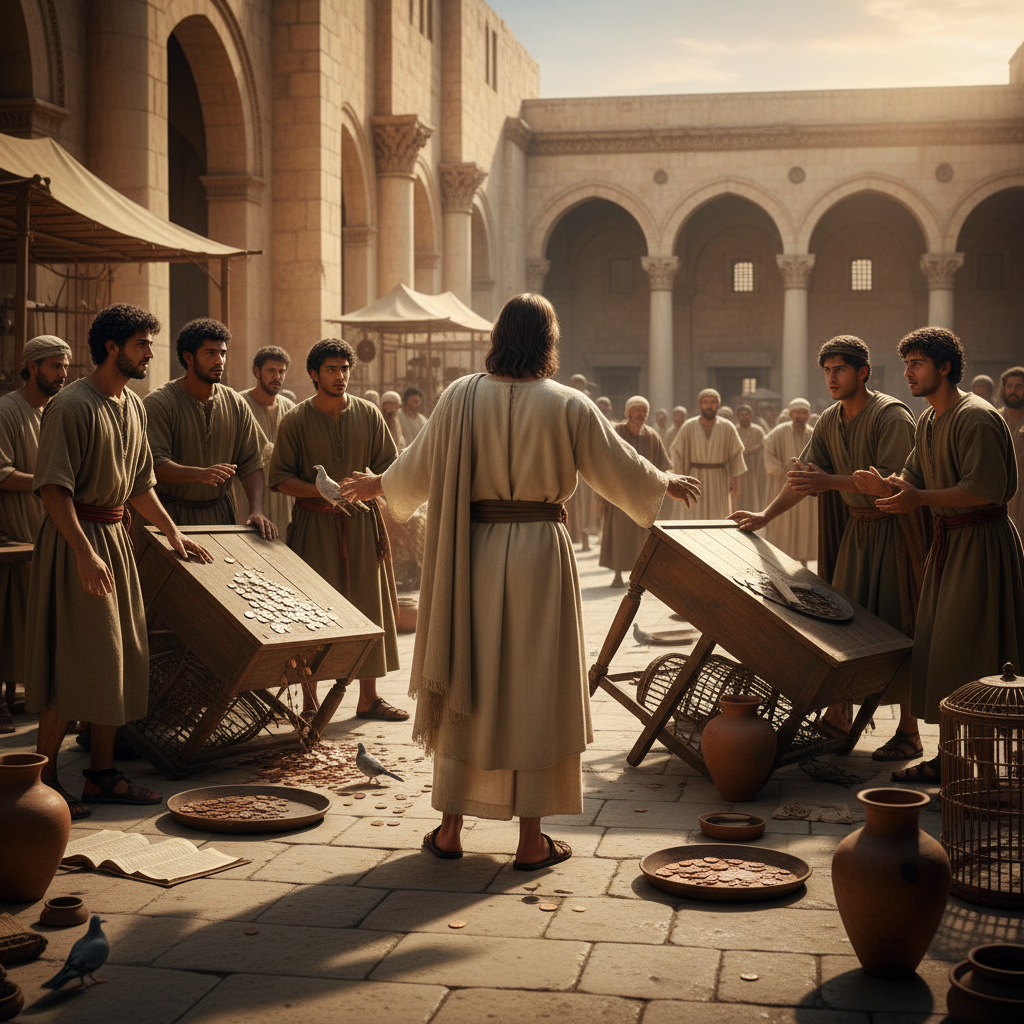


This, then, is the second time the Messiah Jesus drives the sellers out of the Temple. His action does not consist in expelling the whole multitude of merchants, which would immediately have provoked the intervention of the soldiers. It is an essentially symbolic act, meant to denounce the situation without triggering a bloody reaction. Those around him understand perfectly the message and the condemnation it expresses.
For three years nothing has changed (PER039): the Temple will no longer become a house of prayer. This cleansing takes place on the 10th of Nisan, the day on which, according to the law of Moses, the lamb intended for the Passover sacrifice was to be set apart (Exodus 12.3-8), which gives the action of the Messiah Jesus a particular prophetic significance.
On a practical level, the sellers stood at the periphery of the Court of the Gentiles, the outermost area of the Temple, in particular under the arches of the Royal Portico. They were therefore set up in the Royal Basilica, the large covered portico located south of the court, a space provided for the transactions needed for worship. Solomon's Portico, on the east, served rather for teaching and religious gatherings.
In time, these merchants began seeking their customers directly in the Court of the Gentiles. The space, originally reserved for the quiet reflection and prayer of non-Jews, turned into a veritable livestock market. The Temple authorities largely tolerated this situation, because they drew considerable revenue from these transactions. The system was by now fully integrated into the running of the Temple.
In this context, the intervention of the Messiah Jesus remains symbolic, because it seems that nothing can any longer correct this drift. However, many devout Jews were deeply saddened by it and probably welcomed Jesus' action.
The Messiah Jesus overturns the tables of the money changers, drives out the animal sellers and brings the commercial activity to a halt. He quotes Isaiah 56.7 (“My house shall be called a house of prayer”) and Jeremiah 7.11 (“You have made it a den of robbers”), thereby stating that he wants to restore the sacred calling of the Temple. He does not condemn commerce in itself, but the corruption, the injustice and the exploitation of worship. His action stands in the line of the prophets who denounced a hypocritical and perverted worship.
The Temple was meant to be a house of prayer for all nations, yet commerce was invading precisely the only space reserved for the nations: the Court of the Gentiles. By this action, the Messiah Jesus criticizes a worship that is rich in appearance but lacking true faithfulness, which the episode of the barren in the Gospel of Mark (PER282) also symbolizes.
The religious leaders perceive this gesture as a direct attack on their authority and their system. It is from this event on, according to Mark, that they seek more concretely to put the Messiah Jesus to death. His action thus becomes an implicit announcement of the judgment that will strike the Temple, destroyed in AD 70.
By driving out the sellers, the Messiah Jesus demonstrates his authority over the Temple. This prophetic, symbolic and messianic act denounces the corruption of worship, announces the judgment and shows that a new way of worshiping God is now opening.