
We invite you to consult the following studies on the parables: PAR038 : The Unjust Judge, as well as PAR000 : The Parables.
The discourse reported by Luke may be set at different times and in various places, which suggests that no strict chronology is followed in his narrative. It even seems very likely that Luke deliberately chose this point in the account to gather several teachings together. This approach allows him not only to omit certain contextual elements in order to make his account more concise, but also to enrich and develop his argument on the theme of the kingdom of heaven.
Thus, Luke presents accounts that do not necessarily follow a formal chronological order. On the contrary, he arranges his material according to a precise logic, structured around his theological aims. This organizing principle is explored further in the section titled “The ”. It is therefore essential, in studying these chapters, to take into account the author’s intention in the composition and structuring of his gospel.
The
The
The of the unjust judge (Luke 18.1-8) illustrates perseverance in prayer and belongs to a sequence of parables that develop the believer's response to the expectation of the Kingdom. It is part of a coherent whole in Luke, which contains about 24 parables, arranged according to a theological progression.
The Parable of the Unjust Judge: Content and Message
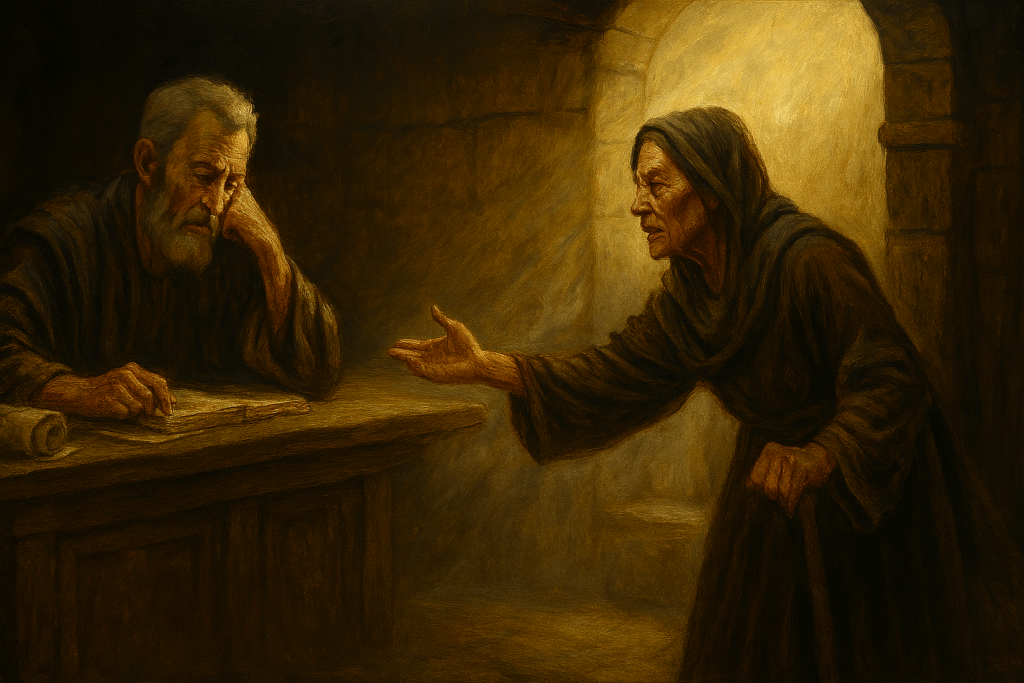
In Luke 18.1-8, the Messiah Jesus tells the story of a widow who, through her perseverance, obtains justice from an indifferent judge. The judge fears neither God nor men, but yields before the widow's insistence. The Messiah Jesus concludes that if an unjust judge can respond to perseverance, how much more will God, righteous and loving, respond to those who cry out to him day and night.
The main message: to persevere in prayer with faith, even when God seems slow to answer. The ends with a provocative question:
The Messiah Jesus thus underlines the link between prayer, faith and eschatological expectation.
Place in Luke's argument
Luke organizes his gospel around 24 parables, 18 of which are unique to his account. These parables are not scattered at random: they follow a thematic progression that accompanies the development of the ministry of the Messiah Jesus and prepares the disciples to live in expectation of the Kingdom.
Progression of the parables in Luke
Parables on the nature of the Kingdom (Luke 18.8, Luke 8.4-15, Luke 13.18-21) E.g.: The sower (Luke 8.4-15), the leaven and the mustard seed (Luke 13.18-21) → The Kingdom grows in secret, but with power.
Parables on the welcome of the Kingdom (Luke 14.15-24, Luke 15.11-32, Luke 16.19-31) E.g.: The great banquet (Luke 14.15-24), the prodigal son (Luke 15.11-32), the rich man and Lazarus (Luke 16.19-31) → God invites all, but many refuse or are blinded by their possessions.
Paraboles sur l’attente et la vigilance (Luke 17.7-10, Luke 18.1-8, Luke 18.9-14, Luke 19.11-27) Ex. : Le serviteur fidèle (Luke 17.7-10), le juge inique (Luke 18.1-8), le et le publicain (Luke 18.9-14), les mines (Luke 19.11-27) → Le Royaume tarde, mais il viendra soudainement. Il faut persévérer dans la foi et la prière.
The of the unjust judge comes at the beginning of this third section, right after the teachings on the coming of the Son of Man (Luke 17.22-37). It extends the call to watchfulness by showing that prayer is the concrete expression of this expectation.
Links with the other parables of Luke
Luke 11.5-13 : The persistent friend and the father who gives good gifts → God answers persevering prayer.
Luke 18.9-14 : The and the tax collector → Humble prayer is heard.
Luke 19.11-27 : The minas → Waiting for the Kingdom must be active and faithful.
Conclusion
The of the unjust judge is a keystone in Luke's argument on active faith while awaiting the Kingdom. It belongs to a series of parables that form an instructive progression, from the revelation of the Kingdom to the call to enter it, and then to live in faithfulness until its final fulfillment.