
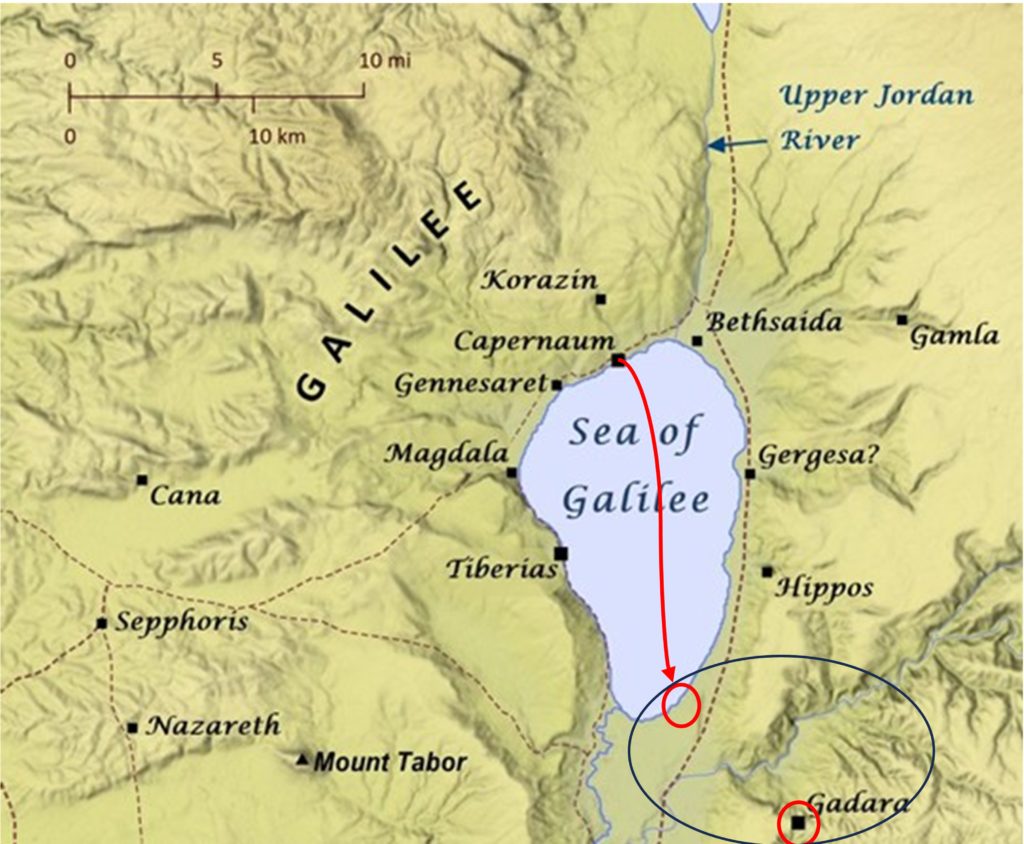
Gadara (Umm Qais) is located in northern Jordan, near the border with Israel and Syria. It is about 10 km south of Lake Tiberias () and east of the Jordan Valley. In any case, the scene takes place on the shore of Lake Tiberias, therefore in the territory of the .
Jesus the Messiah and his disciples arrive in the region of Gadara (or Gerasa) by crossing the lake. Upon their arrival, Jesus the Messiah meets men possessed by demons, living among the tombs. These men are so violent that no one dares to pass that way.
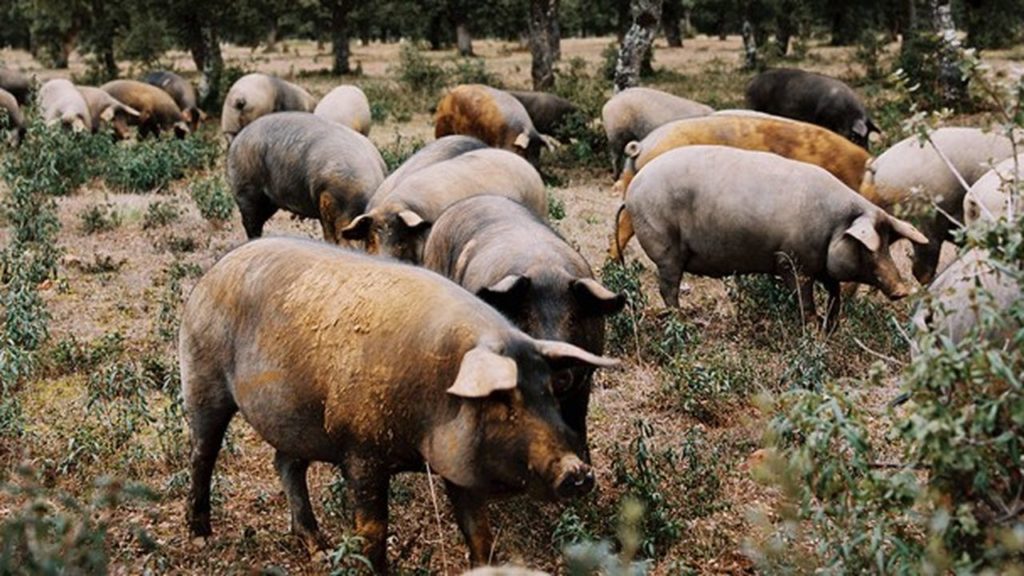
Recognizing Jesus the Messiah as the Son of God, the demons beg him not to torment them and ask to be sent into a herd of pigs. Jesus agrees, and the demons enter the pigs, which rush into the lake and perish. The herdsmen flee to report what happened, and the inhabitants of the city, frightened by this event, come to meet Jesus and beg him to leave their region.
This scene highlights the power of Jesus the Messiah over demonic forces, as well as the reaction of the witnesses of this miraculous event.
The accounts of the deliverance of the demoniacs of Gadara are found in the Gospels of Matthew 8.28-34, Mark 5.1-20 and Luke 8.26-40. Each evangelist provides unique details and highlights different aspects of the event.
Matthew 8.28-34
In the Gospel of Matthew, Jesus meets two men possessed by demons in the region of Gadara. These men are extremely violent and no one dares to pass that way.
The demons, recognizing Jesus as the Son of God, beg him not to torment them before the time and ask to be sent into a herd of pigs. Jesus the Messiah agrees, and the demons enter the pigs, which throw themselves into the lake and perish.
The herdsmen flee to announce what happened, and the whole city comes to see Jesus, but the inhabitants, frightened, beg him to leave their region. Matthew emphasizes the presence of two demoniacs, which differs from the accounts of Mark and Luke.
Mark 5.1-20
In the Gospel of Mark, Jesus arrives in the country of the Gerasenes and meets a man possessed by an unclean spirit. This man lives among the tombs and no one can subdue him, even with chains. When he sees Jesus the Messiah, he runs and bows down before him, crying out: "What do you want with me, Jesus, Son of the Most High God? I adjure you, do not torment me."
Jesus the Messiah asks him his name, and the spirit answers: "Legion, for we are many." The demons beg Jesus to send them into the pigs, and Jesus gives them permission. The pigs then throw themselves into the lake and perish. Mark indicates that the number of pigs is about 2000, which represents a significant quantity.
The possessed man is healed and wants to follow Jesus, but Jesus the Messiah tells him to go back home and tell what the Lord has done for him. Mark concentrates on a single demoniac and gives details about the man's condition and the dialogue between Jesus and the demons.
Luke 8.26-40
The Gospel of Luke presents an account similar to that of Mark. Jesus the Messiah arrives in the country of the Gerasenes and meets a man possessed by demons. This man wears no clothes and lives among the tombs. When he sees Jesus the Messiah, he cries out and bows down before him, imploring Jesus the Messiah not to torment him.
Jesus the Messiah asks the name of the demon, who answers: "Legion." The demons beg Jesus to send them into the pigs, and Jesus the Messiah agrees. The pigs throw themselves into the lake and perish. The herdsmen flee to tell what happened, and the inhabitants, seeing the man healed and seated at the feet of Jesus the Messiah, are frightened and ask Jesus the Messiah to leave.
Luke, like Mark, emphasizes a single demoniac and details the reaction of the inhabitants after the miracle.
Differences between the Accounts
Number of Possessed Men:
Matthew mentions two demoniacs.
Mark and Luke speak of a single demoniac.
Details of the Encounter:
Matthew mainly emphasizes the interaction with the demons and the reaction of the inhabitants.
Mark and Luke give more details about the man's condition before and after the healing, as well as the dialogue between Jesus and the demons.
Context and Location:
All the accounts mention that the event takes place in the region of Gadara or of the Gerasenes, but the geographical details vary slightly.
Reflection on Matthew's Statement
If Mark and Luke speak of a demoniac, they do not specify that he was alone. They obviously focused on the more furious and violent of the two, in any case the one who showed the most hostility toward Jesus the Messiah.
It is possible that Matthew included both possessed men to emphasize the extent of the miracle of Jesus the Messiah, while Mark and Luke chose to concentrate on a single man in order to develop his personal story and his remarkable transformation.
These variations do not affect the essence of the miracle and testify to the richness of the Gospel accounts, offering complementary perspectives on the events of the life of Jesus the Messiah.
Observation
The storm that occurred during the journey to Gadara was unusual because, although the apostles, mostly experienced fishermen, were used to the violent winds of this sea, they were frightened. This leads us to reflect on the real origin of this storm.
Moreover, this violent storm occurred while Jesus was traveling to Gadara to heal a man, and not on his return. It is conceivable that forces, unaware of the exact intention of Jesus the Messiah but suspecting the possibility of a miraculous act, sought to hinder this journey, or even to endanger his safety.