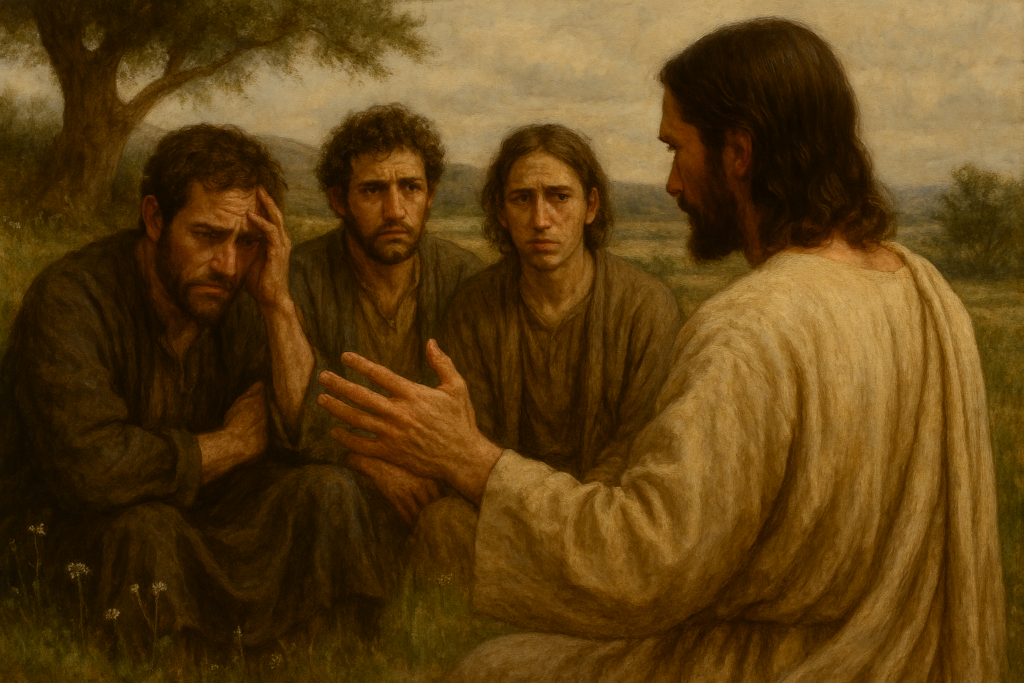

Despite the presence of thousands of people (Luke 12.1), Jesus specifically addresses his disciples at certain moments (Luke 12.1). His discourse to the crowd is interspersed with remarks directed particularly to his disciples (Luke 12.22).
This form of expression bears similarities to the Sermon on the Mount as reported by Matthew. More precisely, the theme addressed here corresponds to that of Matthew 6.25-34. To highlight these similarities, we have rewritten this passage from Matthew (see the pericope PER100: The Sermon on the Mount (16), cares and worries).
It is relevant to consider whether Luke chose to change the setting of this discourse, or whether the Messiah Jesus actually repeated this message in various places and before different audiences.
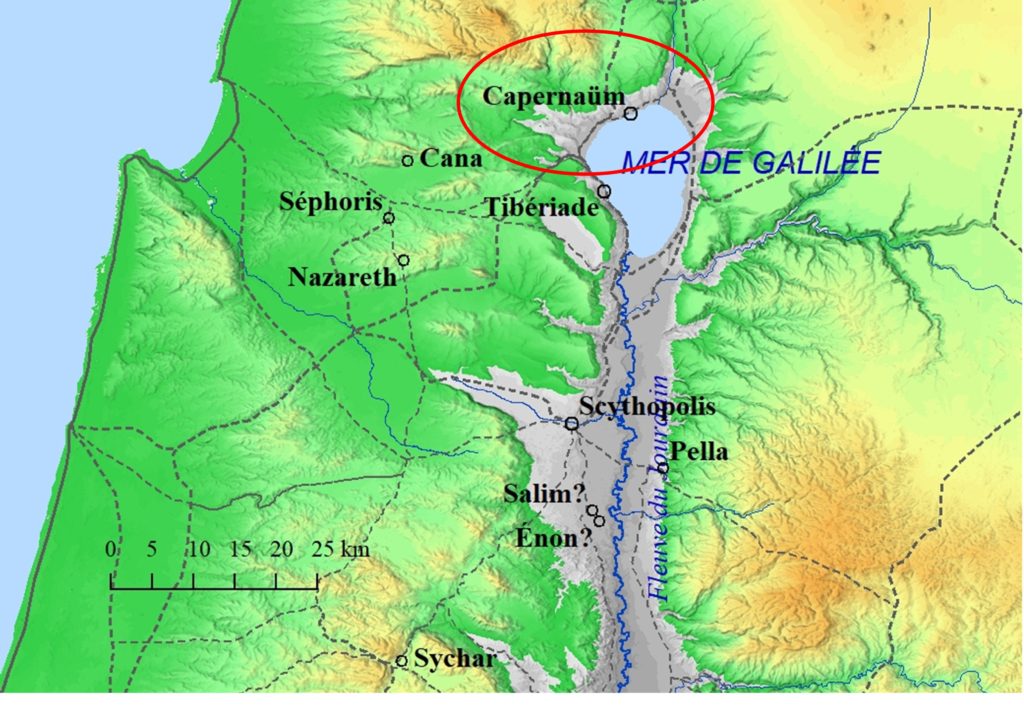
Our analysis shows that Jesus delivered his message in various circumstances. The places, the size of the crowds, and the periods mentioned by Matthew and Luke differ, although the same words are attributed to Jesus. It is therefore evident that Matthew and Luke are speaking of distinct events.
We identify three main elements in the Master's argument that demonstrate the irrationality of concerns about material needs, particularly food and clothing.
The first point offered by Luke 12.22-24 emphasizes that there is no need to worry about food or clothing, because life is more important. God feeds even the birds, so he will take even better care of his disciples, who have greater value in his eyes.
We observe a difference between the two texts. Matthew refers generally to a "bird," whereas Luke specifically refers to ravens. This bird is among the unclean animals according to the law of Moses (Leviticus 11.13-19, Deuteronomy 14.12-18). This strengthens Luke's argument.
The second point emphasizes that worrying about material needs is pointless, because it does not change the situation, apart from adding stress (Matthew 12.25-28). The Messiah Jesus uses an analogy involving the lily and the grass of the field, which have little value compared with human beings. The conclusion is explicit: if God cares for the grass of the field, he will care all the more for human beings, regarded as the pinnacle of his creation.
The third point states that, according to the Messiah Jesus, it is the pagans who attach greater importance to material goods, thus neglecting spiritual matters, which they regard as far less essential. He also affirms that whoever seeks first the kingdom of God, that is, spiritual values, will receive from God what they truly need.
He concludes his demonstration by emphasizing that the priority remains the pursuit of the Kingdom of God, or spiritual values. He explains that in these circumstances, God will provide for their needs. In this way, he gives practical illustrations of the earlier discourses about commitment to God, thus allowing the disciples to benefit from his protection.