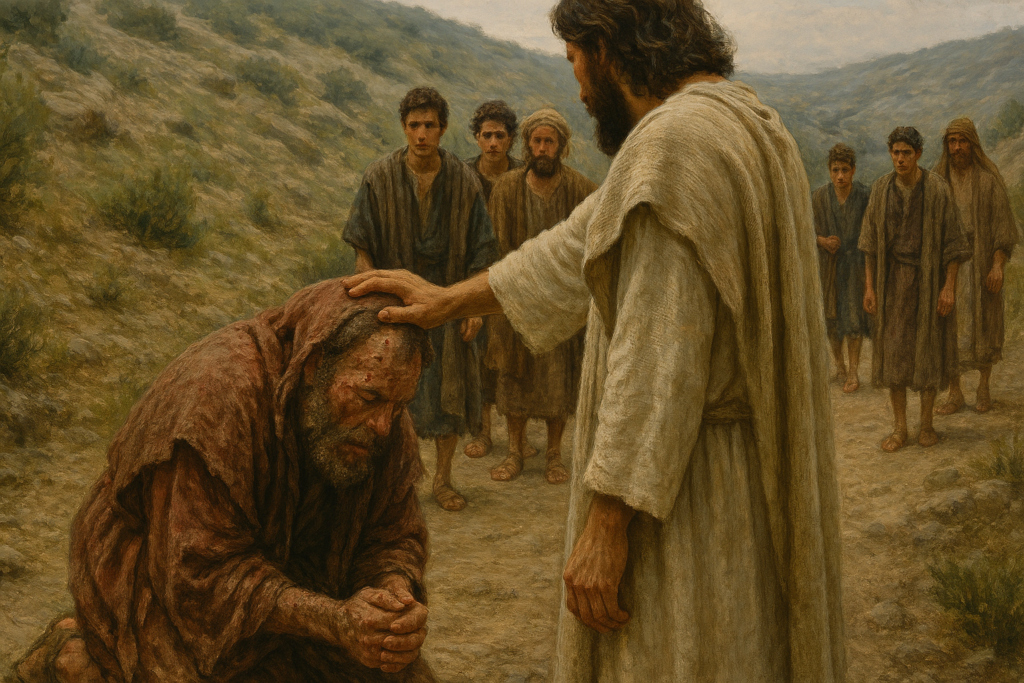


Reading Matthew’s text, we observe that this leper is healed by the Messiah Jesus as he comes down from the mountain after his sermon. Mark 1.40-44 mentions a similar healing and places it before the second pilgrimage to Jerusalem (PER063). Luke 5.12-14 also records this healing, with an account close to Mark’s.
We understand that this is another healing, but we are surprised by the similarity of the wording. The Messiah Jesus frequently urged those who had been healed not to tell others, but they found it difficult to remain silent. Did this leper use the same wording as the other one?
Fortunately, cases of were not very numerous, but for those who suffered from it, life quickly became a nightmare. They were forced to live in isolation, without any contact with the rest of the population, and were strictly forbidden to break this obligation, on pain of serious consequences.
Groups would gather, and whenever a healing occurred, the news spread rapidly. Such a healing could immediately draw all the sick to Jesus. However, his main purpose was to proclaim the Kingdom of God and the salvation of souls.
For this reason, he often forbade those who had been healed from revealing the circumstances of their recovery.
Can we consider similar wording to describe the same miracle recounted differently by Matthew, or is this a separate healing? If it is a new miracle, the leper may have been influenced by his friend’s testimony. If it is the same event, Matthew probably wanted to illustrate how the crowds, particularly the sick, constantly sought the intervention of Jesus the Messiah. It is also noteworthy that he follows it with another miracle, the healing of the officer’s servant.
Regarding the miracle, it is noteworthy that the Messiah Jesus does not hesitate to touch the sick man, despite the Law’s prohibition. However, it is intriguing to observe this man’s presence near the crowd, when he should have isolated himself in accordance with the Law (Leviticus 13.1).
Matthew emphasizes that the multitude was following the Messiah Jesus, which probably enabled this man to approach him. The apostle insists that the healing was instantaneous; otherwise, the man would have been stoned by the crowd. By taking such a risk and being healed, we can infer that the Messiah Jesus also saved his life. At that time, no one took this disease lightly!
We observe that Matthew’s version presents no difficulty, suggesting that this could be a separate incident.
In each case, the person had to go and see the priest, as described in chapters 13 and 14 of Leviticus. We observe that the Messiah Jesus strictly observes the Law of Moses. This was also the only way a sick person could rejoin society.