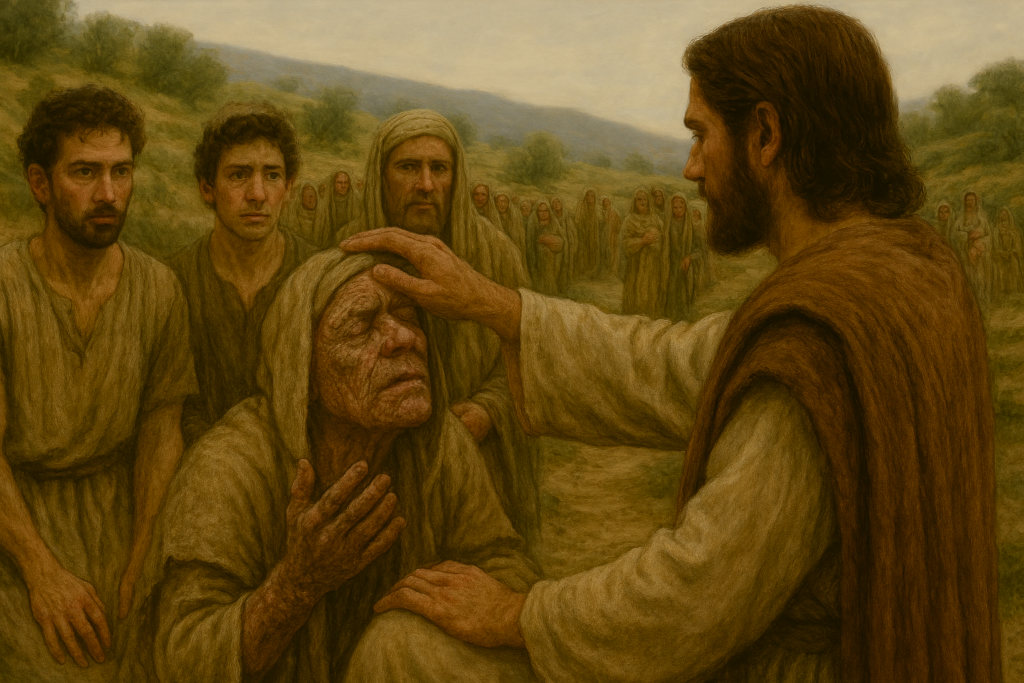

We have followed Mark's chronology. Indeed, it seems clear that Jesus the Messiah healed many lepers; this disease, common at the time, condemned the sufferer to complete isolation. This scene was therefore repeated many times and could have been placed at another point.
Contrary to customary practice, Jesus the Messiah takes the risk of touching the sick man. This gesture makes an impression and bears witness to his authority. The man will be healed!
The Teacher orders him to tell no one. Indeed, too many people came only to watch a spectacle. It therefore seems that this healing took place without witnesses. It would have been impossible for this man to approach Jesus the Messiah if people had been present; because of his disease, he was condemned to complete isolation, on pain of if he broke this rule.
Jesus the Messiah asks him to observe the law concerning (Leviticus 14.1-32). This step will allow the man to return to society. This act will pose a moral dilemma for these priests, since they considered the disease incurable. Hearing from the man himself that Jesus the Messiah had healed him, they had to understand that this miracle came from God, for no human being has such healing power.
Furthermore, the cleansing of this leper constitutes a messianic sign according to Matthew 11.5, Luke 7.22 and Isaiah 35.4. We develop this theme in the pericope PER113: John the Baptist's question.
Under these circumstances, the quotation in Matthew 11.5 and Luke 7.22, ‘as a testimony to them’, would mean that, for these priests, this miracle was to constitute proof of Jesus' messiahship. These religious figures would therefore face a choice: either Jesus is the Messiah, in which case why do they not recognise him? Or Jesus the Messiah is an impostor; in that case, by what power does he bring about these deliverances?
We thus sense in these words a certain tension with the priests, especially the . This tension will only intensify in the years ahead. It will culminate in the Teacher's murder. Indeed, as we shall see, the Synoptic Gospels often evoke this poisonous atmosphere surrounding the , who categorically refused to recognise Jesus as the Messiah.
We could have expected this, for the prophecy in Daniel 9.24-27 had already told us so!