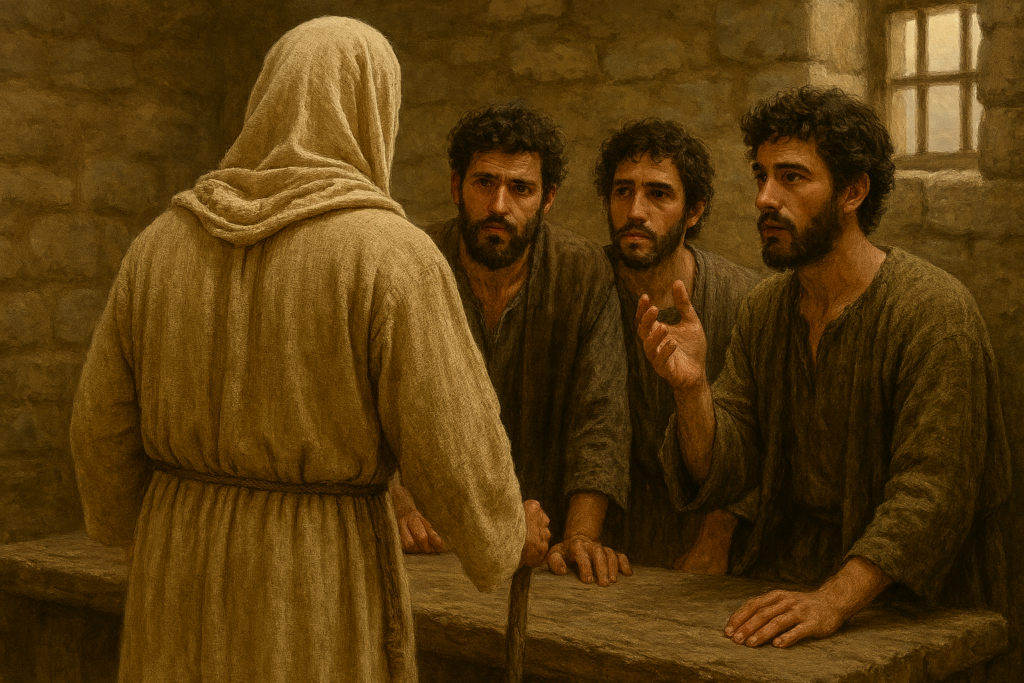

It may seem surprising to see John the Baptist, then in prison (Matthew 11.2), ask this question. After all, when he saw Jesus the Messiah coming to be baptised, he had clearly proclaimed: ‘Behold, the Lamb of God’ (John 1.29).
We discuss this question in the appendix ANN003: ‘The birth and ministry of John the Baptist’.
Was John anticipating the imminent coming of the Kingdom of God? Jesus the Messiah’s behaviour towards people, as well as his associations, did not meet his expectations. This issue highlights the divergence between their two ministries.
In fact, Jesus the Messiah is fully aware of the challenges arising from this difference in ministry, since he will mention this difference in behaviour before the (Matthew 11.18). We will explore Jesus the Messiah’s argument further in our analysis of the next pericope.
The question asked by John the Baptist and relayed by his disciples will lead to a discourse addressed not only to the but also to the crowd. This indicates that Jesus the Messiah’s actions raised many questions, especially among those who had spent time with John the Baptist, and there were many of them.
Jesus Christ answered through his deeds: he heals the sick, including the blind, lepers, the lame and the deaf, and raises the dead, while proclaiming the Gospel to the poor.
This is why Matthew’s references to the healing of the leper (Matthew 8.1-4) and that of the lame or disabled man (Matthew 8.5-13) present chronological difficulties. He had already mentioned the healing of two blind men Matthew 9.27-31) as well as the deliverance of a deaf and mute man (Matthew 9.32-33).
Did he mention these examples to support Jesus’ answer, even though they occurred at another time?
Why, then, did he not mention the resurrection of the widow’s son at Nain? After all, this miracle seems the most remarkable.
We may find part of the answer in the passage quoted by Jesus the Messiah: Isaiah 35.5. It concerns only the blind, the deaf and mute, and the lame. In these circumstances, Matthew follows this passage to the letter and confirms it point by point. This explains why the widow’s son at Nain is not mentioned.
We also know that the words of this prophet, one of the best known at that time, would surely resonate with John the Baptist. Jesus the Messiah therefore declares here that he fulfils everything said about him.
But the most important part of this answer remains what is left unsaid, which everyone at that time could understand. This information is found in the preceding verse.
Thus, John the Baptist is able to understand fully the .
Although John the Baptist’s reaction remains undocumented, this answer could only strengthen Jesus’ position as the Messiah foretold in the Scriptures. We may therefore deduce that these words both satisfied and gladdened the soul and heart of this great prophet.