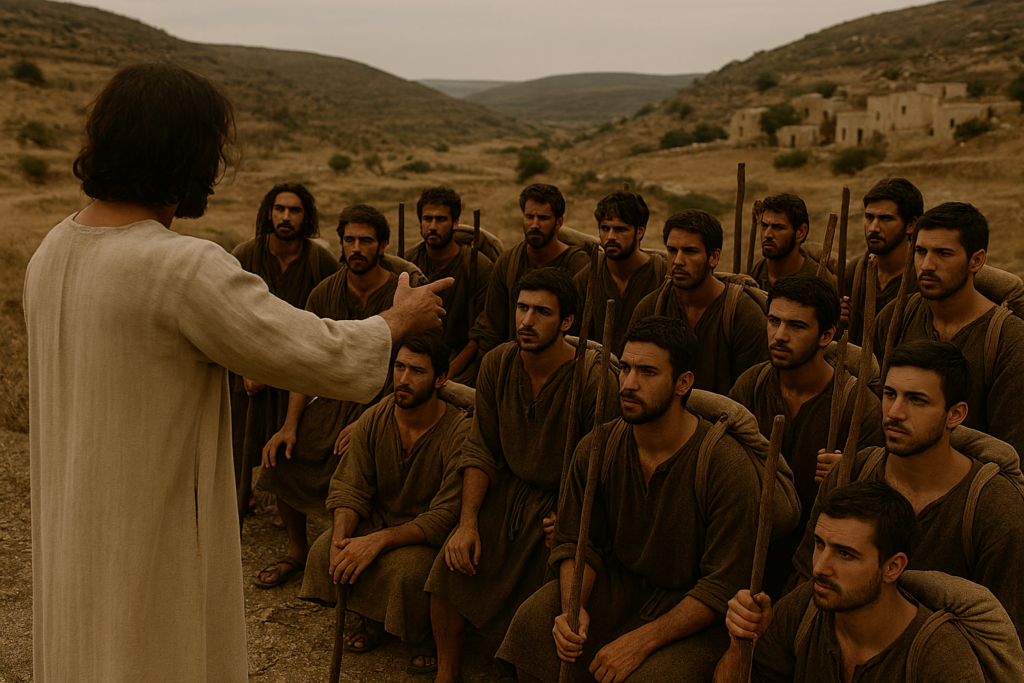


The first instruction, reported only by Matthew, is surprising because Jesus the Messiah asks his disciples to go exclusively to the rather than to non-Jews or the . How should we understand these instructions? Is the Gospel reserved only for Jews? That is what these lines seem to suggest. Yet why did Jesus the Messiah preach at Sychar in Samaria or at Tyre and Sidon?
Matthew 15.24 recounts a particular conversion in which a foreign woman is blessed despite Jesus the Messiah's words recalling this instruction: ‘I was sent only to the lost sheep of the community of Israel’ (PER180). This instruction from Jesus the Messiah should be understood as giving priority to the sheep of the house of Israel rather than excluding everyone else.
Thus, the message is intended first for the Jews, then for the nations. This people was to accept its king, Jesus the Messiah, and then become a source of blessing for all peoples (Genesis 12.3 and Isaiah 60.3). Addressing Jews, Matthew shows them their priority in God's plan of salvation. Mark and Luke, who direct their accounts to non-Jews, avoid emphasising the Jewish people's primacy.
Having specified their mission's aim—to proclaim God's kingdom and encourage people to repent—the three authors list a series of items they were not to take.
Why do Matthew and Luke prohibit a staff in their lists (Matthew 10.10 and Luke 9.3), whereas Mark excludes it from these prohibitions (Mark 6.8)? Mark also permits sandals (Mark 6.9), while Matthew 10.10 forbids them and Luke does not mention them! We answer these questions in appendix ANN094: The apostles' staff and sandals.
The Teacher's instructions are clear: the apostles offer the message of salvation; they do not impose it. They must turn only to those who accept their words, simply proclaiming rather than debating or proving. The results clearly show that Jesus the Messiah delegated to them authority and power that he alone had previously displayed.