
PER080

The choosing of the 12 Apostles

Jesus chooses twelve disciples from among his followers and gives them the title of apostles, a Greek term meaning ‘sent on a mission’. This choice, made after a night of prayer, corresponds to the number of Israel's tribes. The Twelve receive authority to heal and proclaim salvation, forming the foundation of the future Church. The article explores the term's etymology, Jesus' prayer, the question of his omniscience and the case of Judas Iscariot.

7 min apostles choosing the Twelve Jesus the Messiah disciples Galilee 6 verses 5 books

Resources

Biblical texts

Matthew
Matthew 9.38 (King James Version)

Pray ye therefore the Lord of the harvest, that he will send forth labourers into his harvest.

Matthew
Matthew 10.1-4 (King James Version)

And when he had called unto him his twelve disciples, he gave them power against unclean spirits, to cast them out, and to heal all manner of sickness and all manner of disease.

Now the names of the twelve apostles are these; The first, Simon, who is called Peter, and Andrew his brother; James the son of Zebedee, and John his brother;

Philip, and Bartholomew; Thomas, and Matthew the publican; James the son of Alphaeus, and Lebbaeus, whose surname was Thaddaeus;

Simon the Canaanite, and Judas Iscariot, who also betrayed him.

Mark
Mark 3.13-19 (King James Version)

And he goeth up into a mountain, and calleth unto him whom he would: and they came unto him.

And he ordained twelve, that they should be with him, and that he might send them forth to preach,

And to have power to heal sicknesses, and to cast out devils:

And Simon he surnamed Peter;

And James the son of Zebedee, and John the brother of James; and he surnamed them Boanerges, which is, The sons of thunder:

And Andrew, and Philip, and Bartholomew, and Matthew, and Thomas, and James the son of Alphaeus, and Thaddaeus, and Simon the Canaanite,

And Judas Iscariot, which also betrayed him: and they went into an house.

Luke
Luke 6.12-16 (King James Version)

And it came to pass in those days, that he went out into a mountain to pray, and continued all night in prayer to God.

And when it was day, he called unto him his disciples: and of them he chose twelve, whom also he named apostles;

Simon, (whom he also named Peter,) and Andrew his brother, James and John, Philip and Bartholomew,

Matthew and Thomas, James the son of Alphæus, and Simon called Zelotes,

And Judas the brother of James, and Judas Iscariot, which also was the traitor.

John
John (King James Version) not cited in the book

Technical details

Bar chart for the year 31

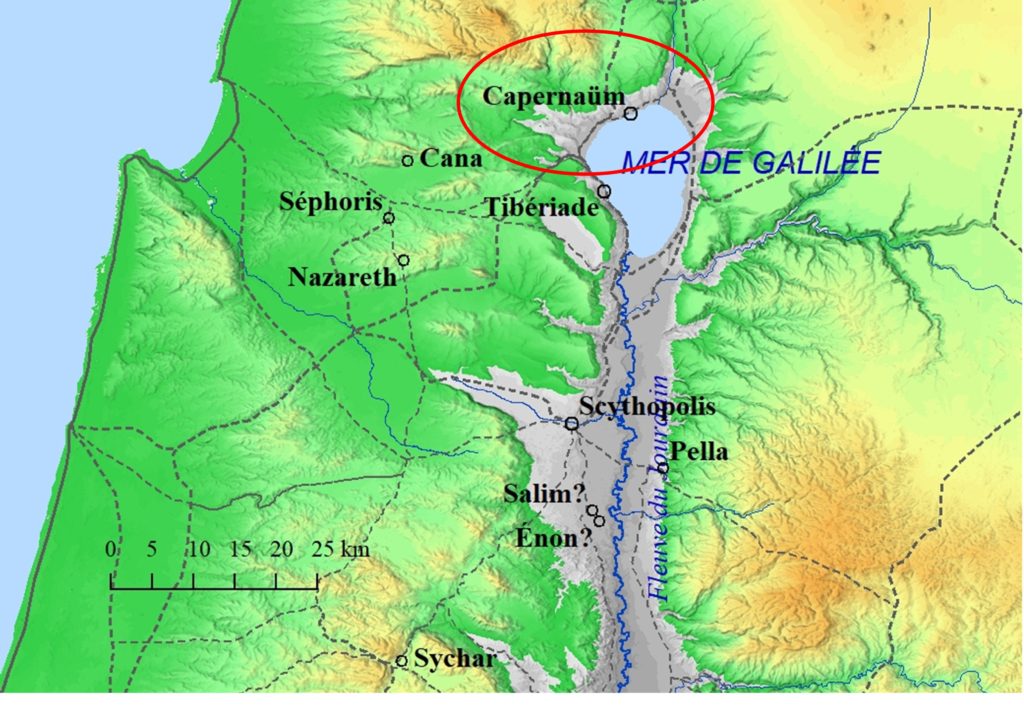
Location: On a mountain near Capernaum in Galilee, with a plateau below

Date: After the Passover pilgrimage to Jerusalem on April 5, AD 31

Approach: We follow Mark's chronology

Note on the approach: Mark placed this appointment immediately after the many healings performed in Galilee

Capernaum

Jesus the Messiah will now select twelve disciples and give them the title of apostles.

The choosing of the 12 Apostles

The choosing of the 12 Apostles

Comments

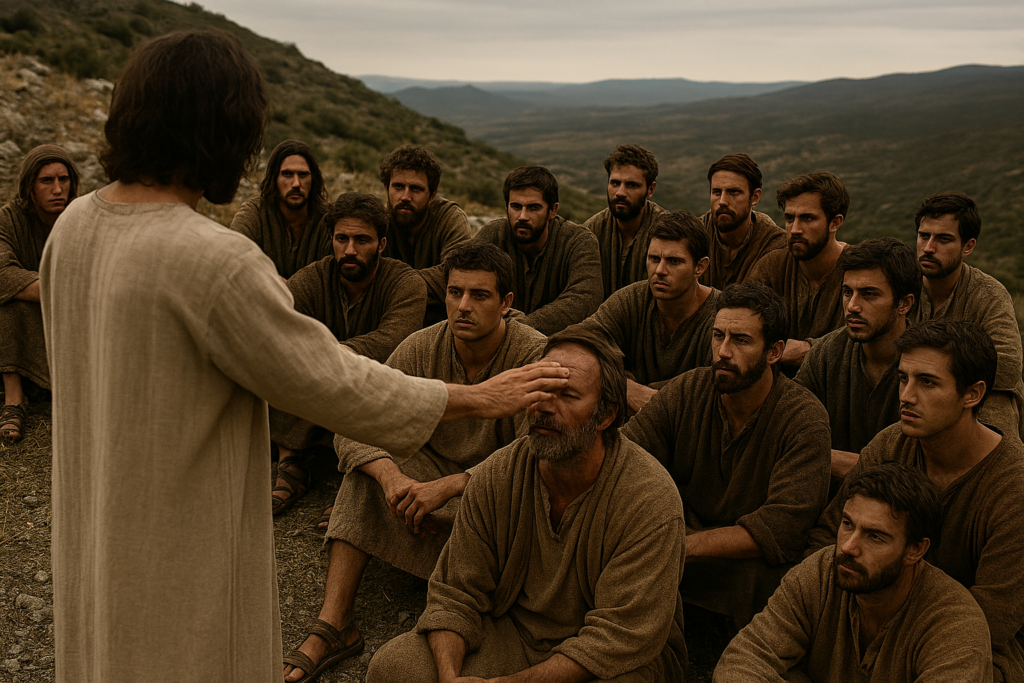
From among the many disciples who followed him, Jesus the Messiah chose twelve, corresponding to the number of Israel's tribes, and gave them the title of apostle.

The term ‘apostle’ comes from the ancient Greek ἀπόστολος / apóstolos, generally meaning a ‘messenger’ entrusted with a mission. In the Septuagint, the Greek version of the Bible, this word is applied to individuals; it translates the Hebrew shaliah, ‘plenipotentiary envoy’. The word is formed in ancient Greek from ἀπὸ, indicating sending or mission, and στέλλω, meaning to arrange or send.

These men, having become ambassadors of God's kingdom, will be given the power to heal the sick and proclaim the message of salvation. Jesus the Messiah thus delegates a degree of authority to them. After his death, they will be regarded as the pillars of the Church. Their reputation will ensure that the accounts of their testimonies, which they will write down, are naturally accepted.

The difference between their decision to follow this new Teacher in Judea (PER033, PER034), their calling on the shores of the (PER054, PER066) and this appointment is explained in the appendices cited at the beginning of this paragraph. We observe the organisation of a rapidly expanding work. This structure makes it easier to meet the crowd's many needs and also prepares for the future, particularly after the crucifixion.

These apostles, or ambassadors, will receive specific training from the Teacher. They will form a very close-knit group recognised and respected by the Church (Acts 5.13).

We observe that Jesus the Messiah chose his twelve apostles after a night of prayer, as Luke reports. Despite his divinity, Jesus did not act independently but always in harmony with the Father. Thus, the Trinity—Father, Son and Holy Spirit—formed a unity.

Several questions then arise: Was he praying to discern the next stage in developing his work? Was he seeking to know these men's identities? Was he imploring divine support for these men in their ministry?

We believe Jesus knew the time had come to select twelve men to prepare them for the arduous task of succeeding him (John 17.15). He knew the motives of the disciples who followed him, so choosing twelve of them seems quite natural. Did he know then that Judas Iscariot would betray him? Was he aware that he would steal money from the purse for which he was responsible? We offer elements of an answer in appendix ANN032: Judas Iscariot.

Jesus the Messiah was aware of his disciples' difficulties in understanding his work and believing in his omnipotence. This leads us to think that his prayers sought God's confirmation of the list of names of these men called to continue his work after his death, and the abilities they needed to carry out this difficult task.

We discuss the omniscience of Jesus the Messiah in the previously cited appendix. That is why we do not go into detail here.