ANN094

The apostles' staff and sandals

The article explores the differences between Matthew, Mark and Luke concerning the apostles' mission, highlighting linguistic nuances and differing audiences. Matthew advises against acquiring new possessions; Mark advocates taking only the bare essentials, clarifying an apparent contradiction.

12 min apostles staff sandals Matthew Mark 6 verses 3 books

Further information

Introduction

After choosing twelve disciples whom he will call apostles (PER080), Jesus the Messiah sends them out two by two to evangelise the region of Galilee. The Teacher's words concerning this mission, a new experience for them (PER081), are reported by Matthew, Mark and Luke.

We will examine these three texts in detail, because a difference quickly emerges. It concerns the staff which Matthew and Luke say not to take, whereas Mark seems to state the opposite. Likewise, the details concerning sandals may cause confusion.

Recall that, according to our conclusions, Matthew wrote his Gospel first, closely followed by Mark's, with Mark acting as Peter's pen. This second Gospel is simply a revision of the first, adapted for non-Jewish readers. Luke's Gospel would not appear until around ten years later. Consequently, as we have already observed, Luke knew Matthew's and Mark's writings, so it seems clear that he would never have contradicted the apostles.

I. Matthew's account

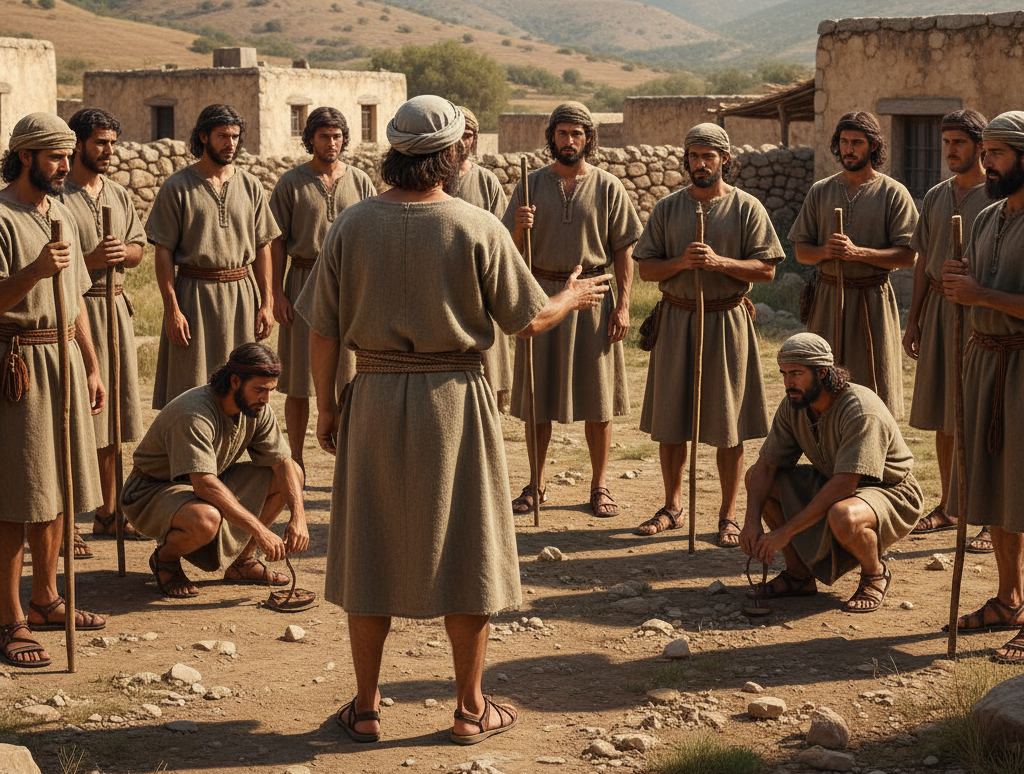
Our attention focuses specifically on verse 10 (Matthew 10.10), which states: ‘Take neither … sandals nor a staff’. This is surprising, since it is difficult to imagine the apostles travelling without shoes or a staff. It is worth observing that Matthew explicitly mentions ‘two tunics’, suggesting that they wore one for travelling.

It therefore seems logical to us that, after mentioning two tunics, Matthew also implies two pairs of sandals and two staffs. However, this interpretation remains personal and unproven.

The term used by Matthew 10.9, translated as ‘do not take’, is Κτάομαι (Strong's number 2932). This word can mean ‘obtain’ or ‘acquire’. In this context, Matthew seems to mean that the apostle should not seek to buy a staff or sandals or acquire additional items. Those blessed by his ministry should provide these things free of charge.

We could summarise Matthew's thought as follows: Do not concern yourselves with material possessions; devote yourselves solely to preaching. Those converted through your ministry should take responsibility for these matters.

II. Mark's account

Verse 8 of Mark 6.8 seems to contradict Matthew's statement. Mark specifies that the apostles must take a staff, sandals and a tunic. Mark's details correspond more closely to reality: the apostles set out clothed and carrying their walking staffs. Nevertheless, we must acknowledge that the two translations differ and even contradict each other.

The term used by Mark 6.8, translated as ‘take nothing’, is αἴρω (Strong's number 142), meaning rather to take along. These are belongings the apostle already possessed! Mark therefore does not use the same term as Matthew. In the first case, the meaning is acquiring or obtaining additional items; in the second, taking one's personal possessions along.

We can summarise Mark's information as follows: take the bare minimum for the journey and do not burden yourselves with unnecessary belongings, because it is for those newly converted through your ministry to meet these material needs.

Mark's wording, as he revisits Matthew's account with Peter to adapt it to a non-Jewish audience, is different, but the meaning is the same. The two Greek terms used allow this interpretation and resolve the apparent contradiction.

However, we now reach Luke's text, which seems to call this interpretation into question!

III. Luke's account

We find wording similar to Matthew's in Luke's text, but Luke uses the same Greek term as Mark. The term used by Luke 9.3, translated as ‘take nothing’, is αἴρω (Strong's number 142), meaning rather to take along. These are objects the apostle already possessed!
We therefore face Mark's and Luke's texts, which seem to contradict each other despite using the same Greek terms, Mark having added a negative.

Luke, who knew Matthew's and Mark's accounts, would never have introduced a contradiction with statements coming directly from the apostles who had heard these words from Jesus the Messiah himself. Moreover, Luke's writing is distinguished by his learning, so he knows how to choose the appropriate word.

How can we explain this linguistic difference?

One point remains clear: the apostles did not set out barefoot and without a staff. A staff was essential for protection against wild animals and robbers as well as for walking. The meaning of these words is therefore indeed to avoid burdening themselves with unnecessary belongings and to rely on the help of new converts.

IV. Explaining the contradiction

Mark's and Luke's use of the same Greek term prevents us from relying on the original words' meanings to explain this apparent contradiction. Logic seems to support Mark's statements, and we know that Luke would never have contradicted the apostles' words without risking his credibility. Under these circumstances, how can we explain the difference?

To avoid this problem, some translators have added an ‘s’ to Matthew's and Luke's versions. Although the meaning is preserved, this translation seems to betray the apostles' words. Moreover, these versions are not accepted by most commentators. The literal difference therefore persists.

We propose the following explanation: Mark quotes another conversation on the same subject between the Teacher and the apostles. This is unsurprising, since they probably did not understand the first formulation: take neither money nor sandals nor a staff. It seems clear that they asked Jesus the Messiah what these words meant: must we go barefoot? Must we travel without a staff?

We observe the same principle in the conversation with Nicodemus: Jesus the Messiah makes a statement that seems difficult to understand. His listener then asks for clarification, and Jesus the Messiah explains his thought more precisely.

Jesus the Messiah therefore clarified his thought in his reply, the one we read in Mark: of course, take your sandals, those already on your feet, but take no spare pair; naturally take your staff, the one you usually use, but only that one. We find the following meaning: do not burden yourselves with belongings, but take the bare minimum. Do not waste time preparing for the journey; go as you are and concentrate solely on spreading the Gospel. Material needs must not limit you; they will be met by the new converts.
This attitude seems new, since journeys usually involved considerable logistical arrangements, with accompanying people who managed material matters.

Furthermore, Luke 22.35-36 offers a conclusion. Jesus the Messiah makes clear that he sent his disciples without money, a bag and, above all, shoes. He asks whether they lacked anything, and the disciples answer no! It seems obvious that, by saying without shoes, Luke means without spare shoes, since these men did not walk barefoot!

There is therefore no contradiction between Matthew's and Luke's words and those of Mark.
Conclusion

Some websites suggest that our Gospels contain contradictions, citing in particular the one examined in this appendix. They conclude that the Bible is not a reliable book.

However, there is no contradiction here. Matthew and Luke report Jesus the Messiah's initial words, whereas Mark records the explanation he gave in response to the apostles' questions. The apostles' scepticism is readily understandable when they hear that they must take neither sandals nor a staff. They evidently did not understand the Teacher's wording and questioned him about it.

Thus, Matthew and Luke convey Jesus the Messiah's initial words, while Mark gives us the explanation that followed. This explanation follows naturally from the biblical texts and from the apostles' attitude, which we discover through various events. It is important to remember that the Gospel writers faced a major constraint: they had to minimise the length of their accounts to fit the capacity of the papyrus on which they wrote.

It was therefore impossible for them to provide all the explanations they would have wished, hence the difficulties we may encounter today. Yet careful study of the text allows us to explain these differences, and that is what matters. Our Gospels contain no error or contradiction, simply points that can be difficult to understand.