PER014

The genealogy or genealogies

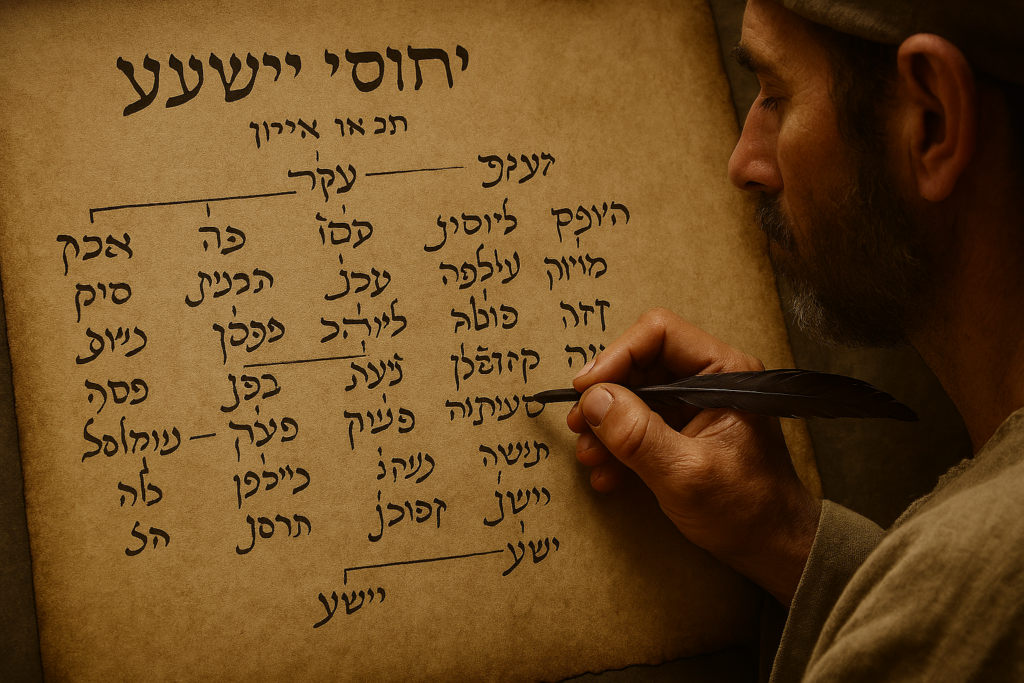
The article examines Jesus' genealogies in Matthew and Luke, reflecting both his royal lineage through Joseph and his humanity through Mary. These complementary accounts emphasise Jesus' divine and human duality, reinforcing his messianic legitimacy.

4 min genealogy Matthew Luke 2 verses 2 books

Resources

Biblical texts

Matthew
Matthew 1.1-17 (King James Version)

The book of the generation of Jesus Christ, the son of David, the son of Abraham.

Abraham begat Isaac; and Isaac begat Jacob; and Jacob begat Judas and his brethren;

And Judas begat Phares and Zara of Thamar; and Phares begat Esrom; and Esrom begat Aram;

And Aram begat Aminadab; and Aminadab begat Naasson; and Naasson begat Salmon;

And Salmon begat Booz of Rachab; and Booz begat Obed of Ruth; and Obed begat Jesse;

And Jesse begat David the king; and David the king begat Solomon of her that had been the wife of Urias;

And Solomon begat Roboam; and Roboam begat Abia; and Abia begat Asa;

And Asa begat Josaphat; and Josaphat begat Joram; and Joram begat Ozias;

And Ozias begat Joatham; and Joatham begat Achaz; and Achaz begat Ezekias;

And Ezekias begat Manasses; and Manasses begat Amon; and Amon begat Josias;

And Josias begat Jechonias and his brethren, about the time they were carried away to Babylon:

And after they were brought to Babylon, Jechonias begat Salathiel; and Salathiel begat Zorobabel;

And Zorobabel begat Abiud; and Abiud begat Eliakim; and Eliakim begat Azor;

And Azor begat Sadoc; and Sadoc begat Achim; and Achim begat Eliud;

And Eliud begat Eleazar; and Eleazar begat Matthan; and Matthan begat Jacob;

And Jacob begat Joseph the husband of Mary, of whom was born Jesus, who is called Christ.

So all the generations from Abraham to David are fourteen generations; and from David until the carrying away into Babylon are fourteen generations; and from the carrying away into Babylon unto Christ are fourteen generations.

Mark
Mark (King James Version) not cited in the book
Luke
Luke 3.23-38 (King James Version)

And Jesus himself began to be about thirty years of age, being (as was supposed) the son of Joseph, which was the son of Heli,

Which was the son of Matthat, which was the son of Levi, which was the son of Melchi, which was the son of Janna, which was the son of Joseph,

Which was the son of Mattathias, which was the son of Amos, which was the son of Naum, which was the son of Esli, which was the son of Nagge,

Which was the son of Maath, which was the son of Mattathias, which was the son of Semei, which was the son of Joseph, which was the son of Juda,

Which was the son of Joanna, which was the son of Rhesa, which was the son of Zorobabel, which was the son of Salathiel, which was the son of Neri,

Which was the son of Melchi, which was the son of Addi, which was the son of Cosam, which was the son of Elmodam, which was the son of Er,

Which was the son of Jose, which was the son of Eliezer, which was the son of Jorim, which was the son of Matthat, which was the son of Levi,

Which was the son of Simeon, which was the son of Juda, which was the son of Joseph, which was the son of Jonan, which was the son of Eliakim,

Which was the son of Melea, which was the son of Menan, which was the son of Mattatha, which was the son of Nathan, which was the son of David,

Which was the son of Jesse, which was the son of Obed, which was the son of Booz, which was the son of Salmon, which was the son of Naasson,

Which was the son of Aminadab, which was the son of Aram, which was the son of Esrom, which was the son of Phares, which was the son of Juda,

Which was the son of Jacob, which was the son of Isaac, which was the son of Abraham, which was the son of Thara, which was the son of Nachor,

Which was the son of Saruch, which was the son of Ragau, which was the son of Phalec, which was the son of Heber, which was the son of Sala,

Which was the son of Cainan, which was the son of Arphaxad, which was the son of Sem, which was the son of Noe, which was the son of Lamech,

Which was the son of Mathusala, which was the son of Enoch, which was the son of Jared, which was the son of Maleleel, which was the son of Cainan,

Which was the son of Enos, which was the son of Seth, which was the son of Adam, which was the son of God.

John
John (King James Version) not cited in the book

Technical details

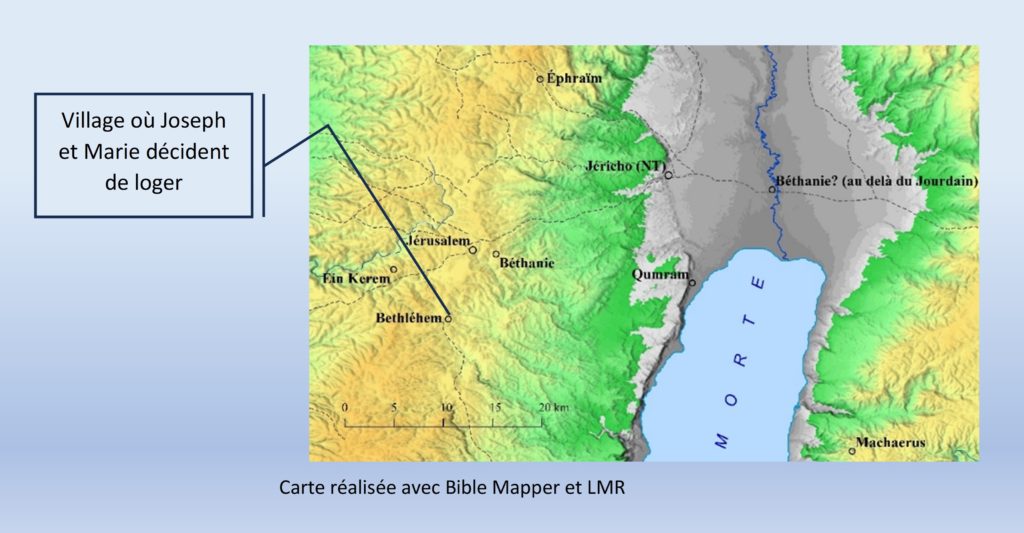
Location: Bethlehem in Judea

Date: 12 October -2 BC. The festival of , or Tabernacles, begins on 15 Tishri, 11 October -2 BC in our Gregorian calendar, and lasts seven days

Method: We return to Matthew

Note on the method: Matthew and Luke each offer a genealogy

The first census of Quirinius

Matthew and Luke alone provide a genealogy

The genealogy of Jesus

Jesus' genealogy

Comments

Matthew knows the importance of tracing Jesus' ancestry to King David to support his argument. The royal Messiah must necessarily descend from Judah and David. Indeed, Herod the Great, who ruled at the time and called himself king, could not, in Jewish eyes, officially claim this title, because he did not belong to that royal line.

The ‘King of the Jews’ can only be a descendant of Judah and David. Matthew's list gives Joseph's ancestry. The argument is clear: under Jewish law at that time, Jesus the Messiah inherited this royal lineage through his adoptive father, Joseph, and could therefore claim the title of King of the Jews.

We will also discuss the five women mentioned in this list, something highly unusual.

Luke specifies Jesus the Messiah's age at his baptism. His use of ‘about’ does not allow us to assume a range of several years. On the contrary, we believe Luke was precise, as usual, and checked this information.

We therefore use this information to calculate Jesus the Messiah's birth date. As mentioned earlier, we have a different genealogy here, Mary's, whereas Matthew presents Joseph's. We explain this choice in Appendix 10: ‘The two genealogies of Jesus the Messiah’.

Luke took account of how difficult this adoptive lineage might be for a non-Jew to understand, since it could be perceived as deceptive.

What use is the genealogy of someone who played no role in the child's birth?

His research enables him to establish that Mary also belongs to a royal line. A maternal genealogy is usually rejected by Jews, but Luke addresses a Gentile audience. This maternal lineage, though surprising, follows from the very nature of Jesus the Messiah's unique birth.

Jesus the Messiah's humanity, transmitted through Mary, is attested by Luke, while his kingship is confirmed by Matthew. Luke also recognises Jesus' kingship, although this is not his main purpose. Luke declares that Jesus the Messiah is the Son of God, a claim difficult for Jews to accept, but he is addressing converts from paganism.