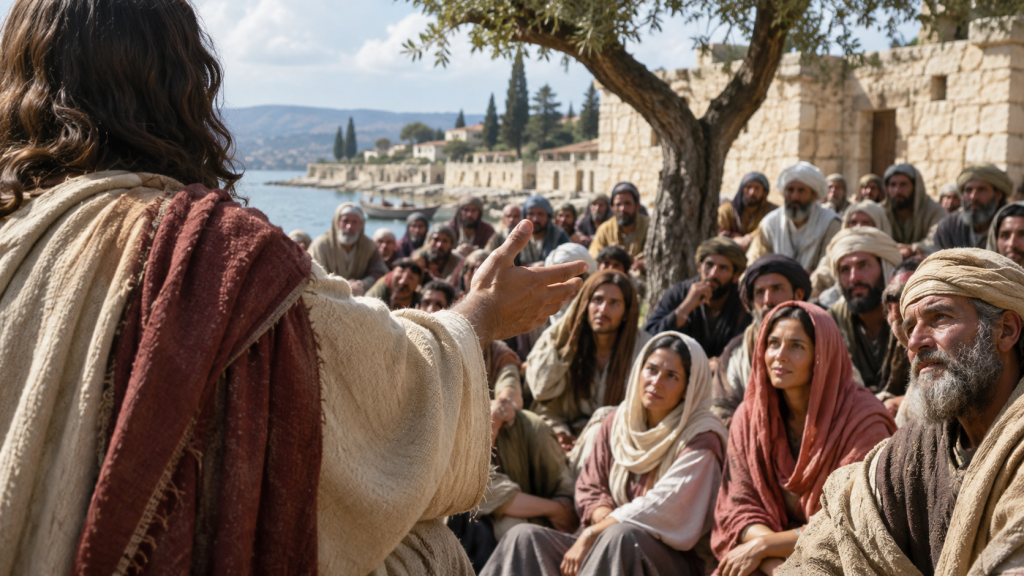
1. Introduction: Why are some parables difficult to understand?
Summary of the paragraph: Some parables of Jesus present morally questionable characters, surprising situations or severe conclusions. Their interpretation requires special attention to the context, structure of the narrative and the teaching sought.
Jesus ' parables use situations borrowed from daily life to reveal the realities of God's Kingdom.
However, not all of these stories are immediately easy to understand.
Some people stage unjust characters.
Others present decisions that seem surprising.
Still others end with particularly severe warnings.
The parable of the unfaithful economist raises one important question: why does a teacher seem to praise a man who acted dishonestly?
The parable of the iniquitous judge presents a magistrate who refuses to do justice.
The workers in the vineyard receive the same remuneration despite different working hours.
The king's son's wedding ends with the exclusion of a guest without the suit expected.
These difficulties must not be ignored.
Rather, they invite us to carefully examine Jesus ' words.
A parable does not necessarily constitute approval of all the behaviours it describes.
Its teaching must be determined from the context and comparison sought.
2. Distinguish the account of his teaching
Summary of paragraph: A parable relates a particular situation to transmit a teaching. Not all the details of the account necessarily have an independent spiritual meaning.
A parable usually includes a narrative situation and a pedagogical scope.
The situation may concern agriculture, trade, family life or social relations.
However, the narrative is not always a description of exemplary behaviours.
Jesus can use an imperfect situation to illustrate a truth.
He may also present an unjust figure in order to emphasize, in contrast, divine justice.
The interpreter must therefore distinguish what belongs to the story told from what constitutes the teaching sought.
This distinction is particularly important when characters perform morally questionable actions.
The behavior of a character should not be considered approved simply because it appears in a parable of Jesus.
The key question is why Jesus uses this situation.
3. The words of the characters do not always represent the thought of Jesus
Summary of paragraph: The characters in the parables may express false, unfair or interested opinions. Their statements must be distinguished from Jesus ' teaching.
In several parables, the characters speak.
They explain their decisions.
They present their motivations.
They sometimes accuse other people.
However, such statements should not be automatically considered true.
In the parable talents, the third servant presents his master as a hard man.
This statement belongs to the servant's speech.
It does not necessarily constitute an objective description of the master.
In the parable of the rich fool, the owner claims that he has enough property to live for a long time in peace.
However, the rest of the story reveals the error of his reasoning.
These examples show that the words of the characters must be evaluated in the light of the entire narrative.
The interpretation must pay particular attention to the conclusions explicitly given by Jesus.
4. The comparison does not imply a total similarity
Summary of paragraph: A parable can make a comparison on a specific point without stating that the characters or situations are similar in all their aspects.
Parables are often based on an analogy.
However, an analogy does not mean a complete identity.
In parable of the wicked judge, Jesus compares the perseverance of a widow to that of believers in prayer.
But God does not morally resemble the unjust judge.
The reasoning is based precisely on a contrast.
Similarly, the image of the thief in the night does not mean that Jesus has the moral character of a thief.
The comparison concerns the unexpected nature of his arrival.
This distinction avoids interpretations that are contrary to the entire Scriptures.
She recalls that each image must be understood according to the particular aspect that Jesus wishes to emphasize.
5. The argument from the least to the greatest
Summary of paragraph: Some parables use a reasoning in which an imperfect human situation allows to emphasize a superior divine truth.
parable of the unfair judge is an important example of this reasoning.
An unfair judge ends up responding to a persistent widow.
Jesus learns a teaching about divine justice.
If even an unjust man can act, how much more will God do righteousness to those who cry out to him.
This reasoning is not based on a moral resemblance between the judge and God.
It is based on the superiority of divine justice.
The parable of the importerun friend can also be understood in the light of this method.
Jesus then led his listeners to consider the goodness of the heavenly Father.
This form of argument allows us to understand why some morally imperfect characters appear in spiritual teachings.
6. Unfaithful economy: a parable particularly discussed
Summary of the paragraph: The parable of the unfaithful economist raises difficulties because a director accused of mismanagement receives some kind of praise. The context, however, shows that Jesus distinguishes the skill from injustice.
Luke 16.1-13 introduced a rich man with an administrator.
He is accused of disposing of his master's property.
The owner announces that he will be accountable for his management.
The administrator understands that he will lose his function.
He then looks for a way to prepare his future.
He summons several debtors of his master.
He has the amounts of his debt recognition changed.
The narrative then presents a surprising statement.
The master praises the administrator for acting with skill.
This reaction is one of the main difficulties of the parable.
However, the text does not say that dishonesty is approved.
He explained that the praise was for the caution or skill of the administrator.
7. Unfaithful economy: what is really approved
Summary of the paragraph: The praise addressed to the economy relates to its ability to anticipate the future. It does not constitute general approval of its methods.
Luke 16.8 notes that the administrator acted with skill.
The narrative therefore highlights its ability to understand a difficult situation and to take action accordingly.
However, Jesus does not ask his disciples to imitate his dishonesty.
On the contrary, the continuation of the teaching emphasizes fidelity.
Luke 16.10 states that the one who is faithful in small things is also faithful in great things.
Luke 16.11 refers to the need to be faithful in unjust riches.
Luke 16.13 recalls that it is impossible to serve God and Mammon simultaneously.
These statements are essential elements of interpretation.
The economy is an example of anticipation, not a complete moral model.
The parable invites the disciples to use the resources present with discernment for the future.
8. Debt forgiveness: a historical issue discussed
Summary of paragraph: The changes in the debt in the parable of the economist have given rise to several assumptions. None should be presented as certain when the text does not confirm it.
In Luke 16, the administrator reduced the debts of two debtors.
The first one owes a hundred measurements of oil.
The second one owes a hundred measures of wheat.
The amounts are reduced.
Some interpreters proposed that the administrator waive his own commission.
Others think he's cutting interest.
Still others consider that he fraudulently reduces his master's debts.
These assumptions seek to explain the economic practices of the narrative.
However, Luke does not explicitly specify the legal nature of the reductions.
It is therefore necessary to avoid presenting one of these reconstructions as a certain fact.
Primary education remains accessible without solving all economic details.
The administrator acts with foresight.
Jesus invites his followers to exercise superior wisdom in their relationship to material possessions.
9. Unfair riches: understanding the expression
Summary of paragraph: The term "unfair wealth" should be understood in the context of money teaching. It does not mean that the disciples would be allowed to obtain goods by dishonest means.
Luke 16.9 refers to unjust wealth.
This expression has given rise to several interpretations.
It can refer to wealth belonging to a world marked by injustice.
It may also emphasize their morally dangerous nature or their frequent association with unfair practices.
However, the immediate context insists on fidelity.
Jesus does not portray dishonesty as a virtue.
He teaches that material goods must be used from a perspective that goes beyond their temporary possession.
This interpretation corresponds to the conclusion of Luke 16.13.
Wealth must not become a master.
They must remain subordinate to God.
10. The iniquitous judge: a comparison by contrast
Summary of paragraph: The parable of the wicked judge shows that God should not be assimilated to the unjust magistrate. Teaching is based on the certainty of divine justice.
Luke 18.1-8 presents a judge who does not fear God and respect anyone.
A widow asks her for justice.
He refuses for a while.
However, he eventually responded.
Jesus uses this situation to encourage his disciples to pray without discouragement.
The difficulty arises when the judge is considered a direct representation of God.
Such an interpretation would lead to the heavenly Father's attribution of indifference and injustice to the character.
However, the narrative highlights the contrast.
God is right.
He hears calls from his own people.
So the parable does not seek to show that God must be compelled to act.
She invites us to persevere in confidence.
11. Irritated L-friend: perseverance or audacity?
Summary of the paragraph: The parable of the importing friend has a difficulty in translating a Greek term. His main teaching, however, is about trust in prayer.
Luke 11.5-8 presents a man who asks a friend for bread in the middle of the night.
The Greek term anaideia, used in the conclusion, may evoke audacity, lack of shame or bold insistence.
Traditional translation often emphasizes importunity.
However, some interpreters feel that the text places more emphasis on the boldness of the request.
The question of which character relates precisely to this attitude is also a matter of debate.
These difficulties must be recognized.
However, they do not abolish general education.
Jesus encourages his disciples to ask, seek and strike.
He then presents the goodness of the heavenly Father.
The parable therefore invites a confident prayer.
She does not present God as a reticent man who should be bothered until he gives in.
12. The vine workers: surprising remuneration
Summary of paragraph: The parable of workers in the vineyard presents identical remuneration for different hours of work. This situation underscores the generosity of the master and calls into question human comparisons.
Matthew 20.1-16 presents an owner who hires workers at different times of the day.
Some of them have been working since morning.
Others start later.
However, all finally receive a denier.
The first workers protest.
They believe that their work should have been more rewarded.
The master reminds them that he gives them the agreed salary.
He also affirms his right to be generous to the latter.
The difficulty comes from the difference between human expectations and the owner's decision.
However, the parable is not a complete presentation of an ideal economic system.
She uses a wage situation to reveal divine generosity.
The context of Matthew 19.27.16 concerns in particular the reward and the place of the first and the last.
13. Divine generosity is not an injustice
Summary of paragraph: In the parable of workers in the vineyard, the master does not fail in his commitment to the first workers. Their discontent reveals a difficulty in accepting his generosity towards others.
The owner recalls that he agreed to a denier with the first workers.
It therefore respects its commitment.
Their protest is not based on a salary lower than the one promised.
It is the result of comparison with others.
The master asks them why his generosity should cause their discontent.
This question is a central element of the parable.
It reveals that divine grace cannot be reduced to a calculation based on human comparisons.
However, this does not mean that God would act unjustly.
On the contrary, the parable presents a master who respects his word while exercising his generosity.
She invites listeners to give up spiritual envy.
14. The Rich and Lazarus: a parable or historical account?
Summary of the paragraph: The account of the rich and Lazarus has particular characteristics. His interpretation must take into account his narrative form and the explicit teaching of Jesus.
Luke 16.19-31 presents a rich man and a poor man named Lazarus.
After their death, their situations are reversed.
Lazarus is presented to Abraham.
The rich one is in the torments.
This narrative has an important characteristic: one of the characters receives a proper name.
Some interpreters therefore consider this to be a historical account.
Others recognize a parable.
The text does not explicitly specify its literary genre.
It is therefore necessary to distinguish what is certain from what remains to be discussed.
Jesus uses this account to convey a warning.
He emphasizes the seriousness of indifference to others.
He also recalls the sufficiency of the testimony of Moses and the prophets.
These lessons remain essential, regardless of the conclusion made regarding the exact type of narrative.
15. The Rich and Lazarus: the images of the Hereafter
Summary of the paragraph: The account of the rich and Lazarus presents several images concerning the situation after death. They must be interpreted without turning every narrative detail into an exhaustive description of the invisible world.
Luke 16 evokes Abraham's bosom, torment, and a great abyss.
The rich man asks for a drop of water.
He also wants a warning to be given to his brothers.
These elements give the narrative a special strength.
However, they do not necessarily constitute a detailed description of the material organization of the invisible world.
The interpretation must respect Jesus ' objective.
The story shows a reversal of situations.
He stressed the seriousness of the judgement.
In his conclusion, he emphasized the importance of listening to the Scriptures.
Poverty should not be seen as an automatic guarantee of salvation.
Similarly, wealth alone is not evidence of condemnation.
The account must be interpreted in the context of Jesus ' teaching concerning money and fidelity to God.
16. Moses and the Prophets: the decisive conclusion
Summary of paragraph: The conclusion of the account of the rich and Lazarus underscores the authority of the Scriptures. It shows that the refusal of their testimony cannot be solved simply by seeking an extraordinary sign.
The rich man asks that a messenger be sent to his brothers.
He hopes that a warning from the world of the dead will lead them to repentance.
However, Abraham replied that they possessed Moses and the prophets.
They have to listen to them.
The rich insists.
He thinks that an appearance would bring about a change.
The final answer states that those who do not listen to Moses and the prophets will not be persuaded by the resurrection of a dead man.
This conclusion has a major scope.
It reveals the seriousness of the refusal of divine revelation.
She also points out that extraordinary signs do not necessarily produce faith.
The teaching joins several passages of the Gospels concerning the hardening of the heart.
17. Talents: Is the master really hard?
Summary of paragraph: In the parable of talents, the third servant presents his master as a hard man. This accusation must be distinguished from the judgment of the account.
Matthew 25.14-30 presents a master who entrusts talents to his servants.
Two of them produce the money received.
The third one hides his talent.
When the master returns, this servant says he knew how to deal with a hard man.
He claims to have acted out of fear.
However, this statement belongs to the servant's speech.
It does not necessarily constitute an objective description of the master.
The master's answer repeats his reasoning to show his inconsistency.
If the servant really believed that his master required a return, he could have at least placed the money in the bankers.
The parable thus highlights the infidelity of the servant.
It must not be used to present God as unjust or arbitrary.
18. Talents and Mines: Two Distinguished Stories
Summary of paragraph: The parables of talents and mines have important similarities, but they have distinct contexts and elements. Their interpretation must respect this diversity.
Matthew 25.14-30 presents the parable of talents.
Luke 19.11-27 reports the mine.
In both accounts, a master entrusts resources to his servants.
He's leaving for a while.
Upon his return, he asked for their management.
However, there are several differences.
In Matthew, the sums entrusted are not the same.
In Luke, the servants mentioned each receive a mine.
The parable of the mines also includes a royal theme and opposition to the kingship of the main character.
These differences must be maintained.
Both stories teach fidelity.
However, Luke particularly emphasizes responsibility while awaiting the Kingdom demonstration.
Matthew is part of the discourse concerning the coming of the Son of Man.
19. Mines: a particularly severe conclusion
Summary of paragraph: The parable of the mines ends with a statement of judgment against the king's opponents. This scene must be interpreted in its narrative and eschatological context.
Luke 19.27 makes a particularly harsh statement.
The royal figure orders that his enemies, who refused his kingship, be brought and executed before him.
This conclusion may surprise the reader.
However, it belongs to a parable that uses a political and royal situation.
The story distinguishes between the servants in charge of managing the mines and the citizens who refuse royalty.
This distinction is essential.
The parable is not an instruction to the disciples to exert political violence against their adversaries.
It presents a judgment in the context of the story told.
Its context concerns the manifestation of the Kingdom and responsibility before the king.
Interpretation must therefore avoid turning a narrative scene into a prescription for human conduct.
20. The wedding of the king's son: wedding dress
Summary of the paragraph: The parable of the king's son's wedding presents an excluded guest because he does not wear the expected habit. The precise meaning of the garment remains under discussion, but the teaching underlines the need for a true answer.
Matthew 22.1-14 presents a king who organizes his son's wedding.
After the first guests were refused, other people were invited.
The room is filling up.
However, the king saw a man who did not wear the wedding garment.
He asks him how he entered without this garment.
Man remains silent.
The king then ordered his exclusion.
Several interpretations were proposed regarding the habit.
Some recognize the righteousness received from God.
Others point to repentance or conduct in keeping with the Kingdom call.
However, the text does not provide an explicit identification of the garment.
It would also be imprudent to affirm as a certain fact that the king himself provided the clothes to all the guests.
The main education concerns the lack of a purely external participation.
21. The ten virgins: what is oil?
Summary of paragraph: The parable of the ten virgins highlights the need to be prepared for the arrival of the husband. The precise symbolic identification of oil is not explicitly given by Jesus.
Matthew 25.1-13 presents ten virgins awaiting the arrival of the husband.
Five are careful.
Five are insane.
The former have a reserve of oil.
The seconds are not sufficiently prepared.
When the husband arrives, only the first can participate in the party.
Oil therefore plays an important role in the narrative.
However, Jesus does not explicitly state that it represents the Holy Spirit, faith or good works.
These interpretations have been proposed in different traditions.
They may be considered, but should not be presented as explanations directly given by the text.
Jesus ' conclusion emphasizes vigilance.
The disciples must be ready, for they know neither the day nor the hour.
22. Unnecessary Servants: An Expression to Understand
Summary of the paragraph: The parable of useless servants emphasizes that obedience does not give man a right of debt to God. It does not mean that the human person would be devoid of value.
Luke 17.7-10 presents a servant who performs the tasks entrusted by his master.
After his work, he cannot claim to have placed his master in a debt position towards him.
Jesus applies this comparison to his disciples.
When they have accomplished what is commanded them, they must acknowledge that they have done only their duty.
The term traditionally translated "unnecessary servants" may seem particularly severe.
However, it does not mean that the human being would be worthless before God.
It concerns the lack of merit to claim a reward as an absolute right.
The parable teaches humility in service.
It does not remove other Bible teachings about God's love for his children.
23. The two threads: a difficulty in transmitting the text
Summary of paragraph: The parable of the two sons presents some handwritten variations concerning the order of the answers. These differences do not nullify his basic teaching.
Matthew 21.28-32 introduced a father asking his two sons to work in his vineyard.
One initially refuses, then obeys.
The other accepts, but does not do his father's will.
However, the ancient manuscripts present some variations concerning the order of the answers and the identification of the son who obeyed.
This question is a matter of textual criticism.
It must be examined from the available handwritten witnesses.
However, the fundamental contrast remains.
A son manifests real obedience despite an initial refusal.
The other presents a favorable verbal response without accomplishing the paternal will.
The application given by Jesus concerns repentance and the answer to John the Baptist's ministry.
The essential scope of the parable therefore does not depend on the resolution of all the variants concerning the order of the characters.
24. The sterile fig tree and the fig tree that announces summer
Summary of paragraph: Two teachings of Jesus use the image of fig tree, but they have different objectives. Their botanical resemblance should not lead to confusion.
Luke 13.6-9 has a fig tree which does not produce fruit.
This parable belongs to a context of calling to repentance.
It highlights the patience and urgency of producing fruit.
Matthew 24.32-35, Mark 13.28-31 and Luke 21.29-33 present another image.
When the branches of fig tree become tender and the leaves appear, observers know that summer is approaching.
This comparison concerns the discernment of the signs foretold by Jesus.
The two passages therefore use the same tree.
However, their teaching differs.
The first concerns repentance.
The second concerns the recognition of the proximity of the announced events.
It would be incorrect to merge the two narratives or automatically assign them the same prophetic meaning.
25. The Thief in the Night: A Voluntaryly Limited Image
Summary of paragraph: The image of the thief in the night underscores the unexpected nature of the coming of the Son of Man. It is not a moral comparison between Jesus and a thief.
Matthew 24.43-44 and Luke 12.39-40 provide a comparison for a housekeeper.
If he knew the time the thief had to come, he would be careful to prevent the break-in.
Jesus applies this image to the need to be ready.
The Son of Man will come at an unexpected hour.
The comparison therefore focuses on the unpredictability of the event.
It does not mean that Jesus acts with the unjust intentions of a thief.
This distinction is essential.
A parable can borrow a particular aspect of a situation without approving the other characteristics of the character.
The main teaching is about vigilance.
26. The images of judgment: darkness, weeping and gnashing of teeth
Summary of paragraph: Some parables end with particularly strong judgmental images. They must be taken seriously without being transformed into detailed descriptions of realities that the text does not specify.
Matthew repeatedly uses expressions of outside darkness, weeping and gnashing of teeth.
These images appear in particular in the parables of weddings and talents.
They express the seriousness of exclusion and judgment.
However, their educational function should be distinguished from any detailed reconstruction from the beyond.
Parables do not necessarily seek to describe each aspect of judgment materially.
They warn listeners of its consequences.
The interpretation should therefore neither remove the gravity of such statements nor multiply the clarifications that are not provided by the text.
Their main scope is human responsibility before God.
27. Children in the public square: an ironic comparison
Summary of paragraph: The comparison of children in the public square uses a familiar situation to denounce the inconsistency of those who refuse both John the Baptist and Jesus.
Matthew 11.16-19 and Luke 7.31-35 present children who accuse their companions of not responding to their games.
They played the flute without causing any dance.
They sang lamentations without causing lamentation.
Jesus applies this comparison to the reactions of his generation.
Jean-Baptiste came in austerity.
Some accused him of having a demon.
Jesus came eating and drinking.
Some accused him of being an eater and a drinker.
The comparison reveals the incoherence of critics.
Opponents refuse two different ministries.
The problem is therefore not only about their external form.
It reveals a deeper resistance to the divine call.
28. The parables and social practices of the first century
Summary of paragraph: Some difficulties of interpretation arise from the historical distance between modern readers and the world in which Jesus taught. Knowledge of the social context can inform narratives.
The parables use familiar practices among Jesus ' listeners.
They refer to farm contracts, relations between masters and servants, invitations to meals and wedding ceremonies.
However, these realities may differ from contemporary habits.
The parable of workers in the vineyard presupposes a daily organization of work.
The parable of the wedding uses hospitality conventions.
The parable of the importing friend evokes the constraints of domestic life.
These elements can be informed by historical knowledge.
However, we should avoid presenting as some of the reconstructions that remain under discussion.
Documentation about the first century does not always allow for the exact reconstruction of each practice.
The historical context must therefore shed light on the text without replacing the information it provides.
29. Modern Parables and Expectations
Summary of paragraph: Some difficulties arise from the expectations that contemporary readers project on the narratives. The interpretation must first seek to understand what Jesus taught his first listeners.
A modern reader can expect a parable to present morally exemplary characters.
It may also assume that each narrative must correspond to contemporary social norms.
However, parables sometimes use surprising situations to provoke reflection.
The unfair judge is not a model of justice.
The unfaithful saver is not a model of honesty.
The workers in the vineyard do not constitute a complete presentation of labour law.
These characters and situations serve an educational purpose.
It is therefore important to avoid imposing on the narrative issues that it does not seek to resolve.
Interpretation must begin with the concerns of the evangelical context.
Contemporary applications can then be established on the basis of recognized teaching.
30. The place of Jesus ' explanations
Summary of paragraph: When Jesus explains a parable, this explanation has decisive authority. It should guide the interpretation of images and limit assumptions.
Some parables receive an explicit explanation.
The sower is a major example.
Jesus identifies the seed and the different lands in their relationship to the reception of the Word.
A detailed explanation is also given for the tare among wheat.
Other parables have an explicit conclusion.
The iniquitous judge is concerned with the need to pray without discouragement.
The Pharisee and the publican concern pride and humility.
However, many parables do not contain such an elaborate explanation.
In such cases, the interpreter must examine the context, structure and Scriptural correspondence.
It must also recognize the limits of what can be affirmed with certainty.
The absence of a detailed explanation does not justify an unlimited multiplication of symbols.
31. Differences between parallel narratives
Summary of paragraph: Gospels sometimes present similar teachings with differences in wording or context. These particularities must be respected in the interpretation.
Some parables appear in several Gospels.
The sower is reported by Matthew, Mark, and Luke.
The lost sheep appear in Matthew 18 and Luke 15.
Both houses are presented in Matthew 7 and Luke 6.
However, the contexts are not always the same.
Matthew 18 uses the lost sheep in teaching about the little ones and the Father's will that none of them perish.
Luke 15 presents it in a context of criticism regarding the reception of sinners.
These differences should not be eliminated.
They make it possible to recognize the particular applications of the same teaching.
It is also necessary to distinguish parables that have similarities but are not identical, including talents and mines.
Harmonization must respect the particular data of each Gospel.
32. The limits of allegory
Summary of paragraph: An excessive allegorical interpretation may attribute to each detail a meaning that Jesus did not indicate. The explicitly explained symbols should be distinguished from the assumptions.
Some parables have an important allegorical dimension.
In the parable of the chaff, Jesus identifies several characters and elements.
However, not all parables work in this way.
The tower to be built does not require to attribute a different spiritual meaning to each stone.
The two armies of Luke 14 need not necessarily represent two specific spiritual powers.
The three loaves of Luke 11 do not have an explicit symbolic interpretation.
The oil of the ten virgins is not directly identified by Jesus.
These examples show the need for caution.
Interpretation must recognize clearly established correspondence.
It must also distinguish between possible and certain applications.
33. Parables and Unity of Bible Teaching
Summary of paragraph: A parable must be interpreted throughout Jesus ' teaching and Bible testimony. This method avoids conclusions that are contrary to the explicit claims of the Scriptures.
The parables belong to the whole Bible revelation.
Therefore, they should not be artificially isolated.
The parable of the unfaithful saver must be brought closer to the teachings of honesty and fidelity.
The parable of the wicked judge must be understood in the light of divine justice.
Parables concerning wealth must be interpreted with other Bible teachings on generosity and responsibility.
However, this should not lead to the deletion of the particularities of the accounts.
Bible unity does not mean that all parables teach exactly the same thing.
It allows us to recognize their consistency while respecting their diversity.
34. Summary table of the main challenges
Summary of paragraph: The difficulties encountered in some parables can be summarized to clarify the precautions necessary for their interpretation.
| Parable | Reference | Main difficulty | Precaution of interpretation |
|---|
| The unfaithful saver | Luc 16.1-13 | A dishonest administrator receives praise | Distinguishing the skill of injustice |
| The importun friend | Luc 11.5-8 | Meaning of the term anaideia | Recognize the possibilities of translation |
| The Unjust Judge | Luc 18.1-8 | An Unfair Judge as an Example | Understanding the reasoning by contrast |
| The workers in the vineyard | Matthieu 20.1-16 | Same salary for different periods | Examine the generosity of the master |
| The rich man and Lazarus | Luc 16.19-31 | Nature of the narrative and images of the afterlife | Respecting final education |
| The talents | Matthieu 25.14-30 | The master is presented as hard | Distinguish the charges of the servant |
| The minas | Luc 19.11-27 | Violent conclusion | Do not transform the story into a prescription |
| The Wedding of the King’s Son | Matthieu 22.1-14 | Meaning of wedding garment | Do not impose an unexplained symbol |
| The ten virgins | Matthieu 25.1-13 | Meaning of oil | Prioritizing vigilance |
| Unnecessary Servants | Luc 17.7-10 | Appearing devalorizing expression | Understanding Humility Before God |
| The two sons | Matthieu 21.28-32 | Variations in order of responses | Preserving the Teaching of Obedience |
| The thief in the night | Matthieu 24.43-44; Luke 12.39-40 | Comparison with a Thief | Limit analogy to unexpected arrival |
| The children in the marketplace | Matthew 11:16-19; Luke 7:31-35 | Ironic comparison | Identifying John and Jesus' Common Refusal |
This table shows that not all difficulties are of the same nature.
Some of them concern vocabulary.
Others relate to the historical context.
Still others come from the narrative structure or from the reader's expectations.
35. A method of interpretation for difficult parables
Summary of the paragraph: The study of difficult parables requires a rigorous method based on the context, the text, the explanations of Jesus and the distinction between certain data and assumptions.
A method of interpretation can be organized around several stages.
The first is to read the entire passage.
The second is to identify Jesus ' interlocutors.
The third is to examine the circumstances in which the parable is pronounced.
The fourth is to recognize the structure of the narrative.
The fifth is to distinguish between the words of the characters and the explanations given by Jesus.
The sixth is to seek primary education.
The seventh is to examine the relevant Bible references.
The eighth is to distinguish explicit data from historical or theological reconstructions.
Finally, the application must be based on the recognized teaching.
This method allows us to respect the richness of parables without assigning arbitrary meanings to them.
36. Implications for the Forty Individual Studies
Summary of paragraph: Individual studies should identify interpretation difficulties where they exist, present key solutions and clearly distinguish conclusions from assumptions.
The 40 individual studies will have to follow a common methodology.
Each parable will be placed in its context.
Textual or historical difficulties will be examined when necessary.
Greek terms will only be studied when they really contribute to understanding.
The main interpretations may be presented.
However, they should not be considered equivalent when Bible evidence allows for a solution.
Jesus ' explicit explanations will remain a key factor.
Correspondence with the Old Testament will also be examined.
Finally, spiritual applications will have to come from the meaning of the text.
This method will produce rigorous, consistent and accessible studies.
37. Conclusion of the appendix
Summary of the paragraph: Difficult parables are not an insurmountable obstacle to understanding Jesus ' teaching. They invite a careful, context-sensitive and conscious reading of the limits of interpretation.
Jesus ' parables present a wide variety of situations.
Some are immediately understandable.
Others raise important questions.
The characters can be unfair.
Their decisions may be surprising.
The conclusions can be severe.
However, these particularities belong to the richness of parabolic teaching.
Jesus uses familiar situations to lead his listeners to reflect.
He can use a contrast to reveal God's righteousness.
He may be a skilful conduct without approval of injustice.
He may also use a severe image to emphasize the severity of the judgment.
Interpretation must therefore respect the distinction between the narrative and its teaching.
It must examine historical circumstances.
She must pay particular attention to Jesus ' explanations.
It must also recognize the limitations of the proposed reconstructions.
Thus, the difficult parables remind us that understanding the Word requires careful and rigorous reading.
Their aim is not to provoke unlimited speculation.
They lead listeners to recognize the realities of God's Kingdom.
They reveal righteousness, mercy, sovereignty and divine demands.
Finally, they call on everyone to respond with faith, repentance and fidelity to the teaching of Jesus Christ.