DAN001

Structure and Organization of the Book of Daniel

The complex, bilingual book of Daniel presents narratives and prophetic visions illustrating the succession of human kingdoms and God's eternal sovereignty. Faithful in exile, Daniel becomes a prophet, revealing major prophecies culminating in deliverance and resurrection.

14 min Daniel prophecies 10 verses 1 book

Introduction

The book of Daniel has twelve chapters.

At first sight, its structure seems fairly simple:

Daniel 1-6: mainly narratives;

Daniel 7–12: mainly prophetic visions.

This division is useful, but it is not sufficient.

Daniel 2 already contains a great prophecy about the kingdoms, while Daniel 7 belongs to the same linguistic section as the preceding narratives.

The book therefore has several levels of organization that complement one another.

In brief

Daniel tells the story of a young Judean deported to Babylon who remains faithful to God in the midst of several political changes.

But the book goes much further than the personal story of Daniel.

Through dreams and visions, it presents the succession of the kingdoms, their conflicts, their disappearance and the final establishment of a dominion that will not pass away.

To understand this progression, it is useful to know the general structure of the book.

Commentary 1 - A book that does not always follow chronological order

The order of the chapters of Daniel is not strictly that of the events.

Daniel 5 recounts Belshazzar's final night and the fall of Babylon.

Yet the visions of Daniel 7 and Daniel 8 are dated to the reign of Belshazzar and therefore take place before this fall.

Why are they placed after it?

Because the author does not organize his book according to chronology alone. He also groups the chapters according to their themes.

We must therefore distinguish two things:

the order in which the events took place;

the order in which the book presents them.

This distinction allows us to better understand its construction.

Commentary 2 - A book written in two languages

The distribution between Hebrew and Aramaic reveals another organization of the book.

Daniel is written mainly in two languages.

The general distribution is as follows:

Daniel 1.1-2.4a: Hebrew

Daniel 2.4b-7.28: Aramaic

Daniel 8.1-12.13: Hebrew

This organization is important because it shows that Daniel 2 to Daniel 7 forms a distinct whole.

The exact reason for the choice of these languages is not explained by the book. We must therefore remain cautious when trying to interpret it.

What we can state with certainty is that the large Aramaic section also has a remarkable literary organization.

Commentary 3 - Daniel 2 to 7: a mirror structure

The six chapters of the Aramaic section answer one another in pairs.

Daniel 2 to 7 can be represented as follows:

Daniel 2 - The kingdoms

Daniel 3 - The faithful threatened and delivered

Daniel 4 - A proud king humbled

Daniel 5 - A proud king judged

Daniel 6 - A faithful man threatened and delivered

Daniel 7 - The kingdoms

Daniel 2 therefore corresponds to Daniel 7.

Daniel 3 corresponds to Daniel 6.

Daniel 4 corresponds to Daniel 5.

This organization makes it possible to understand several essential themes of the book.

1. Daniel 2 and Daniel 7 – The Kingdoms

Daniel 2 presents the great statue made of different materials.

Daniel 7 presents four beasts.

Both visions describe a succession of earthly powers.

But they finally lead to a dominion that will not disappear.

Daniel 2 announces:

“The God of heaven will set up a kingdom that shall never be destroyed” (Daniel 2.44).

Daniel 7 presents one like a son of man receiving:

“dominion, glory and a kingdom” (Daniel 7.14).

The message is clear: human kingdoms pass away; the dominion established by God remains.

2. Daniel 3 and Daniel 6 - The faithful

Daniel 3 tells of the furnace.

Daniel 6 tells of the lions’ den.

In both accounts, servants of God are condemned because they refuse to abandon their faithfulness.

Daniel’s three companions refuse to worship the statue.

Daniel continues to pray despite the prohibition.

In both cases, God delivers them.

These accounts show how to remain faithful in the midst of kingdoms that do not always recognize the authority of God.

3. Daniel 4 and Daniel 5 - The sovereigns

At the center of this organization stand two kings.

Nebuchadnezzar exalts himself in his pride, and then he is humbled.

Belshazzar knows what happened to Nebuchadnezzar, but refuses to humble himself. His kingdom is taken from him.

Daniel 4 sums up the lesson:

“The Most High rules over the kingdom of men” (Daniel 4.25).

Even the most powerful sovereigns therefore do not possess absolute authority.
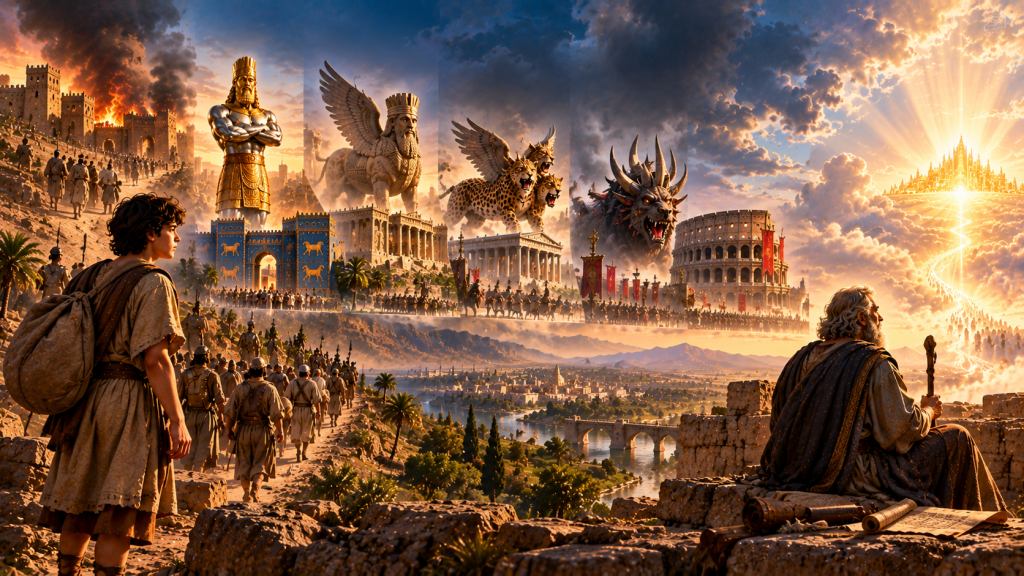
Commentary 4 - The narratives prepare the visions

The stories of Daniel and his companions make it possible to understand concretely what the prophecies will then announce on a larger scale.

The first chapters show men living under the domination of foreign powers.

Daniel and his companions must work, make decisions, serve sovereigns and sometimes refuse their orders when these conflict with their faithfulness to God.

The visions then broaden the perspective.

The narratives show how to live in the midst of kingdoms.

The visions show what these kingdoms will become.

The two parts of the book are therefore complementary.

Commentary 5 - Prophecies that become progressively more precise

The great visions of Daniel complement one another and deepen progressively.

Daniel 2 gives a first general view of the succession of kingdoms.

Daniel 7 takes up this succession in another form and adds, in particular, the judgment and the figure like a son of man.

Daniel 8 becomes more precise by directly identifying certain powers:

“The ram [...] are the kings of Media and Persia. The goat is the king of Javan” (Daniel 8.20-21).

Daniel 9 then focuses attention on the people of Daniel, Jerusalem and the seventy weeks.

Finally, Daniel 10 to 12 forms a great revelation that leads from the conflicts between the kingdoms to deliverance and resurrection.

The progression can therefore be summarized as follows:

general view → deepening → precision → fulfillment.

Commentary 6 - Daniel 10 to 12 forms a single great revelation

The last three chapters must not be studied as three totally independent prophecies.

Daniel 10 introduces the revelation.

Daniel 11 develops its historical and prophetic content.

Daniel 12 brings this revelation to its conclusion.

The progression becomes:

conflicts → distress → deliverance → resurrection.

The book then goes beyond the mere history of empires.

Daniel 12 announces:

"Many of those who sleep in the dust of the earth shall awake" (Daniel 12.2).

The final horizon is therefore not only the disappearance of one kingdom and its replacement by another.

It is that of the resurrection.

Commentary 7 - From exile to hope

The beginning and the end of Daniel allow us to measure the whole distance traveled.

Daniel 1 begins with a defeat.

Jerusalem is besieged and Daniel is taken to a foreign country.

According to the chronological hypothesis adopted in this study, Daniel would then be about fourteen years old. This age is not given by the Bible; it is an estimate used as a reference point.

Daniel will then spend a large part of his life in the midst of foreign powers.

But Daniel 1 contains a small but important indication:

“And Daniel continued until the first year of King Cyrus” (Daniel 1.21).

Daniel will therefore outlive the empire that had deported him.

Babylon will pass away.

Daniel remains.

At the end of the book, the perspective becomes even greater.

God says to Daniel:

“And you, go your way to the end; you will rest, and you will stand in your allotted place at the end of the days” (Daniel 12.13).

The young exile of Daniel 1 has become the aged prophet of Daniel 12.

His journey begins with the loss of his land and ends with the promise of an inheritance.

Commentary 8 - The great movement of the book

All the structures of Daniel ultimately lead toward one and the same progression.

The general movement of the book can be summarized simply:

Jerusalem is defeated.

↓

Daniel goes into exile.

↓

He remains faithful.

↓

The kingdoms succeed one another.

↓

The faithful are tested.

↓

The sovereigns are judged.

↓

The prophecies become more precise.

↓

Deliverance is announced.

↓

The dead awake.

Daniel therefore begins with exile and ends with resurrection.

This progression helps us understand why the book must not be reduced to prophetic calculations.

The prophecies are part of a much broader message concerning the sovereignty of God and hope.

Conclusion

The structure of the book of Daniel helps us understand its message better. The narratives, the visions, the languages and the correspondences between the chapters all contribute to one and the same progression: human kingdoms pass away, but God’s sovereignty remains.

Daniel begins in a situation that seems disastrous.

Jerusalem is defeated.

Daniel is exiled.

Babylon appears to triumph.

But from the very beginning, the text specifies:

“The Lord gave Jehoiakim into his hand” (Daniel 1.2).

This sentence gives a first key to reading.

Visible history does not tell the whole story.

Sovereigns do exercise real power, but they do not ultimately control history.

Nebuchadnezzar is humbled.

Belshazzar loses his kingdom.

Babylon disappears.

Other powers appear in their turn.

Daniel, for his part, passes through these upheavals while remaining faithful.

The visions then broaden this personal experience to the history of the kingdoms.

The book finally leads the gaze beyond the empires themselves, to deliverance and resurrection.

Its general movement can thus be summarized:

from exile to inheritance, from the domination of the empires to their disappearance, from trial to deliverance, and from death to resurrection.

Key points

  • Daniel does not always follow a strictly chronological order.
  • The book is written mainly in Hebrew and Aramaic.
  • Daniel 2 to 7 forms a particularly structured unit.
  • Daniel 2 answers Daniel 7, Daniel 3 answers Daniel 6 and Daniel 4 answers Daniel 5.
  • The narratives show how to remain faithful in the midst of the kingdoms.
  • The visions show the destiny of these kingdoms.
  • The prophecies gradually become more precise.
  • Daniel 10 to 12 constitutes one great continuous revelation.
  • The book begins with exile and leads all the way to resurrection.
  • Its central message remains: kingdoms pass away, but God’s sovereignty remains.

This presentation helps us understand the general architecture of the book. The academic version goes deeper into this structure, the chronology, the Hebrew-Aramaic bilingualism, the mirror organization of Daniel 2 to 7 and the relationships between the different visions.